
Issue #25
In the Grasp of The Rasp

Pitches and Catch(phrase)s
When I leave Kauai for the mainland I can’t wait to go shopping. Not necessarily to get something—I just enjoy the possibility of buying clothes that aren’t island-themed or exorbitantly priced. For that and other reasons pertaining to my habitual poor packing decisions when traveling, in late April I found myself in downtown Bethesda, Maryland, and there, stationed near a parking structure and across the street from Veronica Beard, Jenni Kayne and other expensive boutiques, sat a man in a wheelchair. His body was a sad assembly of losses—a forearm gone, maybe a foot and an eye. It was disturbing to look too closely, and I didn’t. Even so he was cheerful and energetic in the way he called out to passersby.
“On your way back!” he would shout, “on your WAAAAAY back!” I had to laugh. It’s what I say to panhandlers—I’ll catch you on the way back— and at that moment I realized lots of other people do too.
In another life, with better luck, the man in the wheelchair would be shopping on that street instead of begging—he was a born salesman. His pitch had some genius to it: you don’t have to give money to me now, but you will, later. “On your way back!” extends grace, assumes the best, gives people an out while planting a suggestion.
I crossed paths with him again on my way back to the parking garage, and he said to me again, with the same degree of positivity and confidence he had employed before, as if he had just thought of it for the first time, “On your WAAAAY back!”
I looked at him in mock-surprise. “You already said that to me,” I said, laughing, “and I gave you something.” We had a good laugh together (it was a moment funnier than it is in the recounting), fist-bumped, God-blessed each other and parted ways.
All month On your waaaaay back! has been running through my head—partly because it’s a light-hearted reminder of a heart-gladdening truth: there’s always a second chance to do the right thing we didn’t do the first time around. But there’s another reason and it took me some time to figure out—it put me in mind of a different catchphrase. “Step right up” is what I’ll say when I’m trying to get someone to take something they don’t want to take. It comes from an old Tom Waits song of the same name. The lyrics and delivery are just great. With a jazzy accompaniment of bass, piano and occasional saxophone, Waits takes on the voice of a carnival barker, a Ginsu-knife hawker, a preacherman double-talker:
You just step right up
Step right up
That's right it fillets
It chops, it dices, it slices
It never stops
Lasts a lifetime, it mows your lawn
And it mows your lawn
It picks up the kids from school
It gets rid of unwanted facial hair
It gets rid of embarrassing age spots
It delivers the pizza
And it lengthens
And it strengthens
And it finds that slipper that's be en-lodged under the
Chaise lounge for several weeks
If you’ve never heard the song or you haven’t listened to it lately, take a minute (5 ½ minutes, actually) and treat yourself. It’s funny and despite the absurd claims of the old-timey salesman, truthful. We may not ever buy a product that “gives you denture breath,” but we are ever susceptible to promises of youth, ease and novelty.
Marketing has gotten much more sophisticated and entertaining since the song was written in 1976—Yeah! for that, I suppose—but also—Boo!—more ubiquitous. Relentless. We are being sold something all the dang time. I’m so tired of it. My Instagram feed is mostly ads of one type or another. Fewer and fewer of the people I follow (mostly friends and family) post pictures, as if their “content” isn’t good enough to compete with what someone has been paid to produce. We have ceded ground to the carnival barkers. Step right up!, it’s always, Step right up!
(The solution, obviously, is to get off Instagram, my last remaining social media feed. But that’s a subject for another issue.)
I’m not saying anything new, I know. I’m just feeling frustrated with myself and sick of Instagram and its ferocious, all-day-all-night advertising. It’s as if we are all on a conveyor belt in a manufacturing plant we can’t escape, and as we roll along towards some imagined perfection, money-grubbing hands mold us, dress us, embellish, brand and package us, not so they can sell us, but so that we can sell ourselves. We are consumers so that we can become products.
Although he is still performing here and there, Tom Waits has not put out a new album since 2011. Maybe Waits’ typical surreal send-up of American culture has gotten to look too much like actual American culture. But we are in need of his side-eye, and I hope that he writes new songs soon. Tom Waits, hear my sales pitch: On your way back! On your waaaaaay back!
*
Two Days in a Waits World
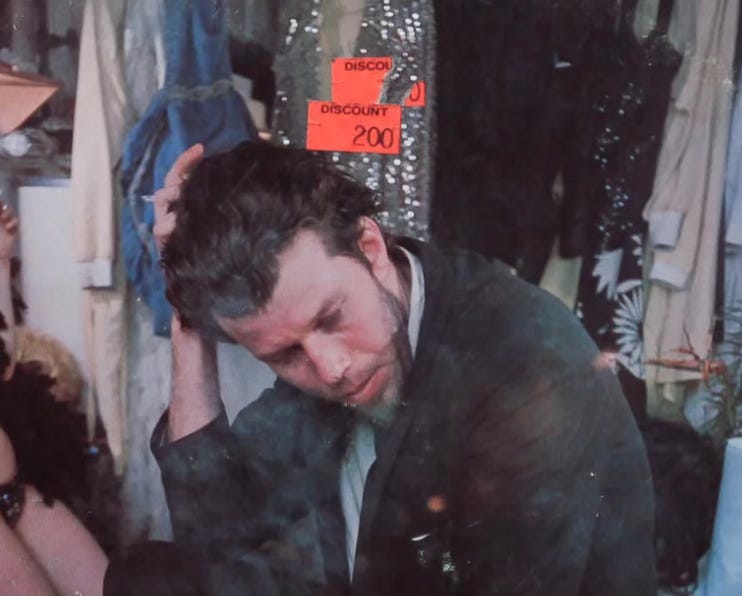
We had a Tom Waits album in our house growing up, courtesy of my brother John. The album was Small Change and the cover showed Tom Waits in full-louche mode, slumping in a strip-club dressing room, a woman in pasties behind him. How that album was allowed in our house—a house where the Jesus Christ Superstar record was banned from being played—is a mystery.
Over the last two days I’ve listened to Small Change and some of the hundreds of songs Waits has written, and I am star-struck at his continued relevance and the greatness of his output. I’ve read blogs about him, watched videos of interviews and performances, tried to track down the facts of his life—in short, I’m living in a Tom Waits world. His biography is fascinating (well, to a fan like me it is), and it’s been an entertaining couple of days (again, to me, not to my husband who has fled the scene to escape The Rasp. Speaking of The Rasp, Waits’ signature voice is an artistic choice, not merely a natural one, and early in his career his wife Kathleen Brennan encouraged him to make it even raspier. It’s brash and loud and has an over-the-top masculine quality that breaks your heart when it goes tender. There’s an interesting story how writer Kazou Ishiguro changed a key character’s development in Remains of the Day after listening to Waits’ raspy ballad, “Ruby’s Arms,” in which a tough-guy soldier breaks down in anguish and tenderness towards the lover he leaves behind.)
I’m not a music critic and I couldn’t begin to do Waits justice, so I’ll turn to the pros.
In a review of Swordishtrombones, considered his greatest album, Stephen Holden of the New York Times wrote this in 1985:
For the last 12 years, Tom Waits, the gravelly-voiced, 35-year-old singer-songwriter from Pomona, Calif., has played American pop's self-appointed spokesman for a segment of society that hardly knows he exists. The would-be poet laureate of urban lowlife, Mr. Waits has peopled his albums with desperate derelict characters who carry their lives in rickety suitcases, live in fleabag hotels or on the street, and dream in blurry Technicolor.
Singing in a slurred, alarmingly raspy drawl, Mr. Waits has enshrined this drifters' world in a post-Beat, pop-rock argot inspired by Jack Kerouac, Charles Bukowski and Bob Dylan, among others.
From Waits’ website, someone, and I am sorry that I am unable to track down who it is, wrote in a 2002 review of his album Alice—
Waits has built a career as varied as there are creative outlets—delving into cinema (both composing and acting), musical theater, opera, live performance, and literature—yet seamlessly interweaving a truly distinctive and fully-realized persona. The tools of his trade have included such things as the marimba, trombone, brake drum, metal aunglongs, banjo, bell plate, bullhorn, conga, accordion, optigon, mellotron, maracas, pump organ, basstarda, chamberlain, harmonium, viola, sticks, chairs, a musical saw, as well as the regular old guitar, bass, piano and drums and, of course, that trademark voice. . .
In a career that has spanned four decades, his music has taken adventurous turns, from confessional country-blues and jazz-flavored lounge, to primal rock and avant-garde musical theater. By turns tender and poignant, to strange and twisted, his songs tend to explore the dark, underbelly of society as he gives his uniquely human voice to adventurers both romantic and mercenary, drifters, con artists and those forgotten characters on the fringe and in the fray. Waits has expanded and drawn from a deep well of American song idioms: folk, blues, country, jazz ballads, polkas, waltzes, cabaret, swing, popular ballads, and a category that can only be described as Waitsian.
I’ll leave you to your own exploring on Spotify or YouTube, but I want to highlight three less-famous songs of his, all in the tender vein.
The first is a dark lullaby. Imagine singing this to a baby—
Sun is red, moon is cracked
Daddy's never coming back
Nothing's ever yours to keep
Close your eyes, go to sleep
—but listen to it and you’ll find the melody and singing so sweet that you may want to.
He wrote a much more traditional one called “Midnight Lullaby”:
Hush-a-bye, my baby, no need to be crying
You can burn the midnight oil with me as long as you will
Stare out at the moon upon the windowsill
And dream
The last song I’ll mention is the song I love the most. Waits has been married 45 years to Kathleen Brennan who not only helped him get sober but has been his lifelong collaborator and co-writer of many if not most of his songs. He wrote “Johnsburg, Illinois” for her. His gruffness is the perfect foil to the delicacy of his love:
She's my only true love
She's all that I think of
Look here: in my wallet that's her

She grew up on a farm there
There's a place on my arm
where I've written her name next to mine

You see: I just can't live without her
and I'm her only boy
And she grew up outside McHenry
in Johnsburg, Illinois
Oh me oh my, that’s romance, folks! Only in the hands of a master like Tom Waits could the words “Johnsburg, Illinois” make your heart melt. Every lover should hold such reverence for the town their beloved grew up in.
*
Rasp-Free Covers
Artists of every stripe have covered Waits’ songs. Here are a few of my favorites (the links are all for Spotify):
I Don’t Want to Grow Up by The Ramones
The Piano Has been Drinking by Dan Hicks & His Hot Licks (hate to say it, but I like his version better than Waits’)
Down There by the Train by Johnny Cash
Jersey Girl by Bruce Springsteen
Long Way Home by Norah Jones (not sure which one I like better, his or hers— they’re so different)
San Diego Serenade by Nanci Griffin (Her voice! Wow)
Ol’55 by the Eagles
Tango Till They’re Sore by Madeline Peyroux
Picture in a Frame by Willie Nelson
Midnight Lullaby by Mae Robertson
Tom Traubert’s Blues (Waltzing Mathilda) by Rod Stewart. (Never thought I could like a Rod Stewart song so much)
Temptation by Diana Krall
Finally, Waits’ own cover: his version of Sondheim’s “Somewhere” from West Side Story. I’ve loved this song ever since the first time I heard it as a teenager. Waits’ singing is transcendent, even when or especially when his voice gets thin.
*
Let me know if you listened to any of these and what you think . . . or tell me what your favorite Tom Waits song is!
*
If you enjoyed this issue of Restless Egg, share it with someone else who might enjoy it too! I love to get new subscribers!
Enjoyed as usual 🙂
“We are consumers so that we can become products.” That’s the keenest of the many keen observations I have relished from you. I greatly enjoy all your insightful turns of phrase and this one knocked me out. Don’t stop sharing the world according to you.