
Issue #9

All we are saaay-ing is give books a chance!
I used to read the Sunday book review section cover to cover. That habit ended because I stopped buying hard copies of newspapers but also because reading reviews was a depressing reminder of how little time I spent with books relative to time with screens. Reading about new books was like having my dental hygienist chase me around the house waving a string of floss every time I ate.
These days I skim the book section listings and only read a review if the headline catches my eye. Such was the case with a New York Times review of Shark Heart: a Love Story by Emily Habeck. The headline was “To Have and to Hold Even if You Turn Into a Literal Shark.” You can bet your sweet clickbait I read that.
The reviewer, Edan Lepucki, outlined the plot, which was what I was interested in (yes, a man really does turn into a shark, slowly and by degrees), but she did something else that stuck with me. In fact she made such an impression that I saved parts of her review in my notes.
After four paragraphs of what seems a positive review (“beguiling first novel,” “chimerical,” “vivid and painful”) Lepucki highlights the book’s strong point:
The novel is most striking when Lewis knifes through the ocean as a shark . . . In a world where human behavior is responsible for the extinctions of so many other species, the idea of an animal perspective blotting out human consciousness is at once absurd and deeply startling.
Then she flips and discusses what doesn’t work:
The weakest aspects of “Shark Heart” are Wren and Lewis themselves. For much of the book, they feel as flat as rom-com log lines: Lewis cast as the romantic, a manic pixie dream boy, with Wren as the strait-laced realist, guarding her heart. We’re told that they’re meant to be together, but Habeck doesn’t show their connection — which makes it more difficult to believe the book’s otherworldly premise . . . And some of the language strains. Wren at 18 “smelled like the wind,” for instance. (What does wind smell like?) I also struggled with this phrase: “Lewis tattooed her with beautiful poetry in a place she would never see but somehow read every second.”
Undeveloped characters? Lazy writing? No thanks. If I were the reviewer, I’d trash the book on that alone and discourage anyone from reading it. But Lepucki goes further:
In the end, I forgive this debut its flaws because it’s surprising and pleasurably uncategorizable. “Shark Heart” is wild, in every sense of the word.
She could be deploying the much-vaunted “feedback sandwich” (a criticism nestled between two compliments), but I think it’s more than that. Lepucki’s approach to the book reveals a whole way of interacting with the world. A generosity of spirit I so often lack. Lepucki seems to have dove into Shark Heart looking for the good and she found it. I’m guessing here, but Lepucki, as a novelist herself, may have considered how much work Habeck put into writing her first book, how much her dreams and self-worth are tied to its success, and decided to afford Shark Heart a large measure of grace and latitude.
When I begin a book, I’m yep/no a few pages in. And then I look for what will reinforce my like or dislike, thereby missing a lot along the way. Forming judgments too quickly and too firmly is not a new problem or particular to me, but it sure is exacerbated in a consumer culture that inundates us with so much stuff—clothes, foods, books, songs, podcasts—that making choices is a constant of daily life; and further accelerated by social media (this applies even if you indulge rarely if at all, the old “trickle-down” theory at play here) that encourages us to brand ourselves by our selections—I’m the kind of person who . . . I hate . . . I love . . . —as if we are defined by micro-discriminations between this and that and the other.
Obviously I’m not just talking about giving books a chance. Too-hasty judgment of people is a long-time fault of mine (I blame my enneagram type, which is type one, IYKYK) but I’ve been making progress. One of my greatest delights is being wrong about someone and one of my biggest goals is to hold two things in mind at once—yes, I don’t like this one thing but look at all these other good things.
This goal requires being less reactive. To slow before responding. To take a beat. A breath. To unclench. Lepucki, in the penultimate sentence of her review, provides a hack for achieving the gentle, see-the good-with-the-bad open-mindedness I seek:
In the end, I forgive this debut its flaws because it’s surprising and pleasurably uncategorizable.
Which I amend to this:
In the end, I forgive this [person/place/thing/situation] its flaws because it’s ________ and pleasurably __________.
*
Comrades in arms
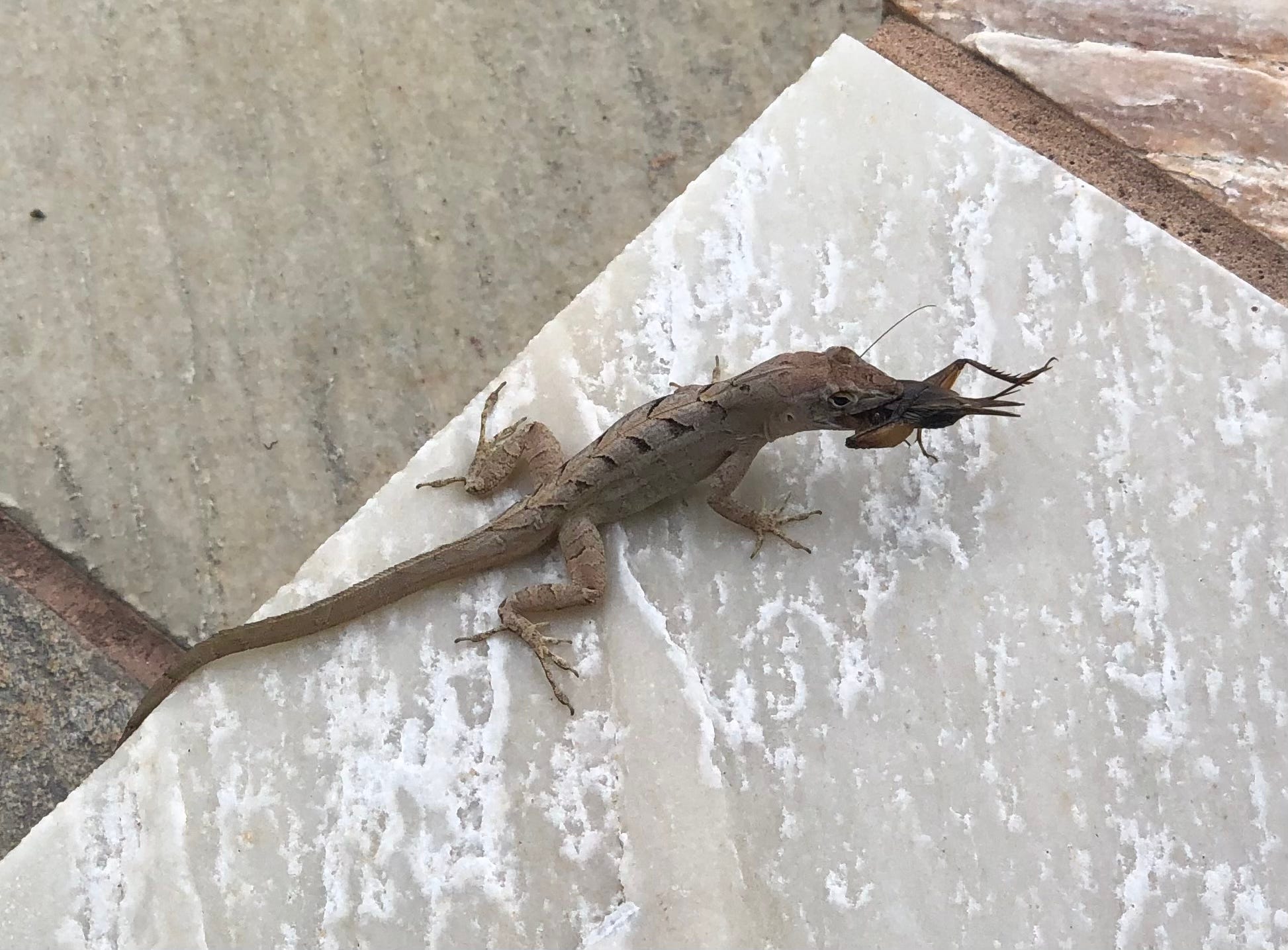
If you have on occasion stepped into a garden boot to find a toad already inside, or if you find yourself startled and maybe even shrieking at the sudden appearance of a gecko darting across the top of a bedroom mirror, I have some comforting information for you: toads and geckos eat cockroaches.
Put another way—
In the end, I forgive this toad its flaws because it’s hungry and pleasurably fond of the world’s most hated insect.
*
Food for thought or thoughts for food
My son told me that my constant worrying about him and his sisters is like a sweet tooth.
Cue the sharp slap of self-awareness.
To wit: worrying about my kids is an addiction, it’s bad for me, and (shudder) somehow I enjoy it.
*
Lit by Brit lit
To book lovers or erstwhile book lovers: Backlisted is the podcast for you. Hosted by two charming and book-obsessed Brits, John Mitchinson and Andy Miller, the show features insightful discussions of old books selected by their listeners. (Note: each discussion is prefaced by a none-too-brief brief on what each host is reading. You may want to skip over this part.)
Search their show list, 233 and counting, and you’ll surely find at least one book you loved. Listening to them praise and analyze a favorite is a delight. For whatever reason, call it my raging Anglophilia, I’m even more delighted when the hosts say to each other, “Oh, that’s very good, isn’t it?”
I just listened to a recent episode on Melville’s Moby Dick, and it made me want to re-read that great tome. But my favorite show covers a favorite book, J. L Carr’s A Month in the Country. (It was made into a movie in 1987 with Kenneth Branagh, Colin Firth and Natasha Richardson.) The book takes place one glorious summer after WWI in the English countryside. The plot concerns the restoration of a medieval mural in an old church, but on a deeper level, the restoration to life of traumatized war veterans. It’s very short with wonderful writing, wonderful characters, and as pointed out on Backlisted, “It's also got something which isn't written about very often. It's the work of experts. It's a craftsman doing something quite brilliantly and enjoying what he's doing.”
Here’s my own pull-quote from the book. I store this beautiful passage in the back of my mind for when nostalgia or sorrow hit hard—
We can ask and ask but we can't have again what once seemed ours for ever - the way things looked, that church alone in the fields, a bed on a belfry floor, a remembered voice, the touch of a hand, a loved face. They've gone and you can only wait for the pain to pass.
It’s brutal but oddly comforting.
*
One for the road
I’ll leave you with one more quote for the week. I heard it on the radio and it made me think of my sister Josie, how she lived her life and what is required of all of us who survive her.
The words were written by theologian and civil rights leader Howard Thurman. He sent his book Deep River and the Negro Spiritual to Martin Luther and Coretta Scott King and inscribed it thusly:
The test of life is often found in the amount of pain we can absorb without spoiling our joy.
Oh Maggie..such a great one and such a touching end. Thank you!❤️
another restless egg...sunny side up! found one new word (chimerical) and one "old" one (penultimate) that i vaguely remembered hearing for the first time, years ago, in what i believe was a eulogy you shared after your father's passing. either way, thinking of josie and your dad and you right now and thurman's quote...of this i'm sure, you're joy is unspoiled.