
Issue #59
Dead Horse, Revived and Beaten Again
I’m old enough to remember how sci-fi fans used to count the days for the next Star Wars release and the frenzy tweenagers went into over a new Harry Potter book. I’m also old enough to rarely feel frenzied about much of anything (the benefit and downside of age-related perspective), but my wait for the Britbox original series The Other Bennet Sister came close. “CAN. NOT. WAIT.,” I texted my brother. The first three episodes of the ten-episode series finally dropped in the U.S., and I can report that it’s met my hopes in many ways and only fell short in a few.
The show focuses on overlooked Mary Bennet of Pride and Prejudice’s Bennet family. In the original source, Jane Austen portrays Mary as plain, serious, priggish, sermonizing, and unpleasant. She’s the buzz-kill and butt of jokes in every scene she’s in. The new series re-imagines her as a lovable misfit. She still has her signature lack of social skills—somehow she thinks it’s a good idea to sing the dolorous “Begone, Dull Care” at the Netherfield Ball—but in the re-boot she is also keenly aware of her shortcomings and lack of prospects. After her father asks her to end her awful performance, her public humiliation is heartbreaking. I cried over it, and anyone who’s suffered similar youthful agonies may well do the same.
The show isn’t perfect. The soundtrack is intrusive and too Hallmark-y. Mrs. Bennet (the wonderful Ruth Jones who was unforgettable as Nessa in Gavin and Stacey) has become a heavy-handed villain rather than the hypochondriacal, silly woman Austen wrote her to be.
But the lead actress, Mary Ella Bruccoleri! I adore her. I adore her square face. I love her round, wide-set eyes, her little spectacles, her short bangs, her very ordinary nose that she squinches when she’s confused. Unlike other Austen or period-piece heroines, her face and neck are not Modigliani-esque. No chiseled features here unless she was sculpted on Easter Island.
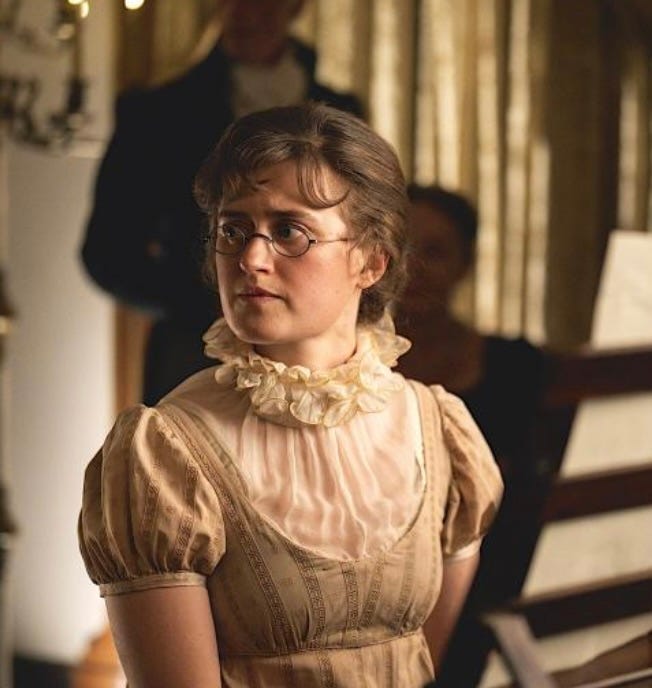
She doesn’t flirt—she wouldn’t know how—but as she begins to take up more space in the world, her own idiosyncratic charm becomes irresistible to viewers and to the show’s male characters alike. The way the color spreads through her cheeks while she observes a man roll up his sleeve on his muscular forearm is the sexiest scene I’ve watched in ages.
Per an interview in the New York Times, Bruccoleri’s been surprised at how popular her character has become in Britain where the show is a huge hit:
It shouldn’t be rare to see “a normal-looking person” onscreen, she said, but “a lot of people, I think, feel very validated by seeing someone that isn’t a supermodel” leading a TV show.
Later in the interview she says this:
“I learned a lesson through playing Mary,” Bruccoleri said, which echoes what her character discovers: “The more I can embrace my authenticity, rather than trying to fit myself into a box that other female actors inhabit,” then “the better off I will be.”
I hate to beat a dead horse (Husband would contend I actually love to beat a dead horse), but as I wrote in Issue # 57, we are in dire need of more interesting and more un-enhanced faces on screen.
Cheers to you, Mary Bennet!
*
One More Paradiddle on My Dead Horse
Let’s turn to another oddball who also embraced her authenticity, much to the literary world’s benefit. Emily Bronte, singular, misanthropic, and unconcerned with how other people perceived her, very briefly taught at a girls’ school in Brussels. Her pupils did not like her. (In fairness, she scheduled lessons at her own convenience which was unfortunately during their limited free time.)
Here’s how her pupil Laetitia Wheelwright described her:
“I simply disliked her from the first; her tallish, ungainly, ill-dressed figure. . . always answering our jokes with ‘I wish to be as God made me’.”
Oh my goodness. Even as a woman who religiously colors her hair and slaps on neck-tightening cream whenever she looks in the mirror, I have mad respect for a woman who can say such a thing. The power of it!
Someday I’ll say it too. I wish to be as God made me!
*
Decadence, Thy Name Is Elf Ears
Look, I am a big fan of elves. I love their mischievousness, their trickery, their hiddenness. I love Dobby, I love Hermey, I love Moql from The Moorchild, I love the elves of Middle Earth, I love the elves who made boots for the shoemaker, I love Buddy the Elf, I love the Icelandic culture of elves, I love the tchotchke elves I own. I even called myself “Poem Elf” for many years when I wrote a blog of the same name. The only elf I don’t like is the one on the shelf.
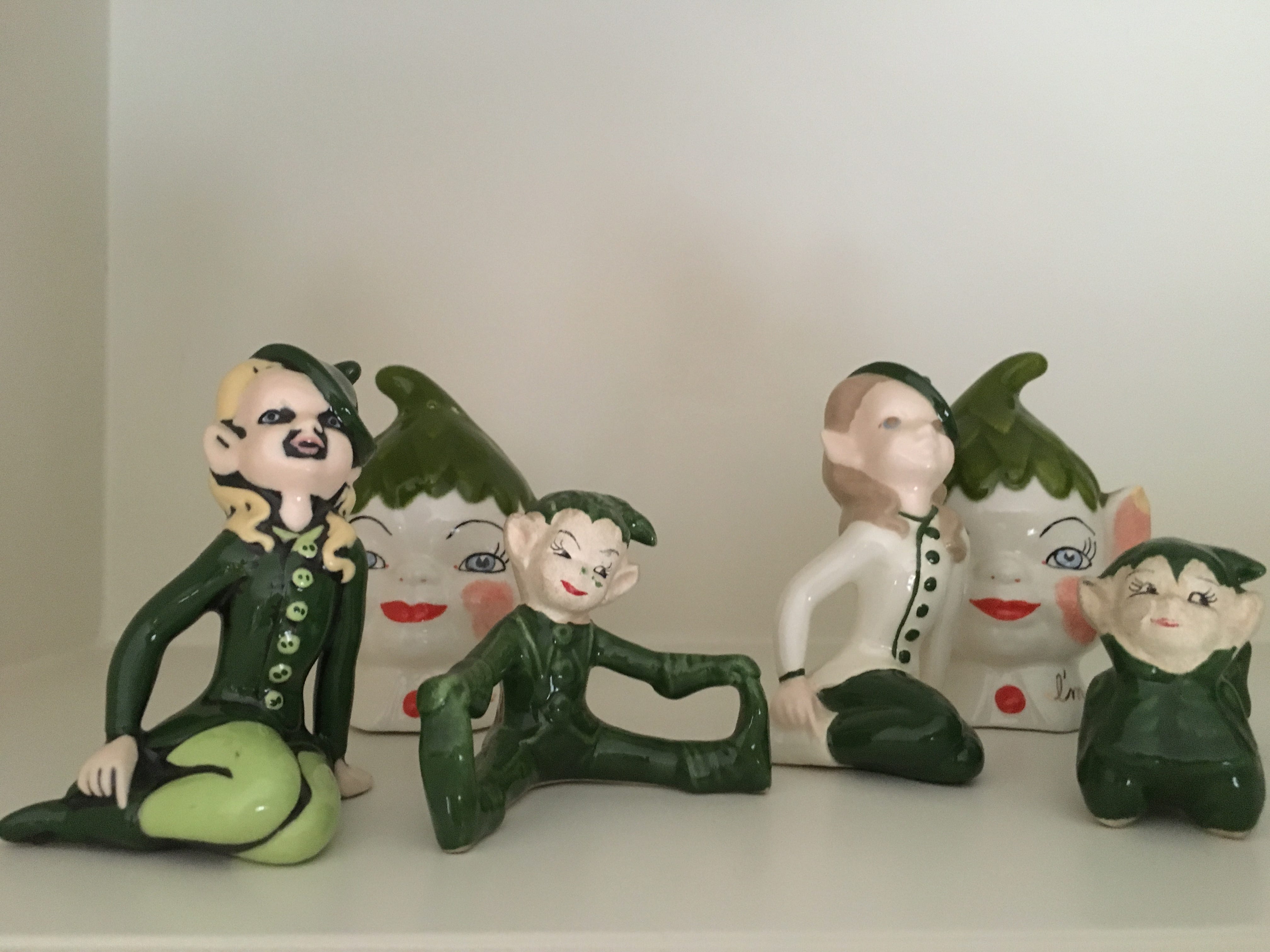
But the latest elf trend in South Korea—and please God, let it spread no further—is too much for me.
To wit: People are spending $70 to inject their ears with filler to make them stick out like elf ears. Supposedly this makes your face look smaller. Previously the look was attained by using painful tape.
The insanity of this trend speaks for itself. No further comment is necessary.
*
Burnout, Thy Name Is —
I just learned a new phrase for burnout. I was listening to an interview with Anglican priest Tish Harrison Warren called “Your Burnout May Be an Invitation.” In an offhand fashion and without trying to make a huge point about it, she gave burnout a new name: “a season of weariness.” It really struck me. A season of weariness implies that the condition is temporary and can be weathered through.
That’s just one small insight from a really insightful No Small Endeavor podcast episode—listening to it on a walk I couldn’t take notes fast enough—until I realized the notes have already been taken in the podcast transcript. I’ll share a few excerpts with you and encourage you to listen to the episode in its entirety.
Warren’s message is encouraging but counter cultural. Our culture, she says, is “addicted to ease but really, really lacking in meaning.” Doing the hard work instead of falling back into what’s convenient allows us to find deep roots and of course, meaning:
Patience, perseverance, resilience. As a culture, these are not virtues we talk about a lot. They’re not very sexy. . . They’re not as cool as other virtues like courage or justice. And I just wanted to make space for the need for these in our culture and what it would look like to cultivate them.
Warren and host Lee C. Camp discuss the Benedict-ian idea that, “if a trial comes upon you in the place where you live, do not leave that place. Wherever you go, you find that what you were running from is ahead of you.” Warren illustrates the point with a story about one the ancient Desert Fathers and Mothers.
And so there’s this great story that actually didn’t make the book of a monk that was living in community and struggled so much with anger.
And so everyone around him was just irritating him. And so he decided to be a hermit. So he left his community so that he would be free of anger.
And he was by himself in a cave, and he went to get water, had to walk a long way to get water, came back. And when he did, he stumbled, and the water basin tipped over and the water poured out. And he got so angry, he kicked it and broke it.
And he said, at that moment, he realized, because he was all alone, he realized the anger was not because of other people, but the anger was inside himself. So he picked up and went back and lived with the community that he had loved.
Later she talks about the under-valued value of patience:
The word for patience in Arabic comes from the same root as the word to be confined. And there’s something about these sorts of confinements of our life, which is where patience begins to grow.
And I think with patience comes love. I mean, because ultimately, I think love is patience.
*
If you’ve enjoyed this issue of Restless Egg, please share it with someone else who might enjoy it too! And if you haven’t yet subscribed, go ahead and make my day.
must get Britbox! must look at my own water bucket too ;)
Love this Maggie, lots of great nuggets!