
Issue #56

Confessions of a Reformed Vandal
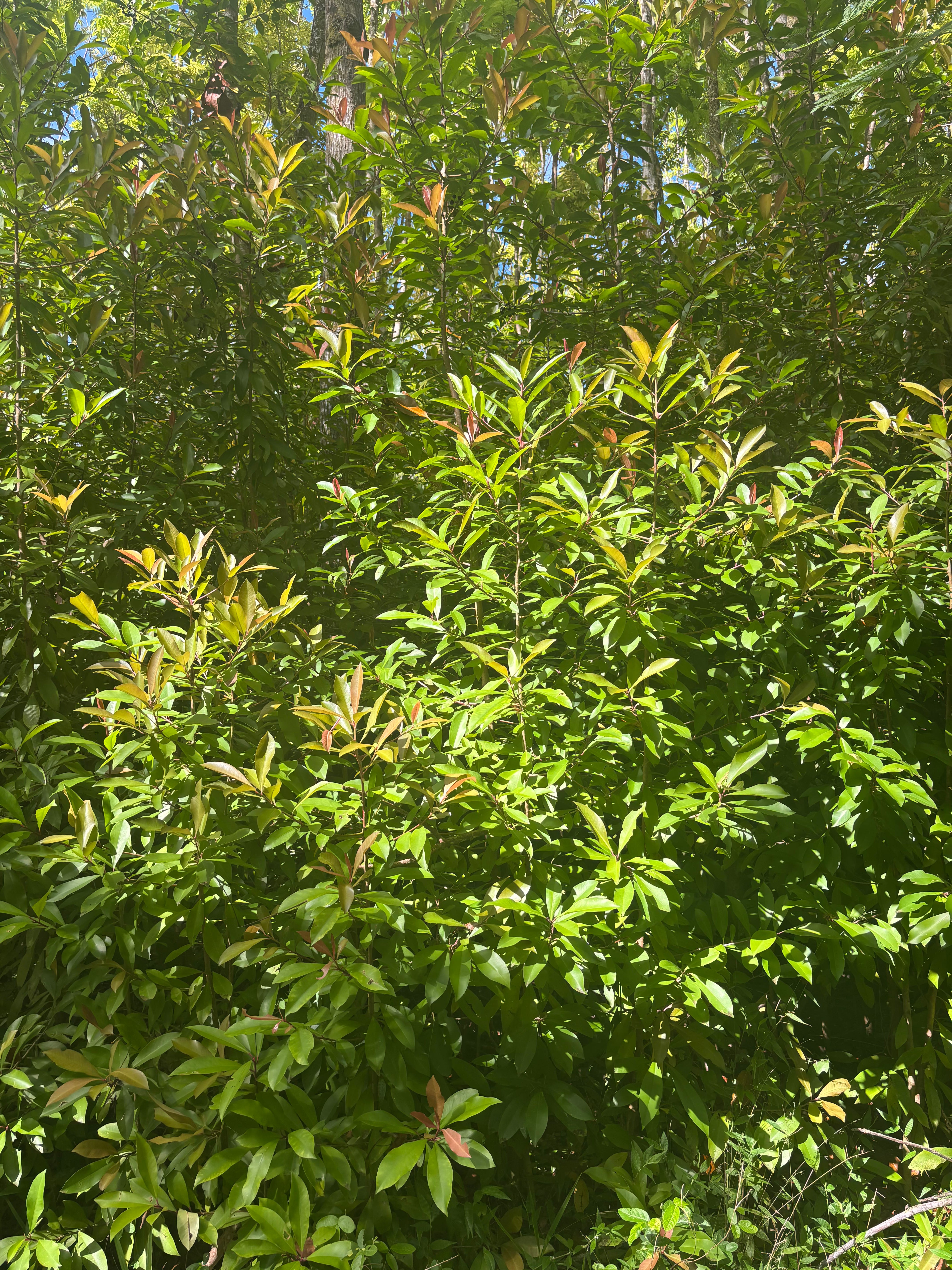
It started with the appearance and sudden proliferation of an innocent-looking tree in my yard. Someone told me it was called a chokeberry—apt because it has berries and strangles all the plants around it—but not accurate, because a chokeberry is not a tree but a bush and grows in the eastern United States and not in Hawaii.
This tree, whatever it’s called, is spread by birds crapping out its berries. Its leaves are waxy and attractive enough that you might think it’s worth keeping. Let it grow at your peril. Ignore a twig one season and the next it’s a full-fledged tree with a dozen babies hiding themselves in other garden plants. I find offshoots everywhere, in the byzantine roots of a bamboo clump, in the crook of a Song of India trunk, in between the branches of a gardenia bush, and worst, in a patch of razor-edged bromeliads where it darn well knows I can’t reach it.
Last year, in a frenzy of hatred, I was pruning a bendy branch of this tree about two inches in girth, and it snapped back and hit me with such force that I fell to my knees. I thought I was going to throw up from the pain. Not coincidentally, I developed a pinched nerve between my shoulder blades that took a year to resolve and cemented the weed tree’s status as my most despised enemy.
Meanwhile the tree also invaded a nearby mahogany forest that was part of my daily walk. Before the weed tree took root there, the forest was a wonder of symmetry, with thousands of trees planted in rows as even as a military band. But after?—pshhht!—you could only see the original grid if you looked up to the tops of the mahoganies.

So I began to vandalize. Every day on my walk I’d snap new growth of the weed tree in half, ten or more at least. It was a Sisyphean task—I’d never beat it back—but my hatred of the symmetry-destroying tree compelled me to break the branches with my bare hands like a cartoon giant on a rampage. In a parting gesture on my last day on island I broke at least thirty. [If you are a fan of Enneagram, at this point you will have correctly guessed my number.]
Earlier this year, back again on my forest walk, I saw that the weed trees had grown fatter and taller and fuller and denser. My daily vandalism had come to nothing. But it wasn’t until my second walk that I realized I could pass by the trees and not feel anything. My compulsion to break them was gone. My resentment of the forest transformation had disappeared. My rage, evaporated.
Where did it go? Over the months I was off island, I had done no work to eradicate my hatred. I didn’t meditate on it, I hadn’t prayed over it, I hadn’t experienced any breakthrough insights. I did nothing except not feed or nuture it, and it just. . . went away.
If I had lost a toenail, a tooth, or clump of hair, I’d know how it I lost it. But losing an emotion? A much more complicated and possibly impossible case to unravel. If there’s an inverse to an unsolved murder—an untraceable gift, let’s say—that’s what happened to me.
This is not a screed against strong feelings. Strong emotions are how art and social movements begin, how our species recreates, how people find the courage to make sacrifices for other people. And this is not to say I’ve gotten over my dislike of the weed tree. I still fight it tooth and nail in my own yard. But the weed trees on the forest walk do not belong to me, and my antipathy to them has turned to apathy.
To be released from hatred of a tree is but a little thing, I admit, no great triumph of the human spirit. Plain old silly when you think about other emotions people experience, like grief. But still. I claim that invisible mending of my nervous system as a beautiful and comforting mystery. Could it be we just aren’t meant to hold onto hateful emotions? Could it be our temperaments inch back towards equilibrium, unbidden by us?
The disappearance of my tree rage reminds me of a poem-prayer I’ve loved for a long time. It was written by Jesuit priest and paleontologist Pierre Teilhard de Chardin. Chardin studied evolution and developed a theory called the Omega Point, which posits that all things are moving towards a single point of unification. I’m not going to attempt to explain or discuss it in this space, except to say that his theory relies upon, as does evolution itself, slow, unseen work happening outside of our consciousness.
(You don’t have to believe in his theory or believe in anything spiritual to find his poem consoling. “Time” works as a substitute for “God” in this poem, as does “the universe” or even “something not ourselves.”)
Above all, trust in the slow work of God.
We are quite naturally impatient in everything to reach the end without delay.
We should like to skip the intermediate stages.
We are impatient of being on the way to something unknown, something new.

And yet it is the law of all progress
that it is made by passing through some stages of instability—
and that it may take a very long time.

And so I think it is with you;
your ideas mature gradually—let them grow,
let them shape themselves, without undue haste.
Don’t try to force them on,
as though you could be today what time
(that is to say, grace and circumstances acting on your own good will)
will make of you tomorrow.

Only God could say what this new spirit
gradually forming within you will be.
Give Our Lord the benefit of believing
that his hand is leading you,
and accept the anxiety of feeling yourself
in suspense and incomplete.
*
I Swear I’m Over It But Still. . .
Does anyone know the name of this tree?
*
Proud Auntie News
My nephews’ band Hathway just dropped a new single: “How Did It Happen To You.” I’ve got it on repeat. Give it a listen! You can also follow them on Instagram.
*
More Music For Ya
Last fall in Sicily, my husband and I noticed that in every place we stayed, the host played beautiful music in the morning which set a relaxing tone for the day. Why don’t we do that? we wondered. Such a simple thing to do. So I’ve made a morning playlist of my own. Every time I remember to play it, my morning takes a gentle turn. (Unfortunately, Husband has begun to find my chill irritating and heads to another room when it’s on.)
The playlist isn’t finished yet, but I thought I’d share it now. “Morning Chillax” is on Spotify, but I’ll list the songs for you to find on other platforms if needed.
“October” by Okonski
“Selenge by Celine Dessberg
“Grammofon” (Belarusian Radio and Television Orchestra, Vasiliy Leonov)
The Magie Flute, “Papagena” (Mozart) Wilfried Gahmilich, Anna Gonda, etc
“Bradenburg Concerto No. 4 in G” (Bach) English Chamber Orchestra
“Ylang Ylang” by FKJ
“Chintamani” by Celine Dessberg
“Luther (String Orchestra)” Steve Hackman adaptation of Kendrick Lamar song
“va sans crainte” by Celine Dessberg
“Love Is Here to Stay” by Oscar Peterson
“Seagull Dance” by very noise person, J. Kobee and Somebuddy
“Liloa’s Mele” by Sonny Chillingworth
“Ku’u Kika Kahiko” by Ozzie Kotani
“Carolan’s Concerto” by the Chieftains
“El Sueno” by LA LOM
“Dove” by Bill Laurance
*
If you enjoyed this issue of Restless Egg, share it with someone else who might enjoy it too! And if you haven’t yet subscribed, go ahead and make my day.
My "weed tree" is garlic mustard. One is suppose to dispose of them in a secure garbage bag and put in the trash. I did that the first year, but now they're put out in the sun for roots to dry out and.....whatever. A wet spring is a rewarding "pulling them up time. " Loved reading this issue! Insights and humor - yea!
Can’t wait to listen to your playlist!