
Issue #52

Notes From the Sickbed
This post is going to be rambling, so lace up your walking shoes and follow along—we’re going for a stroll.
Hours after the biggest winds from the Kona Low subsided (which knocked over a truck-sized clump of bamboo in our yard) I woke at dawn with stomach cramps the likes of which I haven’t felt since childbirth. Husband found me curled up on the cold bathroom tile in a state of—I would say dishabille, but that sounds alluring, and the sweaty gorgon he saw laid out before him decidedly was not.
No one likes being sick with the D (as my sister would say), or worse, the V (I came to the brink but was mercifully pulled back), but being a little sick, as I was after the waves had passed and I felt merely weak and tired, can be quite pleasant as long as there is someone to drape a blanket over you and ask if you need more water or a piece of dry toast.
I felt all the better when I realized I didn’t have the flu at all and I would not be experiencing any more D or possible V, or passing the D and possible V on to the person who was bringing me water and dry toast. What I had was food poisoning from an old bottle of kombucha. This is what you call karma. I hoard kombucha in the fridge, up to fourteen bottles at a time, because I hate not having a steady supply, and my preferred brands can be tricky to find on island. Judging by the faded and unreadable expiration date, the offending bottle may have been around for months, continuously pushed to the back of the fridge to make room for more bottles.
My pleasure in being a little sick goes back to childhood, when fevers and stomach flus augured a visit from Dr. Roundbelly. Dr. Roundbelly, who looked like my dad but was much jollier, arrived with a small gift—a coloring book, new crayons, paper dolls, and when we were older, magazines. Such gifts and attention were the best medicine, especially in a family of 11 children, where gifts and attention can be scarce commodities. And so to this day I have no shame in being fussed over while I recover, as long as the fussing is modest, short-lived, and takes place in private.
I’ve been sick for longer periods than hours or days, and with an illness that carried no guarantee of recovery. I’d never say I enjoyed that time, but the respite from daily duties and the suspension of ordinary life had its charms—not to be explicated or explored here in this space, on this stroll. Let’s move on.
Younger, before facing serious illness myself or that of anyone close to me, I loved a good sickbed-to-deathbed scene in a novel. How many times and with what delight I cried over Helen Burns’ death in Jane Eyre and Beth March’s in Little Women! But such fictional scenes no longer carry the comfort of catharsis. Losing people you love to illness or seeing up close the suffering illness brings will ruin that for you.
Nowadays the only illnesses I care to read about are of the Jane Austen variety, in which recovery is a given (for the reader, anyway) and illness is a prelude to romance. In Austen’s world, the ill person may suddenly realize who her truest love actually is (Marianne in Sense and Sensibility) or the caregiver will win the admiration of her future spouse because of her competent and tender sickbed ministrations (Lizzie caring for Jane in Pride and Prejudice, Fanny caring for her ne’er-do-well cousin Tom in Mansfield Park, and Anne’s level-head dealing with the injured Louisa Musgrove in Persuasion).
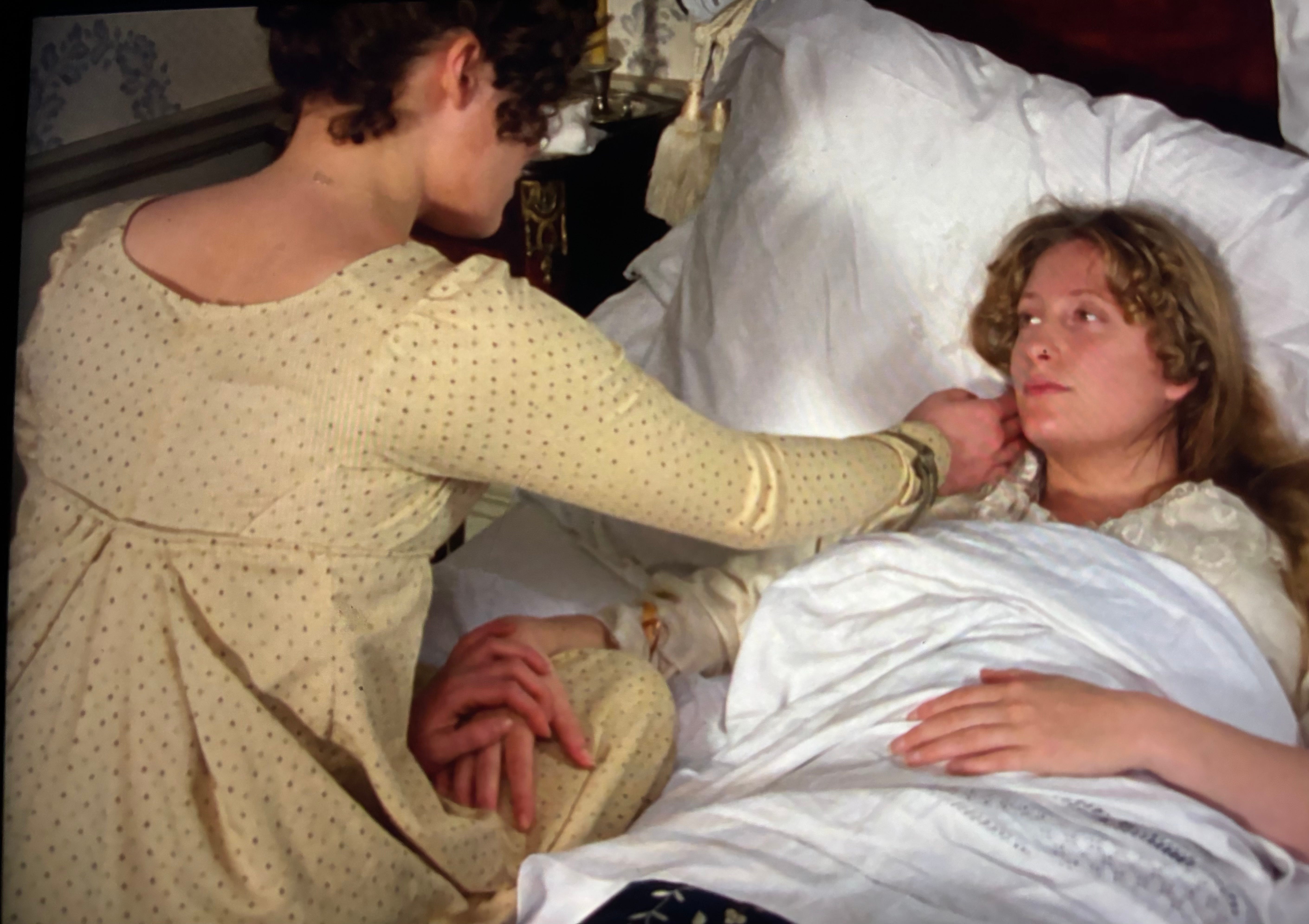
Besides Austen’s romantic sickbed scenes, there are two other illness narratives I take pleasure in, the first for its implications and the second for its humor.
When I saw it at the movie theater nine years ago, I can’t say I delighted in Phantom Thread, but it’s stayed with me all these years and I think about it more often than I’d ever expected to. The pace is slow and ponderous—your nervous system will be lulled into a near comatose state—at least until the V begins. Ralph Fiennes plays a domineering, hyper-controlling couturier in 1950’s London who is [SPOILER] brought to near death by poisoned mushrooms. His wife and muse serves him the mushrooms on purpose. It’s her way of bringing him back to her when she feels him slipping away emotionally and of renewing his creativity when she sees him drifting artistically. At the end of the movie, when he realizes what’s been happening, he willingly subjects himself to her treatment.
What is a phantom thread but an unseen binder of souls, a connecting force that begins in vulnerability and humility, which happen to be two side effects of illness? Artistry has its own phantom thread, a spirit of continuously renewed creativity pulled along by gratitude—one of the many possible byproducts of recovery. In the unavoidable cycle of illness and recovery, connection and creativity are a choice. Bitterness is the other choice, and it is not a good one.
Betty MacDonald’s The Plague and I is pure comedy with some quiet moments of poignancy. The book is a hilarious account of MacDonald’s nine-month stay in a tuberculosis sanatorium in the late 1930’s. At the time she was hospitalized, MacDonald was the mother of two young children, near broke, and so full of life and jokes that it seems impossible she could lie still for all that time. (MacDonald would go on to write the famous Mrs. Piggle-Wiggle children’s books, and humorous books for adults, including The Egg and I and, my favorite, Anybody Can Do Anything.)
These days tuberculosis is treated with antibiotics, but during MacDonald’s sanatorium stay, complete rest and isolation were the prescribed treatment. Here are the rules of Pinewood, as dispensed by a nurse she calls “Granite Eyes” during MacDonald’s first weekly bath:
“Patients must not read. Patients must not write. Patients must not talk. Patients must not laugh. Patients must not sing. Patients must lie still. Patients must not reach. Patients must relax. Patients must . . .” I was ready for the bath so I interrupted to ask if I might put a little cold water into the steaming tub or if there was a rule that patients must be boiled.
It’s hard to imagine anyone enduring such an empty day for months on end (years for most of the patients) all the while being harassed to keep a positive attitude so they can be cured. Which MacDonald manages to do. (Caveat: I am not someone who believes a positive attitude is a key factor in getting well. Plenty of doomsayers, complainers and whiners recover just fine while too many cheerful, hopeful folks are taken early.)
While I was looking into pre-antibiotic tuberculosis treatment, I came across a diary written by another young mother facing the disease. The diary was written in 1944 by a 32-year-old British woman who was placed in a sanatorium and separated from her husband Bill and 15-month old baby. She’s not a humorous writer by any means, but she captures the spirit of the times and of Betty MacDonald in a way I find touching. She wrote a list of TB survival guidelines (which I’ve edited and shortened). They’re good for whatever ails you or even if nothing ails you at all:
Never give way to self pity. List the disadvantages and then, having conquered them, forget them—
Always appear cheerful. Partly for self-discipline and partly because people will soon get sick of me if I don’t
Interest myself as much as possible in outside things—both world-wide, through the newspapers, books and also personal (our friends’ affairs, troubles and joys, and those of anyone else I hear of). In other words, cultivate an extrospective and not an introspective outlook
Try and improve my mind by reading and thinking, and use this period as one of rest, refreshment and study, in preparation for trying to make some constructive contribution to the good of the world
Do not talk about myself and my illness
Do not organize other people (very easy habit to fall into when you are lying in bed doing nothing, and most irritating for people who are up and busy and think ‘yes, it’s all very well for her...’)
‘Blessed is he that expecteth nothing’, i.e. don’t expect Bill and other people to be always coming to see me; cultivate the habit of being pleased when they come and not aggrieved when they don’t, so that it never becomes a duty to them.
*
Unsolicited Advice for Parents:
Re: Dr. Roundbelly. I highly recommend the creation of alter egos for the entertainment of children. Dr. Roundbelly brought so much delight to our lives and is one of our best memories of our dad. My mother also had an alter ego, an identical twin sister who lived in Denver. For the amusement of the older six kids, my mother would step into a closet and say, “When the door is opened, it will be my identical twin sister who comes out.” And they believed her. For the younger five of us, the never-seen identical twin’s absence was explained by a disease called pea-itis. My mother’s imaginary twin never ate her peas, so she blew up into a giant green ball, rolled down the street, and was never heard from again. We loved this story and begged her to tell it again and again and again.
I carried on the tradition for my own kids. My alter ego was—well, I hesitate to give you her name because with the distance of time it sounds cringy—but I’ll say it anyway because the fact is, the creation of an alter ego requires the abandonment of dignity and seriousness. Mrs. Figglefump wore a silly hat, spoke with an English accent and gossiped with the children over tea about imagined bizarre events.
*
If you enjoyed this issue of Restless Egg, please share it with someone else who might enjoy it too! And if you haven’t yet subscribed, make my day!
Love reading about your folks!! 💕
Humor is the best medicine?