
Issue #50
You Can’t Take It With You
This is a cautionary tale, not a character assassination.
On the last day of sun before the rains came, a crew of eight or nine cleared out the house of an elderly couple who had to leave the island quickly because of the wife’s dementia and other health problems. The realtor had asked for help because the house was so overrun with stuff that it couldn’t be sold.
The wife who had dementia—let’s call her Eleanor—ran the clothing section of a food pantry here on Kauai’s north shore. Her husband, we’ll call him Walt, ran the food distribution. Walt’s was a big job—organizing, shopping, delivering, setting up, crowd control. Eleanor’s job was to sort clothing, bedding, housewares and toiletry donations and hand them out as needed. Walt and Eleanor had devoted their retirement years to this project, and for Walt, at least, it was nearly a full-time job.
Those of us volunteers at the food pantry already knew Eleanor was a hoarder, but we thought the hoarding was limited to the food pantry building. The clothing and home goods area was always a semi-organized eruption of donations that only grew over time. Never in all the years I’d been there had a plastic bin or shelf been emptied. This was because Eleanor doled things out like she was emptying a swimming pool with a teaspoon.
She was famously reluctant to give blankets and pillows to people living on the beach because the bed linens would get wet when it rained and then people would be back the next week looking for more. “Are you camping?” she’d ask everyone who made such a request. She was the same with toiletries, t-shirts, shorts. Then she’d set out useless things on the check-in desk for people to take as they pleased—old notecards, Tupperware, pencils with pop-pom ends, egg-decorating kits, plastic jewelry for children.
If one of the volunteers advocated for someone to get something that Eleanor had refused them, she’d say, “Then we won’t have it for people who really need it.” Donations lingered and languished and went out of style, waiting years for the Person Who Really Needed It.
Given these long-noted tendencies, the state of Eleanor’s house shouldn’t have shocked us, yet it did. The screened-in porch was lined with plastic bins stacked nearly to the ceiling. The contents were labeled and neatly folded, so neatly folded it broke my heart that no one ever had the pleasure of unfolding them to check the fit. Here there were toiletries, the most-requested and the most low-stock item at the pantry; here there were sheets, blankets, diapers, feminine pads. Presumably Eleanor’s plan was to bring these over to the food pantry bit by bit as supplies ran low, which they never did. Donations were constantly coming in because people move off island, children outgrow clothes, tastes and styles change.
She herself had more clothes—dressers and closets full of matching outfits and dressy dresses—than any one person could wear in a year, especially in Hawaii, where putting on a collared shirt counts as fancy.
The crew worked for hours, carting load after load to trailers and trucks, and we still only got halfway done. There was a lot of head-shaking. “Can you believe this?” gave way to “This is so sad.” Because it wasn’t just habits from a different generation—frugality, mending, saving—that were manifest in those boxes; it was mental illness. At some point hoarding crossed over to dementia. If it had gone on much longer Eleanor would have boxed her and Walt in the house.
Twenty years’ work snuffed out just like that. Twenty years of saving clothes and shoes and shaving cream for Just the Right Person was bundled up and headed to the dump, headed to other donations sites, headed to the beach where it was now raining. What a legacy.
The woman who took over Eleanor’s job, let’s call her Jess, lives on the beach herself and is hoping to clear out the entire collection in a month or two. Shortly before she was whisked off island, Eleanor called the cops on Jess because Jess (who was following someone else’s instructions) bagged up clothes to distribute to people living on the beach. Now Jess has laid claim to a fur coat from Eleanor’s house. Why Eleanor had a fur coat on a tropical island will never be known. But it looks absolutely smashing on Jess and makes her happy.
Poor Eleanor. She was so set on parsing out each donation for Just the Right Occasion and to Just the Right Person, to all the Deserving People, that she missed the little joys that happened after she left. Little girls thrilled with Disney costumes. Dozens of people grateful to have a tote bags. Utensils, a big hit, and the brown foundation a real find for some of the women with darker skin. The clothing area is now open for people to browse and choose what they will. Eleanor’s worst nightmare is a major success for the food pantry.
I don’t intend this as a cautionary tale about hoarding old clothes. Marie Kondo has covered that well; so has the philosophy of Swedish Death Cleaning. I’m thinking about a more abstract kind of hoarding.
After witnessing the sad legacy Eleanor left behind, I can’t help but think about what I’ll leave unused when I make my final exit. What am I holding back and from whom? What stores of time, attention, affection, smiling, laughter, gentleness, patience, and interest do I save for a deserving few on certain special occasions? Am I handing out or merely doling out what Wordsworth called our “little, nameless, unremembered, acts/Of kindness and of love”? As if there’s a limit on what humans can give and who deserves to receive.
Of course we shouldn’t throw our pearls before swine, but neither are we meant to be misers. What is given will be replenished, over and over and over again.
My dad loved the night sky, especially the epic skies from his native Colorado and the dark skies from his years on Navy ships. Whenever he’d talk about the stars and planets and galaxies, he’d say, “God is profligate!” What he meant was, for the sake of beauty, for the sake of awe, for the sake of wonder and delight, God created more than was strictly necessary.
We’d do well to be profligate ourselves.
*
I’m 50! 50 Issues Old!
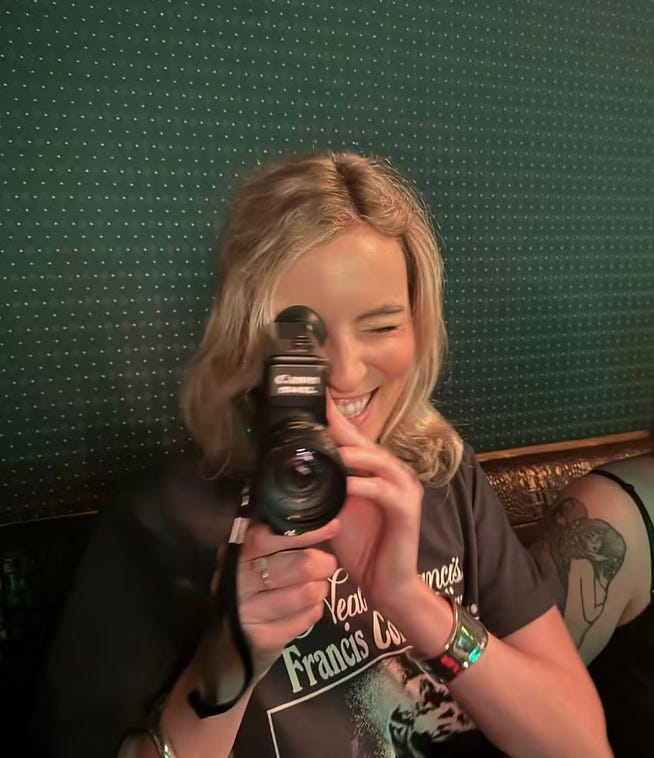
To celebrate my 50th issue, my daughter Anne Marie made a short Super-8 video for me:
If you want to celebrate my 50th issue, please share and subscribe!
*
Yet Another Shameless Plug
Anne Marie has a Super-8 business for bands, brands and weddings. Check out her website and keep her in mind if you need super-creative, super-memorable super-8 videos of an event or business!
Here’s a sample of a super-8 she made for the Neil Francis Band:
(I’m unable to embed her actual website here, so click on the link and see what YÉ-YÉ has to offer!)
Love Anne Marie's video! Really does justice to the great music! And congratulations on reaching "50"! As to hoarding---> ugh. I binge-watched Hoarders until I couldn't take any more. It really is a matter of mental illness in most cases and I hated myself for being so critical but when it came to an episode where the woman was saving all her excrement and urine--it really was all over the place, an unbelievable and unbearable sight and I'm sure smell for the poor folks who had the job of dealing with it--or were unable to deal with it. One good thing, though--watching these shows (or, as in your case, having a hoarded house to deal with) often leads to GETTING RID OF ONE'S OWN HOARDED ITEMS! Mom used to say "If you haven't taken this out and used it, or been entertained by it, or worn it in a year TOSS IT OR GIVE IT AWAY! Good advice!
Did you keep anything! Maybe just to remind you not to hoard! Congrats on 50 issues!