
Issue #49
Reset
This being the beginning of Lent, two shortcomings have presented themselves for examination. (“Just two?!” says an interior voice. An exterior voice coming from the couch as he reads this says the same.) Although these are non-spiritual problems, I am determined to use my forty days to hack away at them and see what’s left of me. This 49th issue is both my confession and my plan for expiation.
*
Re-boot
Last fall on a walk with my friend Casey, we were discussing how best to co-exist in this age of division, and she offered a tip she picked up from Ryan Holiday, a.k.a. The Daily Stoic. “You don’t have to have an opinion about everything,” she told me.
The heavens opened, the mist cleared, the earth shook, my blinders lifted, and the key to human happiness was thus revealed:
You don’t have to have an opinion about everything.
It’s not that I hadn’t heard this before. I have. Certain people, people who have lived in the sunshine of my constant opinionating for many, many years, have said those exact words—with the additional ornament of an exclamation point. But because Casey was speaking in a general way, and not making a complaint or a criticism, I heard it as if for the first time.
I am one of those unfortunates overloaded with opinions. If you peeled back my scalp a mere inch or two, opinions would spew out like a colony of bats. Years ago I nearly drove everyone out of a book club because I was so “animated.” What they loved I hated; what they were bored by I loved. I have strong opinions about writers, clothes, music, children’s books, health, television shows, politics of course, Miracle Whip (foul), clogs (against), Judy Collins (GOAT), Diet Coke (evil), Brazilians (let it grow, girls), microwaving (only in emergencies), football (watching other people sustain brain damage is not entertainment), and lunch (please don’t invite me to ruin the middle of my day).
Granted, opinions are a writer’s bread-and-butter, but writing and blurting out are two different things. No one needs to hear my unsolicited opinions in conversation. No one will be convinced by them. I’m hard-pressed to think of an occasion when the impulsive airing of my opinions benefited anybody. Much easier to think of times they irritated people.
I looked up Ryan Holiday for more guidance:
Not a lot of people understand this…but you actually don’t have to have an opinion about everything. You don’t have to decide if something is good or bad. Marcus [Aurelius] says limiting the amount of opinions we have is one of the most powerful things we can do in life. Do you need to have an opinion about the scandal of the moment—is it changing anything? Do you need to have an opinion about the way your kid does their hair? So what if this person likes music that sounds weird to you? So what if that person is a vegetarian? “These things are not asking to be judged by you,” Marcus writes. “Leave them alone.”
The Stoic’s idea is to stop opinions before they even form—but that’s a life’s project for a reactive person like me. I need more immediate help to stop opinions at their outlet—to keep my mouth shut so a bat doesn’t fly out and crap all over the dinner party.
I’ve found my role model. The latest episode of All Creatures Great and Small** (Season 6, episode 6), introduced a character named Elijah Wentworth, a farmer who is taciturn to the extreme. As Siegfried, the overly-opinionated, bad-tempered, heart-of-gold vet, complains, “His entire vocabulary consists of three words: aye, ah, and oh.”
I tried the “aye, ah, oh” response for a few minutes with Husband, and while it was amusingly effectual, the “aye’s” did not exactly trip off my tongue, as I am not a native of the Yorkshire Dales. So I’ve assembled my own arsenal of anodyne phrases. Hopefully they’ll be useful when the compulsion to opine takes hold. The phrases are borrowed from others (and a good story behind many of them) so feel free to borrow them too.
For any political conversation you get drawn into and want to exit quickly from, say as neutrally as possible,
That’s one way to put it.
When someone is telling you that ever since they turned their internet off at night, they’ve been thinking clearly and sleeping like a baby, do not snort and make the crazy sign with your finger circling your head. Instead say,
If it works, it works!
When someone is talking about the theories of general relativity and quantum mechanics and tells you the two are incompatible which means we’re missing something and then asks what you make of all that, do not say, “Bor-ing!” Try instead,
Hard to say without knowing, really.
When someone complains that all their co-workers are missing the point, don’t say, “Have you considered that it might be you missing the point?” Just say,
It is what it is.
When someone is telling you that because Mercury is in retrograde and the moons of Jupiter are sitting in the Delta of Venus, they are going to get a foot massage and a new bicycle, resist the urge to tell them their brain is in retrograde. Instead say,
There ya go!
When someone tries to engage you in a discussion about macroeconomics and the gold standard and international monetary policy, and you think this person should probably just load the dishwasher, keep your thoughts to yourself and say,
I hear ya.
When that same person tells you at length about a recent golf game, each birdie, each bogey, each putt, each missed opportunity, and you notice that the dishwasher still needs to be loaded, say nothing except,
It’s so hard.
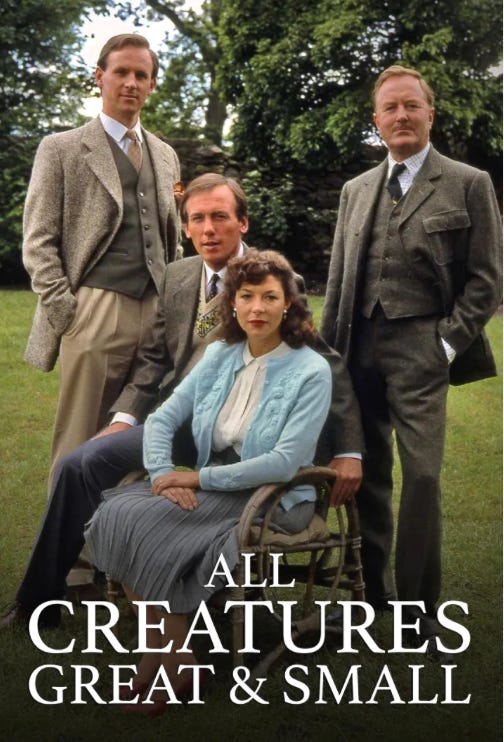
**Note: I’ve said it before and I’ll say it again, the original All Creatures Great and Small series from the 70’s and 80’s is loads better than the new one. Less hokey, a more manic Siegfried, and more realistic locals (less attractive, stronger accents, quirkier). However, if you really love the new one. . . I hear ya!
*
Re-Book
Up until about six or seven years ago, I was a reader. An obsessive, voracious reader.
I read everything that crossed my path, like a dog gobbling a trail of kibble. As a young girl I read in the bathroom late into the night; in school I got in trouble for reading a novel instead of my textbook; every day I’d read the entire Washington Star and Washington Post, even the classifieds. As a young mother I’d check out a dozen books from the library, just for myself, and pile them up on the living room floor, holding off the kids’ requests for snacks or attention with, “One more page!”
Years later a smart phone had the usual effect. Little by little my identity as an avid reader faded away. It was as if “avid reader” was a costume I was taking off piece by piece, leaving me exposed me as a Non-Reader.
It fills me with shame to be a Non-Reader.
Obviously part of the solution to reading more is to scroll less. That’s an ongoing battle. But eliminating screen time is not necessarily going to drive me back into the arms of a book. Just because you give up sweets doesn’t mean you eat salad greens all the day long.
Recently I read an essay that’s helped. In “How I Began to Love Reading Again,” writer Jeff Giles introduces the idea of “the broken reader,” a term he got from a writer friend who had also stopped reading for a time.
It took weeks for me to realize that I was a broken reader. I assumed I’d just had a streak of bad luck in the Dept. of Picking. I started taking fewer chances. I bought only books that looked like books I would buy. This backfired in a kind of horror-movie sequence during which I brought a novel home; gave up on it within 20 pages; and then carried it to a bookshelf, where I discovered that — cue the jagged violins — I’d already bought a copy and not liked it.
I tried that too, and now I have half a shelf of unread essay collections and Virago Modern Classics.
What finally worked for Giles was trying to approach a book with more expectation than dread:
Without realizing it, I had put every novelist on probation from word one. I needed to stop thinking that I knew more than the author and give in to whatever ride they had spent years planning. I needed to read slowly and remind myself that if I ended up disliking a book the earth wouldn’t get sucked into the sun.
Yep and yep. I’m a quick judger of most things I experience (Enneagram type 1, IYKYN). Keeping an open mind is always wise, but it didn’t solve my reading avoidance.
What has helped is the very concept of “the broken reader.” Thinking of myself as a broken reader means that I can repair my habits; I’ll get back to it; I’ll read again. But more than that, it means that despite these many years of not reading, I am still in my heart a reader. That’s who I am. And readers read.
It’s a subtle shift, but somehow it’s working. Thinking of myself in this kindly way has led to more reading in 2026 than for most of 2025. Since January I finished a book I started months ago, Memento Mori by Muriel Spark (a quirky and hilarious story of elderly folks getting prank calls about their imminent deaths); Murder at Gulls Nest by Jess Kidd (a cozy, undemanding British mystery); Slow Days, Fast Company by Eve Babitz (best thing I’ve read in a while, a portrait of L.A. in the 70’s); and Stone Yard Devotional by Charlotte Wood (see Issue #48). I’m working on three more simultaneously: All the Beauty in the World (listening to it on Audible—thanks to my friends Joan and Tanya —it’s a wonderful memoir by a guard at the MET); Secret Hours by Mick Herron (I’m a sucker for British spy thrillers); and The Jesuit Guide to (Almost) Everything by James Martin, SJ (a good book for the bathroom).
Next up is a re-read of Wuthering Heights (anyone else?) and a return to Mr. Loverman by Bernardine Evaristo, which I started, enjoyed, and for no good reason at all abandoned.
This new energy for reading is nothing short of a grace, and I am grateful for it.
*
If you enjoyed this issue of Restless Egg, please share it with someone else who might enjoy it too! And if you haven’t yet subscribed, make my day!
Love this and the Tarzan clip too, Maggie!
Haha classic!