
Issue #48
Of Mice and Munch
Musophobia is the name for the fear of rodents, a fear I suspect is near universal. There should be a corresponding term for the fascination and weird shiver of delight we get from hearing rodent stories, because that too, seems near universal. How about musomania? I recently experienced musomania listening to a story about a rat-infested townhouse in Georgetown. The residents had to put dumbbells on the toilet lids to keep rats from coming up the pipe. And my sister Josie had a great tale about a rat that nested under her couch in a group home in New Orleans. When the roommates discovered the rat’s nest, they also discovered missing jewelry the rat had stolen.
I’ve got rodents on the brain, you see, because I’m in the middle of a novel that features scads of them. Waves and buckets and shovel-fulls of mice. The narrator of Charlotte Woods’ Stone Yard Devotional has taken refuge in a cloistered convent in Australia. Her refuge turns out to be anything but peaceful. An infestation of mice takes over the convent. There are mice in the piano, mice in the cushions of the car, mice in her shoes. They skitter, they gnaw, they smell. They destroy the pantry, they scurry behind walls, they eat each other’s faces off.
The novel is set during Australia’s great mice plague of 2021. Yes, this is a real thing. A plague of mice hits Australia every couple years and causes millions in damage to crops. It’s absolutely and delightfully disgusting:
We hear stories from further north in the state: mice in babies’ nappies; women going to bed with pillows over their faces to stop the creatures crawling on them as they sleep. Children bitten in their hospital beds.
The other plot line in the novel revolves around the bones of a murdered nun, returned after many years to the convent. A small casket containing the bones sits in the “good room” as the nuns wait, days upon days, for permission to bury the bones on convent grounds. They keep vigil to pay respect, but also to keep the mice—who will chew through anything— from getting to the bones:
We are doing everything we can to avoid trapping in the bones’ room. There would be something very wrong, we feel, about such violence near Sister Jenny’s coffin. But soon we will have no choice. Every morning [Sister] Bonaventure sets the wire-and-plastic traps outside the room, either side of the door, before she goes in there to sit. And within minutes the traps are heard snapping in the hallway.
The grotesque possibility of mice eating human remains took me back to something I wrote over twenty years ago, a few months after my bilateral mastectomy. I began to wonder what happened to my breasts. These days I would just Google, “What happens to breast tissue after mastectomy?” thereby ruining my algorithm forever, but back then, internet research wasn’t the first option that came to mind.
The piece I’m sharing with you today is only mildly gruesome, I promise. I’ve edited it a little and removed (no pun intended) a section on an imaginary bosom funeral. If you’re especially squeamish, this may not be for you; and if you’ve recently dealt with cancer, please protect your peace of mind and skip to the last sections where something much more pleasant is on offer.
*
I start with my oncologist. “What happened to my breast tissue?” I ask. I use the term “breast tissue” to sound more clinical and less cuckoo-crazy.
He says he doesn’t know exactly. “Exactly” tells me he does indeed know something. He’s still leaning back in his chair, but his usual languid demeanor has an edge now. He asks why I want to know. Either I’ve broken some taboo or he’s worried I’m developing an abnormal attachment to my amputated body parts, like the specter in the old story who chants, “Johnny, I’m on the first step and I want my liver back.”
I say, “I’m writing about it.”
This seems to reassure him that I’m involved in a healthy healing process, and he decides to tell me a little more. After a mastectomy, he says, slides are made of both the diseased and the healthy tissues. A finger-tip sized sample of each is put in wax. These specimens are stored at a hospital warehouse for fifty years.
There’s something more. “I’ve heard from the men who work at the warehouse that after a while—”
“What’s a while?”
“I don’t know, a long while. After a long while,” he goes on, probably already regretting the over-share, “mice get to the waxed samples.”
I make a face. I imagine hungry mice scrambling along shelves and in and out of drawers, nibbling on thousands of nipples and breast tissue samples.
Then I realize that a finger-tip sample is still only part of the whole. “What about the rest of it?”
He repeats that he doesn’t know, leaving out “exactly” this time. He suggests I call the surgeon’s office. So I call the surgeon’s office. They pass me on to the lab. I make several more phone calls. No one seems to know the answer. Or no one wants to say. But every person I speak to wants to know why I want to know. I stick to “I’m writing about it,” but what I feel like saying is, why shouldn’t I want to know? Isn’t that a normal response to losing an important part of your body? Why the secrecy?
Finally I get a hold of a pathologist willing to spill the beans. First she tells me that the breast tissue is kept for four weeks and then disposed of in a “medically approved way.”
“What does that mean?”
She pauses. “Do you have any idea?” There is something she doesn’t want to say out loud.
“Incineration?”
“No,” she says, “we stopped doing that years ago. Now, if it were a limb, it would be sent to the funeral home that handles limb disposal.”
It’s too bad she’s about to tell me that my breasts weren’t sent to a funeral home. It’s too bad, really, that the boneless tissue of my mammary glands won’t receive the same respect as a foot or a finger. Because they were important, they were useful. Didn’t they nurse four babies, each baby for a whole year? Hats off, I say, props to that!
Instead I ask, “So where does it go?”
A pause on the other end. “It goes down the drain.”
I understand immediately that before the breast tissue goes down the drain, it has to be liquefied in a garbage disposal.
She confirms this. “It’s a called a ‘grind-out’ and it’s done in the autopsy room.”
“And where does that liquid go?” I’m imagining a secret cesspool of liquified flesh fenced off behind the hospital.
Fortunately she tells me that’s not the case. The liquefied tissue is sent to some kind of treatment facility. “But it doesn’t end up in our drinking water,” she reassures me.
I stop asking questions.
I have a brief gross-out moment thinking about the grind-out. Blood and flesh chopped up in sharp blades till a mauve-colored smoothie spills into a storage tank.
Then it occurs to me that the treatment facility de-toxifies. It purifies. The cancer in my breasts has been neutralized.
I adjust my imaginings of my breasts in their liquid state. This time they’re distilled and clarified, light as water, with an amber glow that captures the sun like a prism. My golden breasts flow out of a pipe and sink into the earth, maybe to help, once again, young things grow. Or maybe just to rest benignly in the soil, not killing any living thing. That’s all I really need to know.
*
A Few More Rodents
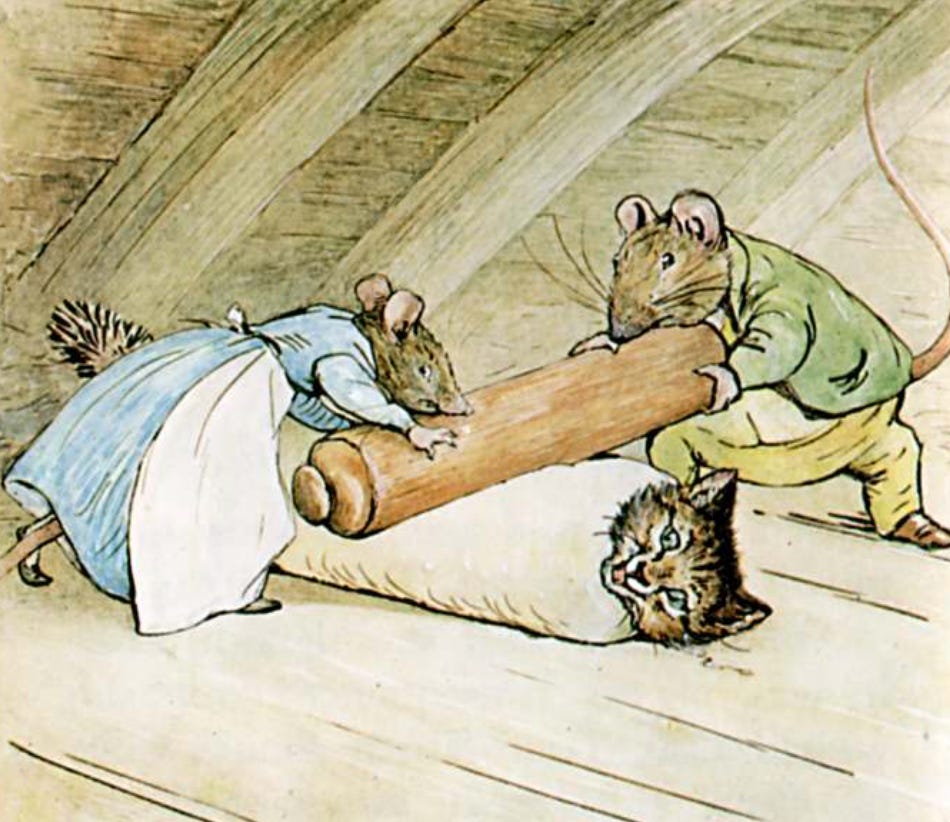
Musomaniacs will enjoy re-visiting Beatrix Potter stories. Forget about the bunny nursery wallpaper and the kitten-in-dresses onesies—Potter is much darker than that. Let’s call her Edward Gorey Lite. Remember Peter Rabbit, nearly turned into a pie? Remember Farmer McGregor chasing him around the garden with a pitchfork? That gal was twisted, in the best way. Her darkest story, and my favorite, is The Roly-Poly Pudding in which a kitten is caught by rats and rolled in pastry to eat for dinner:
Presently the rats came back and set to work to make him into a dumpling. First they smeared him with butter, and then they rolled him in the dough.
“Will not the string be very indigestible, Anna Maria?” inquired Samuel Whiskers.
Anna Maria said she thought that it was of no consequence; but she wished that Tom Kitten would hold his head still, as it disarranged the pastry. She laid hold of his ears.
*
Rodent-Free Content
Should anyone need a love poem for Valentine’s Day, here’s a sweet old-fashioned one by William H. Davies:
Come, Let Us Find

Come, let us find a cottage, love,
That's green for half a mile around;
To laugh at every grumbling bee,
Whose sweetest blossom's not yet found.
Where many a bird shall sing for you,
And in your garden build its nest:
They'll sing for you as though their eggs
Were lying in your breast,
      My love—
Were lying warm in your soft breast.

'Tis strange how men find time to hate,
When life is all too short for love;
But we, away from our own kind,
A different life can live and prove.
And early on a summer's morn,
As I go walking out with you,
We'll help the sun with our warm breath
To clear away the dew,
      My love,
To clear away the morning dew.
The best lines in the whole poem, worth holding on to:
‘Tis strange how men find time to hate,
When life is all too short for love
*
“Chintamani” by Celine Dessberg is my new morning song. And my afternoon break song. And my after-dinner song. The instrument giving it an other-worldly beauty is the Mongolian zither-harp.
*
If you enjoyed this issue of Restless Egg, please share it with someone else who might enjoy it too! And if you haven’t subscribed yet, go ahead and make my day!
Wow, now THAT'S what I call an unusual post! I'm sorry your breasts got pureed. Guess mine did too as we both went through the same experience...To honor them how about a belated prayer for the. . . . the. . . the whatever-they-ares...or weres. (Didn't think the computer mind inside this machine was going to let me type that"weres") Speaking of rats, it's coincidental that years ago, back in the 60's, my brother and his new bride were renting a really cool apartment in Georgetown, a converted carriage house. But not long after they moved in the bride, while in the bathroom performing a natural act, had it interrupted by a rat that had made its way up the toilet.... Now, my brother is a great exaggerator, so I'm not 100% convinced this happened. And his ex has passed away in the meantime so I can't ask her. But it makes for a great, though creepy, story. (And I HAVE to read that book.)
There is never a dull thought in your brain Maggie Lane!!!!