
Issue #47

Old Man in the Sea
On our drive to the beach we saw a red helicopter circling overhead. We knew what it was looking for.
“That poor family,” we said to each other. “Still no body.”
Then we forgot about it, the way one does on a beautiful Saturday afternoon when chores are done and the sun is out but not too hot and there’s nothing to do but study the waves and look for whales.
Near us a roly-poly elderly man was wading into the water to snorkel. He wore a yellow flotation vest that fit like a brassiere. Flippers in hand, also yellow, he steadied himself with poles— “Are those hiking poles?” we wondered, never having seen such a thing used in the ocean—as he hobbled forward, ankle-deep, then shin-deep. “This is not going to go well,” we observed, with equal parts snark and concern for his safety because the current was stronger than usual.
All the sudden three jet skis skirted around him and pulled up on the beach. Four men hopped off and unstrapped a long white bag from a sled attached to back of one of the jet skis.
The bag sagged in the middle and seemed heavy. Even so the men moved quickly up the narrow beach as if they didn’t want the body to stay in the ocean one second longer than necessary, quickly because they wanted to return it to a family who lived in an agony of waiting. Police parked on the road—we hadn’t noticed them till now, they had arrived silently—took the delivery.
Three days earlier a young man, only 19, was swept off the rocks at nearby Kahili Beach along with a friend. It was a terrible story. They were fishing with a group. One fisherman was rescued, the other not. His friends, unable to save him, had watched him struggle to swim back to the rocks. Then they lost sight of him. The search had been extensive: divers, drones, helicopters.
It all must have happened so quickly. It happened quickly on our end too, the jet skis landing, the body pulled out of the water and rushed off the beach—it was as if we watched his fall in reverse, the way people film themselves jumping into the water and play the tape backward to show themselves jumping out of the water
It was when the search-and-rescue team was ready to leave that the tragic turned to the absurd. The old man, now face down in the shallow water, hovered right behind the jet skis. One of the crew tapped him to get out of the way, but he didn’t look up. When he was tapped a second time, he emerged to hear their request, but went right back to snorkeling, not moving his position at all. The jet skis had to maneuver around him.
His lack of awareness was so extreme that it seemed intentional, selfish, rude. I felt a mild outrage at his lack of decency. It was easier, I suppose, to feel irritated than to feel the full weight of a young man drowned.
Later it occurred to me that the scene we witnessed was Auden’s poem “Musée des Beaux Arts” come to life. I don’t remember when I first read this poem—high school or college—but it’s stayed with me all these years. The speaker of the poem is looking at pictures in a gallery and meditating on just the kind of obliviousness the old man had demonstrated:
About suffering they were never wrong,
The Old Masters: how well they understood
Its human position; how it takes place
While someone else is eating or opening a window or just walking dully along
The poem turns to one particular picture as an example of the “human position” of suffering: Bruegel’s Landscape With the Fall of Icarus. (Icarus, you recall, of Greek myth, flew too close to the sun and his wax wings melted. He fell into the sea and drowned.)
In Brueghel's Icarus, for instance: how everything turns away
Quite leisurely from the disaster; the ploughman may
Have heard the splash, the forsaken cry,
But for him it was not an important failure
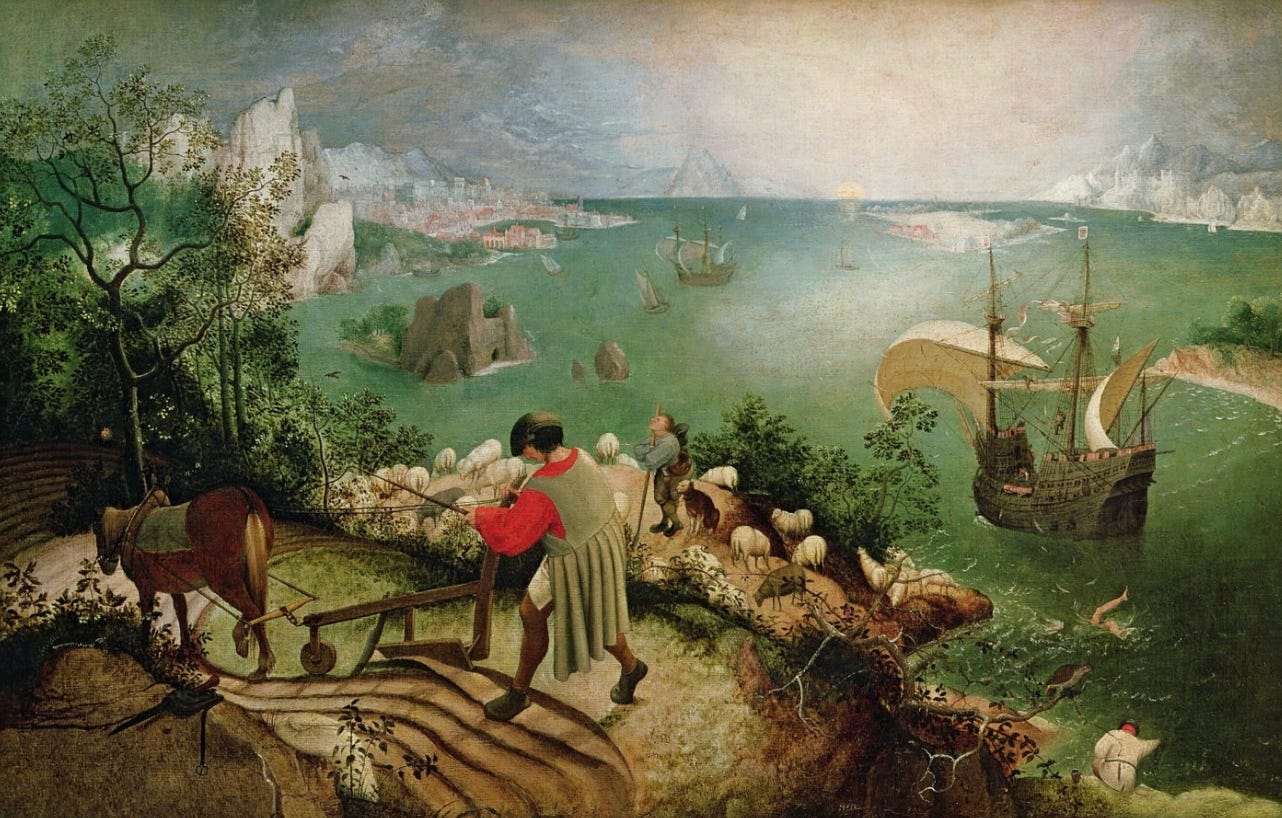
Could there be a better description of the snorkeler than this: “everything turns away/Quite leisurely from the disaster”? Or, in point of fact, a better description of my own actions? Hadn’t I turned away and gone back to my book once the jet skis sped away, hadn’t I turned away from the old man himself, from his likely suffering, hadn’t I made fun of him? Not to equate the expected infirmities of old age with the loss of a young man, but even the smallest bit of imagination would have brought the old man’s situation into focus: painful joints, loss of hearing, confusion, weak muscles, possible loneliness, and expectation of death sooner than later.
I’m not beating myself up about it—as Auden says, turning away is as human and as old as our myths. I’m just aware that turning away or turning towards, that is, seeing or not seeing others’ suffering, is a choice we make. We can’t choose one or the other exclusively—balance is necessary. If we only saw suffering, we would be overwhelmed, we couldn’t live. We can’t all be Dorothy Days or Greg Boyles.
But if we choose to not see suffering, if more often than not we choose our own comfort and amusement, what kind of life is that? What shallow waters do we float in, how isolated and how foolish are we in our protective gear, in our masks, waiting for the next pretty fish to dart past?
*
Here’s the full poem:
Musée des Beaux Arts
by W.H. Auden, December 1938

About suffering they were never wrong,
The Old Masters: how well they understood
Its human position; how it takes place
While someone else is eating or opening a window or just walking dully along

How, when the aged are reverently, passionately waiting
For the miraculous birth, there always must be
Children who did not specially want it to happen, skating
On a pond at the edge of the wood:
They never forgot
That even the dreadful martyrdom must run its course
Anyhow in a corner, some untidy spot
Where the dogs go on with their doggy life and the torturer's horse
Scratches its innocent behind on a tree.

In Brueghel's Icarus, for instance: how everything turns away
Quite leisurely from the disaster; the ploughman may
Have heard the splash, the forsaken cry,
But for him it was not an important failure; the sun shone
As it had to on the white legs disappearing into the green
Water; and the expensive delicate ship that must have seen
Something amazing, a boy falling out of the sky,
Had somewhere to get to and sailed calmly on.
I happened upon a wonderful close reading of the poem from a few years back. Entertaining, insightful and interesting. Well worth a few minutes!
*
On the lighter side
I’ve been nonstop listening to Volfman and Jackie Evan’s “Sleep for Days.” It has the just right blend of sweet melancholy and gotta-dance to it. Also, these lines—
Every time I go upstate I sleep for days
Maybe I just get tired when I’m feeling safe
make me think of my adult children coming home and how I’d love to tuck them in as I used to, and close the door and feel happy they were resting well.
*
One more song recommendation and also a shameless plug for my niece Mary Grace Hathway who just wrote and recorded this wonderful tune, “Agnes.”

*
If you enjoyed this issue of Restless Egg, share it with someone else who might enjoy it too! And if you haven’t subscribed yet, make my day!
Beautifully insightful. The final paragraph of the story of the Old Man in the Sea was incredibly poignant and true. It's hard to find the balance of being attuned to suffering, but also able to handle it . . . or better said, to entrust it to God.
Poignant story beautifully illustrates a difficult theme. I've always counted this Auden poem as one of my all-time favorites. I keep coming back to its ideas as time goes by, and don't like what this might mean. (But so it goes--if it does mean, it does mean.)