
Issue #45
Getting It All Wrong About Marriage
Any time I write a Restless Egg post about poetry, Husband will say, “A little less of that.” What he means is that most people aren’t interested in reading about poetry.
He’s right—those posts garner the fewest hits of any. But as he well knows, I follow my own lead. There will be poetry today.
But hold on—don’t leave just yet—here’s me extending my hand to draw you in and offer you a comfortable chair and a cuppa. Here’s me assuring you that “Marriage”” is an easy poem to read, and an interesting one, a little vignette about a wife telling her husband a story about their courtship that he had never heard before.
The poem centers around a series of phone calls, so it’s important to know that Lawrence Raab’s poem was published in Poetry magazine way back in 1990. “Marriage” operates in a pre-cellphone and pre-caller ID world. It’s a landline poem.
Settle in, this will only take a moment to read:
Marriage
by Lawrence Raab

Years later they find themselves talking
about chances, moments when their lives
might have swerved off
for the smallest reason.
                                     What if
I hadn’t phoned, he says, that morning?
What if you’d been out,
as you were when I tried three times
the night before?
                           Then she tells him a secret.
She’d been there all evening, and she knew
he was the one calling, which was why
she hadn’t answered.
                               Because she felt—
because she was certain—her life would change
if she picked up the phone, said hello,
said, I was just thinking
of you.
            I was afraid,
she tells him. And in the morning
I also knew it was you, but I just
answered the phone
                            the way anyone
answers a phone when it starts to ring,
not thinking you have a choice.
*
I’m resurrecting this poem and my commentary on it from a blog post twelve years past. (The idea behind my old blog, Poem Elf, was to bring poetry out of books and into the world. I would place copies of poems in public spaces and write about them. “Marriage” landed on the entry pillar of a very expensive bridal salon.)
I’m going to share my 2014 interpretation (slightly edited and updated), and then I’ll tell you how I found out said interpretation was a whole lot of misguided yackety-yak.
*
From Poem Elf December 2014:
If the couple in this poem had courted more recently, he would have called her cellphone, then texted, voice messaged and checked her location. There would be no we-almost-lost-each-other-forever. Either he would have tracked her down or he would have known she was ignoring his calls.
But even with the outdated technology of the poem, his version is overly-romanticized. We don’t know the whole story, of course, but surely he would have kept trying to reach her after she didn’t answer. Surely there would have been another opportunity to connect before their lives/might have swerved off/for the smallest reason.
Years later, happy years it would seem, she demolishes his version of their love story. It turns out that the single moment when their lives might swerve off course is not the missed phone calls so many years ago, but the telling of her secret this late in their relationship. It wasn’t kismet, she tells him, it was a choice, at first a conscious one formed in fear, and then an unconscious one formed out of habit.
You can just see the poor fellow’s face fall. It’s not devastating news, but it’s deflating. He doesn’t know her as well as he thought. His treasured romantic-comedy relationship is going to have to be re-cast.
It reminds me of the last beautiful scene in James’ Joyce’s The Dead. Gabriel Conroy and his wife Gretta are in their hotel room after his aunts’ annual holiday party. As he takes her in his arms, he asks, because she seems distracted, “’Gretta, dear, what are you thinking about?’” She doesn’t want to answer him, but he presses her, and at last she says, “’O, I am thinking about that song, The Lass of Aughrim.’” Then she throws herself on the bed, sobbing.
Earlier at the party Gabriel had watched Gretta at the top of the stairs listening to that song played in a distant room. He couldn’t decipher her strange expression, but it excited him. Now she explains. She tells him a story she’d never told him before, just as the wife in the poem does. When she was a young girl, she and a sickly boy named Michael Furey fell in love. He would sing “The Lass of Aughrim” to her. The night before she was leaving home for school, he came outside her window in the rain and told her he did not want to live if she left. He died a week later.
After this revelation Gretta falls asleep. Gabriel is left alone, humiliated, angry, then by turns tender and wistful. Just before the story ends with the immortal lines about the snow falling faintly and faintly falling upon all the living and the dead, there’s this:
He thought of how she who lay beside him had locked in her heart for so many years that image of her lover’s eyes when he had told her that he did not wish to live. Generous tears filled Gabriel’s eyes. He had never felt like that himself towards any woman, but he knew that such a feeling must be love
That’s marriage, right there, that acceptance that your spouse is a separate person from you and not exactly the person you thought they were early in your romance when imagination and fantasy were so much at play.
Years ago when my husband and I were moving to Michigan and arguing about every house we looked at, our 80-year-old realtor, now long dead but at the time long-married, told us that married people are like two trees. She used her forearms to show us the trees side by side. Separate trees, Millie said, but always growing beside each other. She was right. Any happily married person will tell you it takes years of marriage for the old idea of who you married to make room for the actual person who shares your bed and sometimes farts in it.
The title of Raab’s poem covers not just this little vignette of a married couple’s life, but what happens after the poem ends. Yes, marriage can be the bliss of shared memories, but it’s also the negotiation of differing memories. Romance is a construct; marriage is what happens after deconstruction. Or doesn’t. We don’t know where this marriage is headed.
*
Confident of my analysis, not having a single doubt about my interpretation, I forwarded the post to the poet, Lawrence Raab. He was kind enough to answer, and even kinder to gently set me straight.
Because I had gotten it all wrong.
Mr. Raab wrote, “I’m glad you like the poem, although I have never thought that he would be deflated by her story; it’s too good a story, and her reason for not initially answering relates directly to him.”
In a subsequent email he told me that he heard the poem is often used at weddings. In other words, most people read the poem as a hopeful, romantic one.
I had made it all sound so dreary.
*
Years ago one of my daughters lived with my mother for a few months. Rosemary liked to ask her questions about her life, usually while they were watching a television show. “Grandma, how did you know Grandpa was The One? How did you decide to marry him?” My mom’s answers weren’t satisfactory, so Rosemary would keep asking until finally my mother would say, amused and a little exasperated, “I don’t know, Rosemary, I just did it!”
I can hear exactly how she said that, and I can imagine what she was thinking: It all worked out, what more is there to say? My mom was a happy person and not an over-thinker. Those two qualities are probably related.
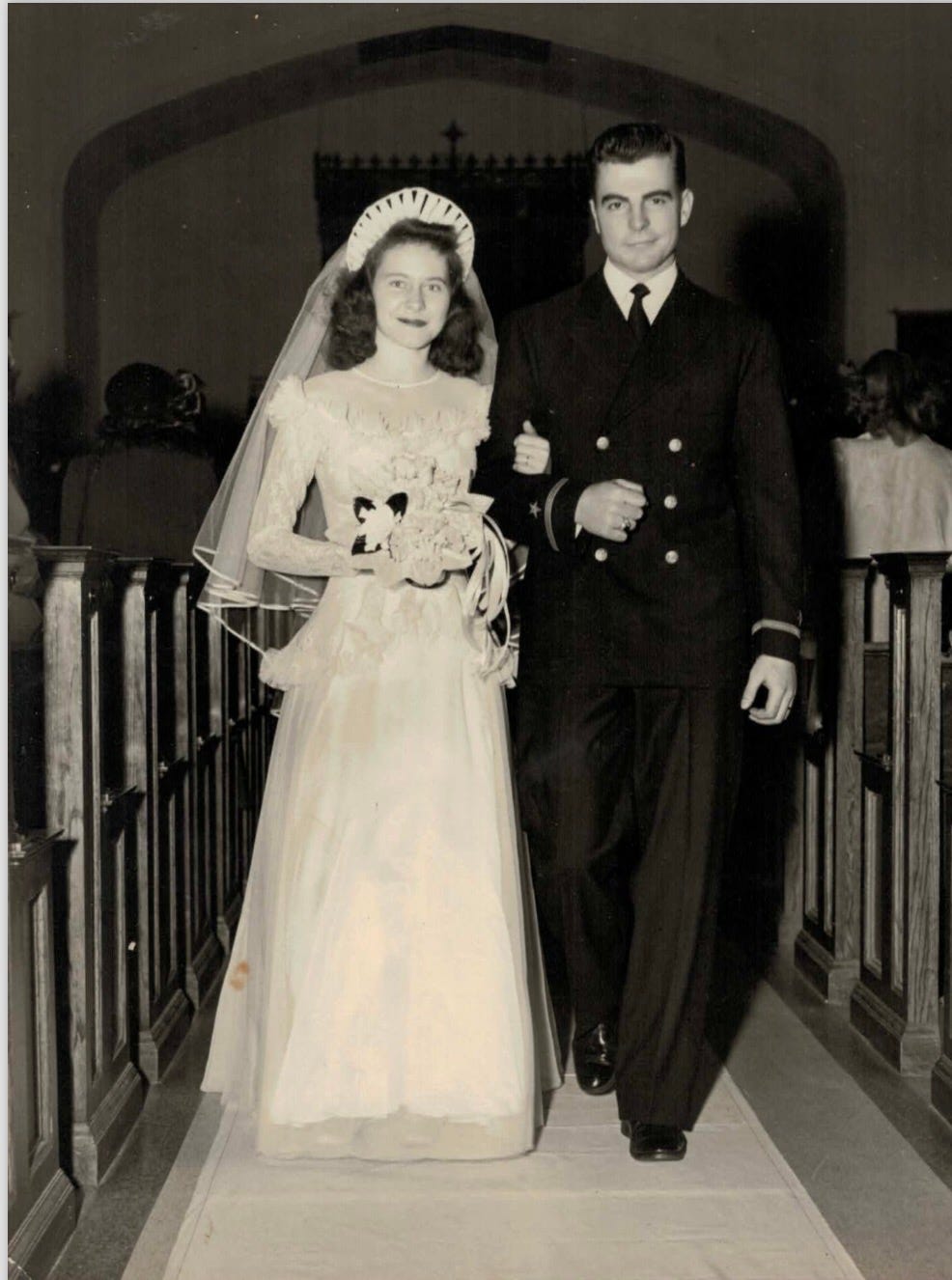
We live in an age of near constant decision-making, of curated lifestyles and life choices, an age of being intentional. I’m not wholesale disparaging this. The italics are for term-recognition, not for scorn. I fully realize how many unexamined lives have been unhappy. I know I would not want to live in an age where only one kind of life was expected and you followed along without questioning. I admire people who live thoughtfully, who think things through and make hard, interesting and/or good decisions.
But there are other forces at work in our lives, forces under-valued, mysterious, and waiting in the wings to help us move forward. Forces of instinct and trust. Instinct towards what is good and trust that good awaits.
I heard something recently that would have resonated with my mother: Make a decision and then make it work. Over-thinking is eventually exhausting and paralyzing and a dead-end.
Because sometimes you just need to pick up the phone.
*
Joyce’s The Dead is such a beautiful story, and I always think of it when snow falls. For you snow-lovers, here’s that famous last paragraph to increase your enjoyment of the weather:
Yes, the newspapers were right: snow was general all over Ireland. It was falling softly upon the Bog of Allen and, further westwards, softly falling into the dark mutinous Shannon waves. It was falling too upon every part of the lonely churchyard where Michael Furey lay buried. It lay thickly drifted on the crooked crosses and headstones, on the spears of the little gate, on the barren thorns. His soul swooned slowly as he heard the snow falling faintly through the universe and faintly falling, like the descent of their last end, upon all the living and the dead.
*
Here’s Angelica Huston in John Huston’s The Dead in the scene where she hears “The Lass of Aughrim.”
*
If you enjoyed this issue of Restless Egg, share it with someone else who might enjoy it too! And if you haven’t subscribed yet, make my day!
Beautiful posting, Maggie. I love "The Dead" too but it took me a long time to understand it. At one and the same time I DID get it, then, suddenly, I'd not get it at all.... funny, that. (I think you would like Angelica Huston's bio--"A Story Lately Told." Life with a fascinating father, et al.)
Maggie thank you for combining the Poem Elf and The Restless Egg. It was a joy.