
Issue #42

Poison
“Sixties Surreal,” an exhibit at the Whitney in New York, is by turns funny, disturbing, puzzling. Very little of it is beautiful. Last week as I strolled from room to room, studying and sometimes ignoring sculptures, paintings, collages and short films, thought-provoking art began to merely provoke. At a certain point I had seen enough reproductive organs, exaggerated human forms, scatological references and cartoonish color schemes. I say this not to dismiss the passions and cries for justice that inspired the art—but it all got to be too much strangeness, too much ugliness. When everything startles, you get immune to twitching.
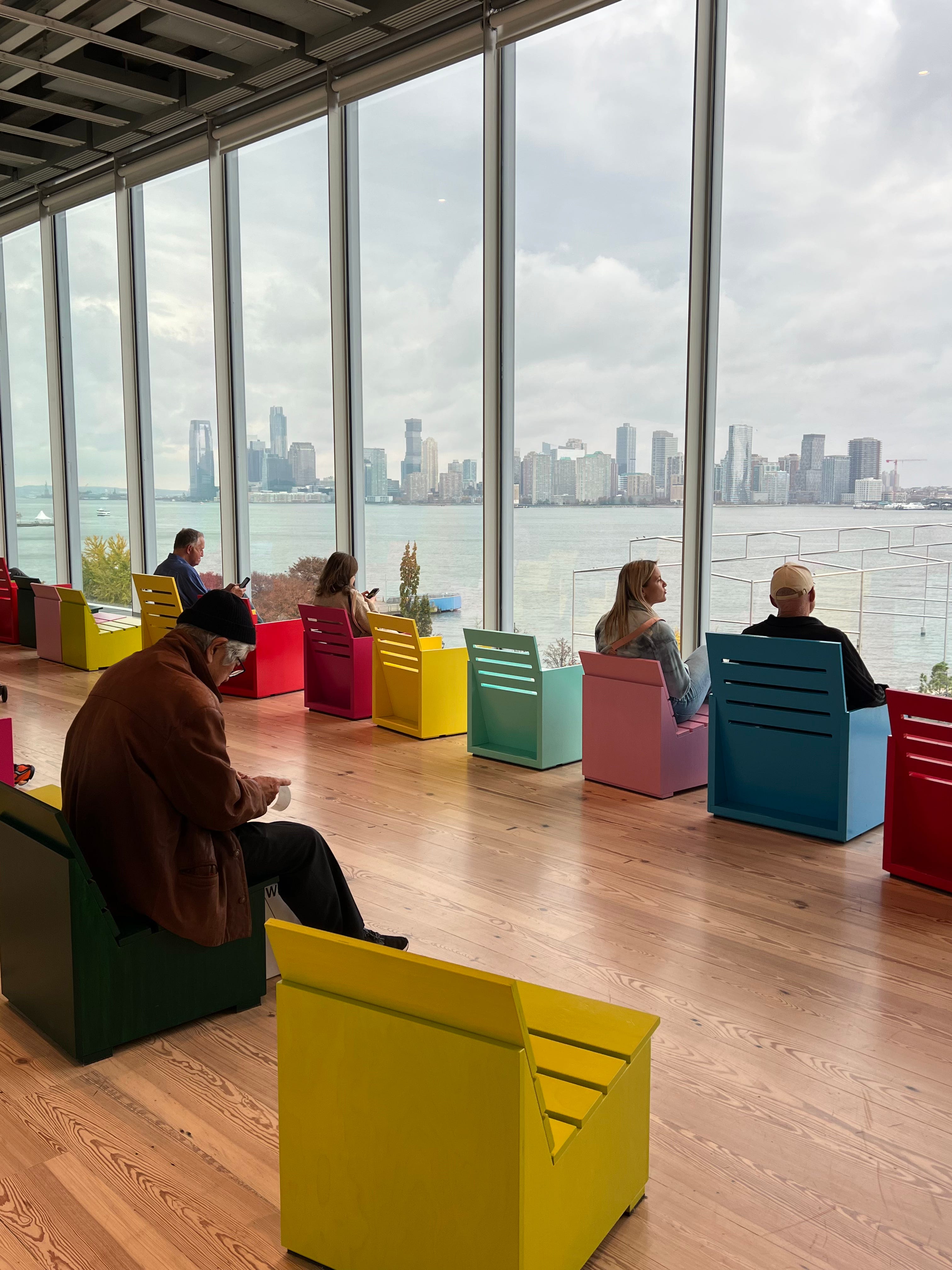
I headed down to the fifth floor and took a breather in a sitting area with an expansive view of the Hudson and Gansevoort Peninsula Park. The trees and cars and kids playing soccer far below were the opposite of surreal; the absence of street noise made the scene on the other side of the glass peaceful and restorative.
On the same floor I saw a Georgia O’Keefe painting from the early 30’s, a close-up of a flowerhead. Nice enough, but nearly colorless and less abstract than the typical O’Keefe. It was the accompanying text that drew me in. O’Keefe explains why she decided to magnify flowers:
“In the twenties, huge buildings sometimes seemed to be going up overnight in New York . . . so I thought I’ll make [flowers] big like the huge buildings going up. People will be startled—they’ll have to look at them. And they did.”
Her intent is clear enough—make “even busy New Yorkers” stop and study what they usually ignore—but that afternoon I misconstrued her words to suit my mood. Here was my takeaway: O’Keefe is offering an antidote to ugliness. She’s neutralizing it. The beauty of her supersized flowers is a counterpoint to the concrete towers of commerce.
As I thought about massive flowers floating over the facades of New York City skyscrapers, covering their windows and scaffolding with velvet petals, a woman I hadn’t thought of in years came into my consciousness. She is midwestern through and through and maybe out of place in the middle of New York City, but there she was by my side at the Whitney, reminding me of her practice of reverse gossip. Whenever someone says something mean about a person not in the room, she provides a counterpoint and says something positive about them. She’s human chemotherapy to ugliness, stopping unkindness from spreading and perhaps even killing it dead.
That should have been the happy end of my New York City experience of surrealism. But the government shutdown had other plans for me.
Our flight home got canceled, so my daughter and I had an evening to kill before our re-scheduled early-morning departure. We decided to go to a comedy club, but we chose poorly. “Welcome to rock bottom,” the emcee joked. Unfortunately it wasn’t a joke. The room smelled of urine and dried beer, the floor was sticky, the temperature so cold we had to keep our coats on, the crowd so sparse we knew we couldn’t leave early without getting called out. A slate of comics tried to extract laughs from the audience with all the joy of ditch diggers. “What are we doing here?’” my daughter and I said to each other, a question that surely has inspired many a surrealist.
For two hours we were trapped in the dark with unfunny people. The comics talked about hating themselves. They talked about hating their jobs. They talked about smoking weed, snorting coke, and having either a penis or a vagina, using cruder terms, as if crudity alone would make their monologues funny. One of them bragged about being a racist. He also used the R word three times and claimed he wanted to kill himself.
Never had New York air tasted cleaner than when at long last we walked up the steps to street level.
At the airport the next day surrealistic tribulations continued. Our 6 a.m. flight got us as far as Chicago, but then we were stuck all day in no-man’s land. Our connecting flight to Traverse City got delayed and delayed and delayed, and with each delay we moved gates and sometimes terminals. We moved five times. We worried we’d eventually get cancelled again. I spent hours sucked into my handheld outrage generator, reading newspapers and watching reels. I had a good book I was too lazy to read. My mood grew worse, more irritable. I was making myself sick with screentime. It was as if I were trapped again in the bleak comedy club basement, and once again, nothing was funny.
In our group of Traverse-City-bound nomads was a lovely woman with whom we shared updates. She had a stylish white bob, glowing skin, a wide smile, and bright, clear eyes. Unlike us she seemed calm, at ease. She told me she was a hospice nurse. Clearly she knew something about patience and perspective.
Occasionally I’d look up from my phone at her face. It was a sunny day and the light seemed always to find her and give her, out of all the hassled passengers around us, a special radiance.
She was the palate cleanser for my doomscrolling. Her very face was an antidote.
Let me come to the point. I am trapped in surrealism. The trap is my phone. The trap is the news cycle, the never-ending siren call of fast-breaking and what is the world coming to. The trap is the supposed moral superiority of paying attention, close, close attention, to cruelty and injustice even as my own pillow is still fluffy—or more accurately because my own pillow is still fluffy. That’s the trap—keep up, keep up, stuff is going down!
The surrealism is that I spend hours, even in the middle of the night, with my trap. The surrealism is that I want to escape and the escape hatch seems so easy to open—just put it down—but I don’t do it. I keep suckling on the poison.
I tell you this with shame. I tell you this because I think most people have some degree of screen addiction and most people dislike themselves for it.
I get advice. Keep your phone in a different room. Use an app to limit your screentime. Stop focusing on things you can’t change. As anyone with a problem behavior knows, someone telling you to just stop doing the problem behavior doesn’t help you stop it.
What does help is Georgia O’Keefe’s words. What does help is an antidote. What does help is thinking about experiences and activities as counterpoints and palate cleansers to the surreal way I interact with my phone. The eyes need a break. The lungs need fresh air. Looking up at the sky helps. Looking down at the earth helps. Art helps. Books help. Kind words help. Kind people help. Any reminder that ugliness, consumerism and cruelty is not the whole of life helps. Any reminder that a real world still exists and the surreal world doesn’t have to steal my attention 24/7, that helps.
And yesterday, punk rocker Patti Smith helped too. In a wonderful interview with Ezra Klein she said this:
“Despite everything that’s happening in the world and everything around us and any frustration or helplessness we feel or betrayal we feel, we have to remember it’s also all right to feel the joy of being alive and feel the joy of your own possibilities. Even in the face of the suffering of so many people around us.”
*
Just to be clear . . .
. . . “Sixties Surreal” was nothing like the comedy club basement. The exhibit is worth seeing. There were some wonderful pieces. Two in particular stayed with me, one because of its strange beauty and the other because of its concision and power.
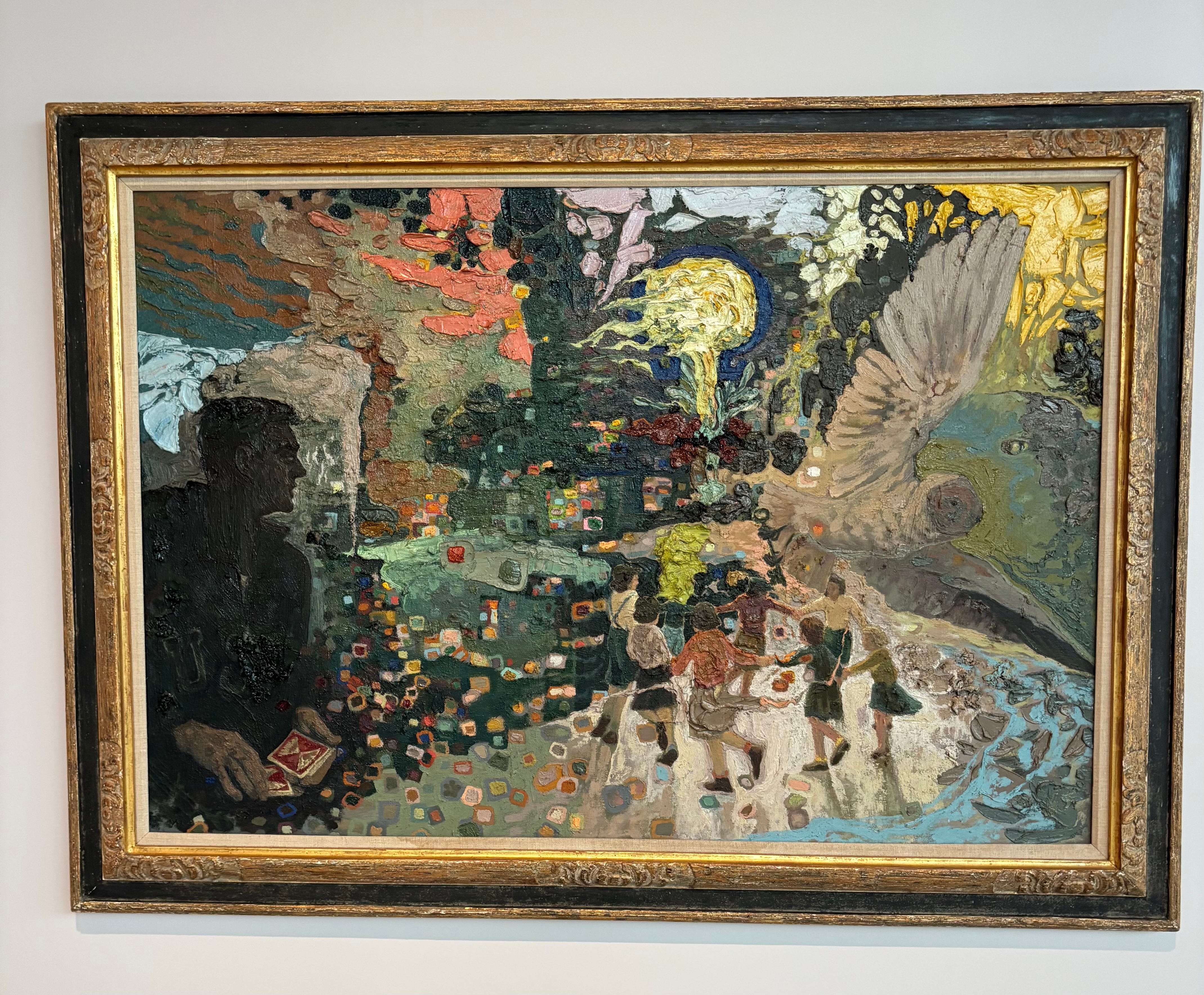
Here’s “If All the World Were Paper, and All the Water Sink” by Jess from 1962. The subject is an apocalypse—notice the nuclear explosion in the back and the lurking stranger in the front—but the brush strokes and colors are gorgeous. Something about it reminds me of Vuillard.
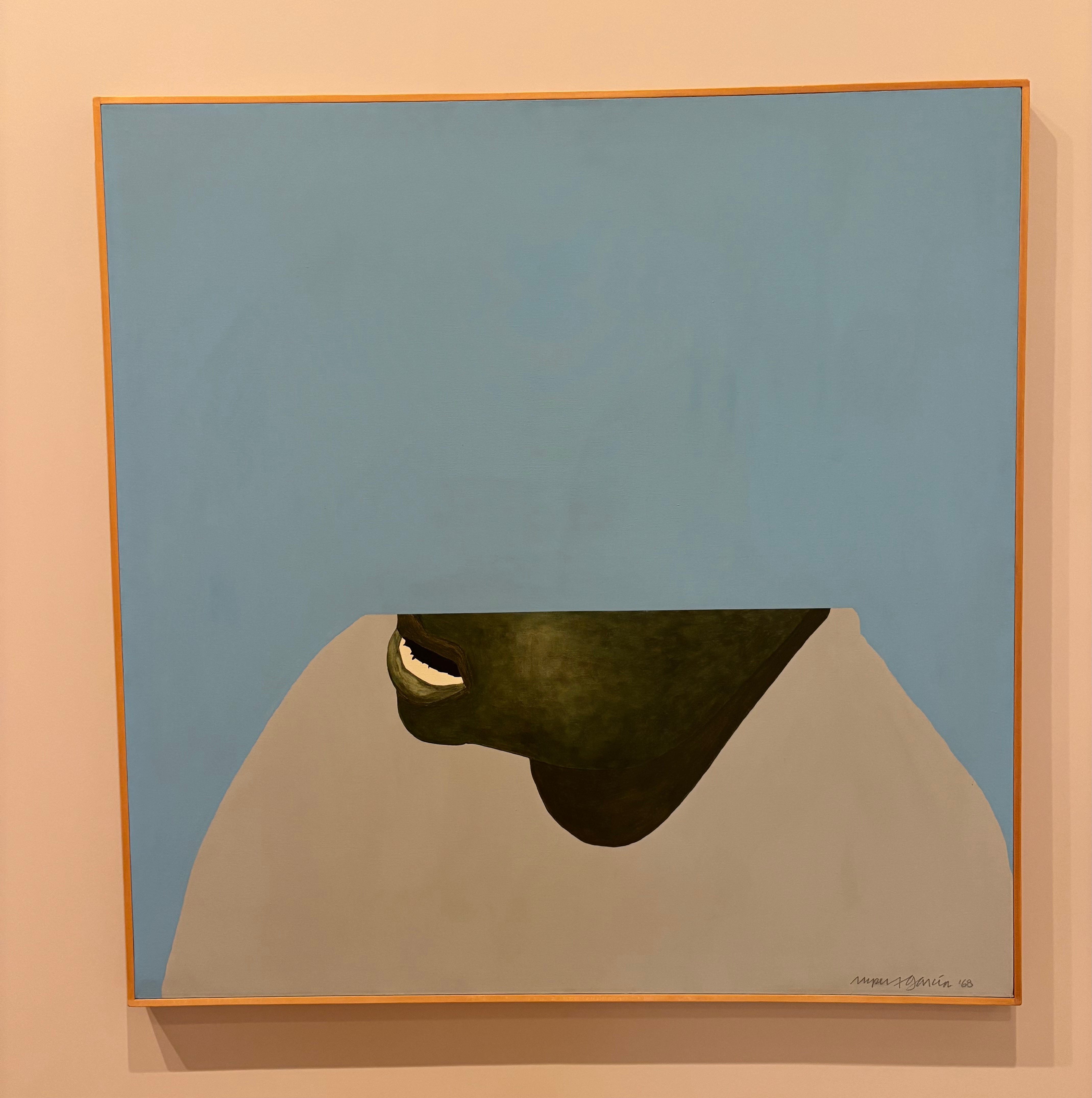
My favorite piece of the day was Unfinished Man by Rupert Garcia from 1968. Here’s the description: “Unfinished Man relies on abstraction to capture the disorienting and jarring experience of a disillusioned soldier reintegrating into an American society roiling with anxiety.” The set of his jaw, the highly edited elements of shapes and color—it was a wow. (If you’re interested in the “roiling anxiety” of America in 1968, I can’t recommend enough the four-part Rest is History podcast series on that year.)
*
Final recommendation and you can go about your business
One other thing I can’t recommend enough—the Patti Smith interview with Ezra Klein I mentioned earlier. I love how seriously Smith takes the books she was drawn to in childhood. I love how she talks about being pulled into art in a visceral way. I love her stories of New York City in the 70’s. I love her “rebel hump.” (Still not 100% sure what a rebel hump is, but I’m pretty sure I have one.)
Note: I read the interview rather than listening to it because I wanted to focus on her words, and not have to hear so much from him, as he has a habit of taking over conversations. You have to have a New York Times subscription to read it, but you can listen to it for free.
I’ll pull a few more quotes to give you the flavor of her mind:
“. . . if you get the greatest of poems, it can distill everything like a teardrop. If you’re thirsty and you get that drop of water, it suddenly becomes like a liter of water. Then you’re satisfied. And that’s what a poem can do.”
Talking about the 70’s in West Village, when it was affordable and artists were everywhere and she felt free, she adds—
“But I don’t like painting things like it was the best era ever, so that young people in future generations feel like they missed out. Because that’s not fair. Being alive in present tense is the greatest thing you have.”
And later she reiterates that point:
“New things are being done constantly. New books are being written, new films are being made. And I always pin my faith on youth.”
*
If you enjoyed this issue of Restless Egg, share it with someone else who might enjoy it too! And if you haven’t subscribed, make my day and do it!
Wow, Magser, you hit the nail on the head! I seem to get pulled into every ipad,iphone, macbook, and TV article/comment/click bait headline like they're iron shavings and I'm a magnet. The beautiful in all its micro and macro forms is going on all around us, thriving amidst the chaos and disruption and disappointment, and we betray it by not acknowledging or remembering it, thus, for me at least, the guilt. It of course becomes our loss, we are the weaker for it, while it remains above the fray, unexhausted, inextinguishable. We need to make the search for the beautiful an automatic response when the ugly and the awful threaten to smother us, have somewhere to get to and sail calmly on....
My favorite of yours yet ❤️ thank you for continuing to observe, write, and share! Inspired.