
Issue #40
Remember, you must die

Memento mori #1
“Oh God Our Help in Ages Past,” sang the congregation one Sunday morning mid-October. The relentlessly cheerful 17th century hymn, still in regular rotation, is simple and short: eight measures of quarter notes, one note for each syllable, conveyed ever forward until the final word, “home.”
Because this particular congregation likes to sing every last word in the hymnal, we came to a verse unfamiliar to me:
Time, like an ever rolling stream,
Soon bears us all away—
We fly forgotten, as a dream
Dies at the opening day.
I pulled out my phone to take a picture of the music. I wasn’t documenting the poetry, however lovely it was. I was marking the absurdity of the moment. Here we were, enthusiastically—militantly, Husband would say—singing away with one full-throated voice to celebrate our own extinction. The disconnect between message and tone was pure Monty Python. No one else in my pew seemed to find it funny. Actually, it was funny only because it wasn’t funny at all.
I’ve always liked my memento moris with candlelight and human skulls, framed and at a roped-off distance. “Remember, you must die!” in C major and sunshine is unsettling and harder to skip past.
*
Memento mori #2
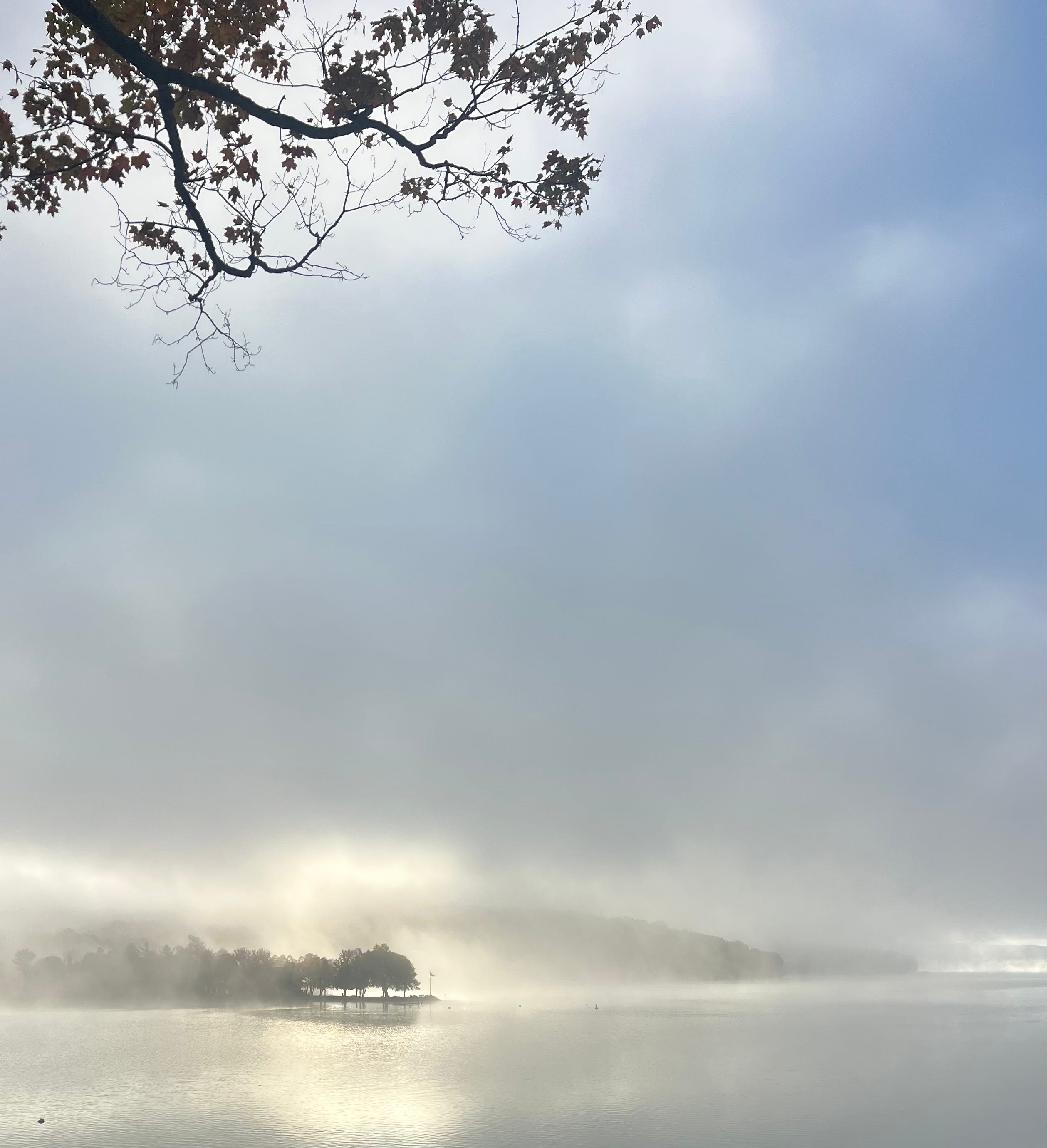
There’s a certain kind of October morning on the lake when the line between the real and the surreal is fragile, when the mystical and the ordinary share the horizon, when the shape-shifting landscape is so magical you’re up off the couch every other minute to rush outside for yet another photo.
We’ve had three of these extraordinary mornings of late. The world beyond the window is covered in thick fog, the existence of sun and water a matter of faith. The air is still, windless, but somehow the fog suddenly thins to a mist. A dreamy flotilla of ducks has been there all along. Minutes later part of the sky over part of the lake clears completely and blue sky appears. But then you look up from your breakfast and the wall of fog has returned. And so it went on through the morning, as if a theater scrim was lifting to reveal another, more intricate backdrop, and behind that, a curtain and another stage set waited to be revealed. It was Brigadoon, it was Middle Earth, it was a liminal space where Druids and high priestesses might suddenly emerge from the mist.
My brother-in-law had other words for it: “Warm water, cool air. Condensation,” Alas, his equation was right. The unearthly scene was merely heat leaving the lake.
There goes summer, I thought. There goes my last chance to do all the things I had planned to do, the bike ride, the long hike, the stack of summer books to read, the scavenger hunt I didn’t organize, the trip to the Upper Peninsula, even just an hour in the hammock—
The ephemera of it depressed me. The stunning view was, after all, summer’s last exhale, a gossamer beauty evaporating silently, swiftly, gone before I could breathe it back in.
*
Memento mori #3
E.B. White, author of Charlotte’s Web fame and to my mind our greatest American prose stylist, published an essay in 1941 called “Once More to the Lake.” It’s a beautiful meditation on aging that I did not appreciate when it was assigned in school. In fact, I so little appreciated it that I did not even read it. I can see now that I was too young to understand it anyway.
In the essay, White recounts a time he took his young son to the very same lake in Maine where he vacationed every August as a boy. I mention the publication date because in 1941 the world was at war, and the United States very soon to join. Mortality must have been on everyone’s mind, and for White too, I assume. For all the nostalgia in the essay, death has a strong presence.
From the start White confuses his son with himself as they cycle through the same activities White enjoyed at the camp as a boy:
I began to sustain the illusion that he was I, and therefore, by simple transposition, that I was my father. This sensation persisted, kept cropping up all the time we were there. It was not an entirely new feeling, but in this setting it grew much stronger. I seemed to be living a dual existence. I would be in the middle of some simple act, I would be picking up a bait box or laying down a table fork, or I would be saying something, and suddenly it would be not I but my father who was saying the words or making the gesture.
The last paragraph is justly famous. After a thunderstorm forces all the swimmers from the lake, people return to swim in the rain, just as White had once done:
When the others went swimming my son said he was going in too. He pulled his dripping trunks from the line where they had hung all through the shower, and wrung them out. Languidly, and with no thought of going in, I watched him, his hard little body, skinny and bare, saw him wince slightly as he pulled up around his vitals the small, soggy, icy garment. As he buckled the swollen belt suddenly my groin felt the chill of death.
I too have experienced the chill of death, just a few weeks ago in fact, but my experience came not from identifying with my offspring, as White did, but from feeling separate from them.
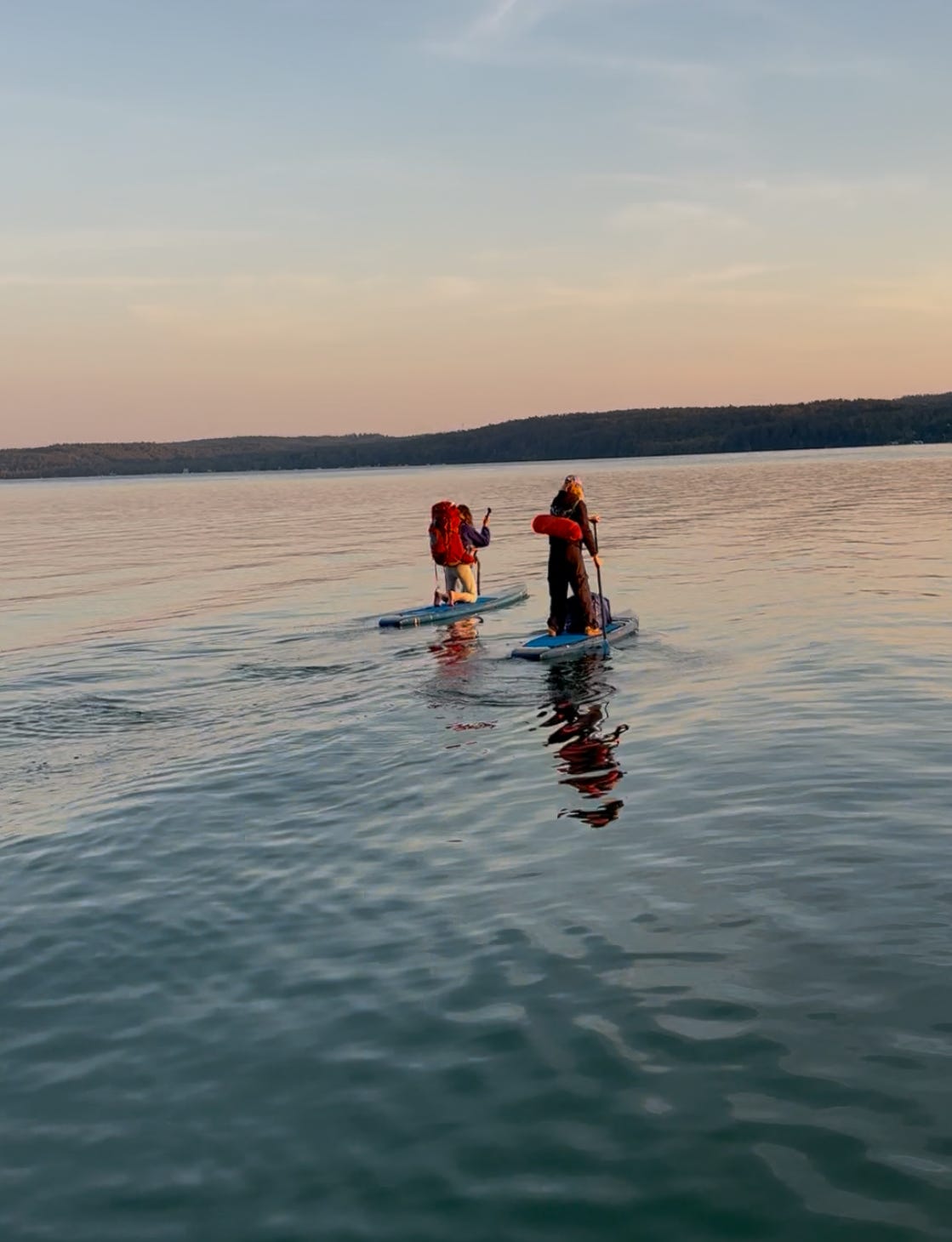
Mid-September two of my daughters decided to go camping across the lake. It was already getting dark when they packed up their sleeping bags, tent, kettle, and breakfast of coffee, clementines and scones. They tied their bulky backpacks to the stretched-out cords of their boards and paddled nearly a mile to some woods to spend the night. I observed their wobbly, slow progress from the dock, waving and calling out instructions. Hold on to your packs! Watch out for bears! Put your fire out completely! I wasn’t actually worried. I was glad they were having an adventure. It wasn’t an adventure I wanted for myself, and, after all the bustle of rushing them off before it was too dark, I welcomed the quiet.
But in the dimming light, standing alone on the dock, shivering a little in the cool evening air, I saw myself in the future as an old woman listening to younger people tell me about their adventures, how I might smile at their stories, how I’d enjoy their energy and laughter, how I’d wish they would stay just a little longer.
*
Memento mori #4
To you autumn lovers, to you lovers of football and cider and mellow fruitfulness, you lovers of sweaters and nippy air, of all things crisp, of burnt colors, of de-greening and de-leafing, of gourds and soup and root vegetables: forgive my Debbie Downer approach to your favorite season. I don’t want to take one iota of your pleasure away. It’s just how I’ve always experienced autumn, even as a young girl.
Autumn is probably not a memento mori to you. And to most people, dying flowers are not symbols of their own demise but something to be chopped down or dried out for table arrangements; colder temperatures mean hearth fires and wool scarves and have nothing to do with the gradual dwindling of life; sickles are homey harvest-time symbols, not Death’s favorite accessory.
But here’s the rub: once you start thinking about changing seasons, about how quickly time passes, everything becomes a reminder of your mortality. You don’t have to travel to ancient ruins to imagine the lives of people who came before and the people who will come after. The entire earth is a ruin. Stones and air and dirt and mountains and lakes—they belonged to other people once, people who laughed and cried and fell in love and got constipated and shivered in the cold and liked each other’s smell or hated each other’s smell, who sang in churches or around a fire, who watched sunrises over a lake in awe, who watched their children grow up to be just like them or very different from them.
Others will one day live in our dwelling places and walk the paths we once walked. Perhaps they will wonder about who came before them. That would be us, long gone. As Yeats wrote, “Under every dancer, a dead man in his grave.”
*
Nothing to see here, folks, move on
Years ago, after writing a few consecutive posts about death on my old blog Poem Elf, my college roommate emailed that she was worried about me. She needn’t have been. Death was just another topic I choose to write about. I was not in a dark place, I was observing one.
Nor am I in a dark place now. Even with this catalogue of memento moris. I’m not wallowing or drowning. I’m just . . . alive, I guess. A human thinking about what it is to be human.
It’s the same way I read novels: I skip to the end so I know what happens. Then I go back and read slowly, enjoying how the writer reaches the conclusion. I’d rather do that than read in rush just to find out what the conclusion is.
We know what the conclusion is. Perhaps a little memento mori now and then can help us enjoy the rest of our story.
*
If you enjoyed this issue of Restless Egg, please share it with someone else who might too! And if you haven’t subscribed—make my day and do it!
What you wrote about on the dock watching the girls paddle away instantly reminded me of my dad, coming on the porch, seeing me talking to my mom and then saying, don’t leave just as I get here! How does 15 years pass so quickly.
Aw - love reading this issue! As I read through this I am at home in Georgia - in pjs drinking red wine watching UofM v MSU. Thinking about my past wonderful falls in Michigan. The most fun Halloween celebrations - my kids would tell me what Mrs Lane did to scare them!!! Just saw a Facebook post from Nottingham neighbors who are in florida watching the game. All these memories of life, past and present. Beautiful fall - one of my favorite seasons - sweaters, fires, friends, football, cooking and snuggling in. Just spoke with my fiance's daughter, now living in Chicago and experiencing her first fall living in THE NORTH! 39 degrees this morning! Love this pic of your girls headed to their overnight adventure by paddle board. What a wonderful life we are living........