
Issue #4

The Irreplaceables
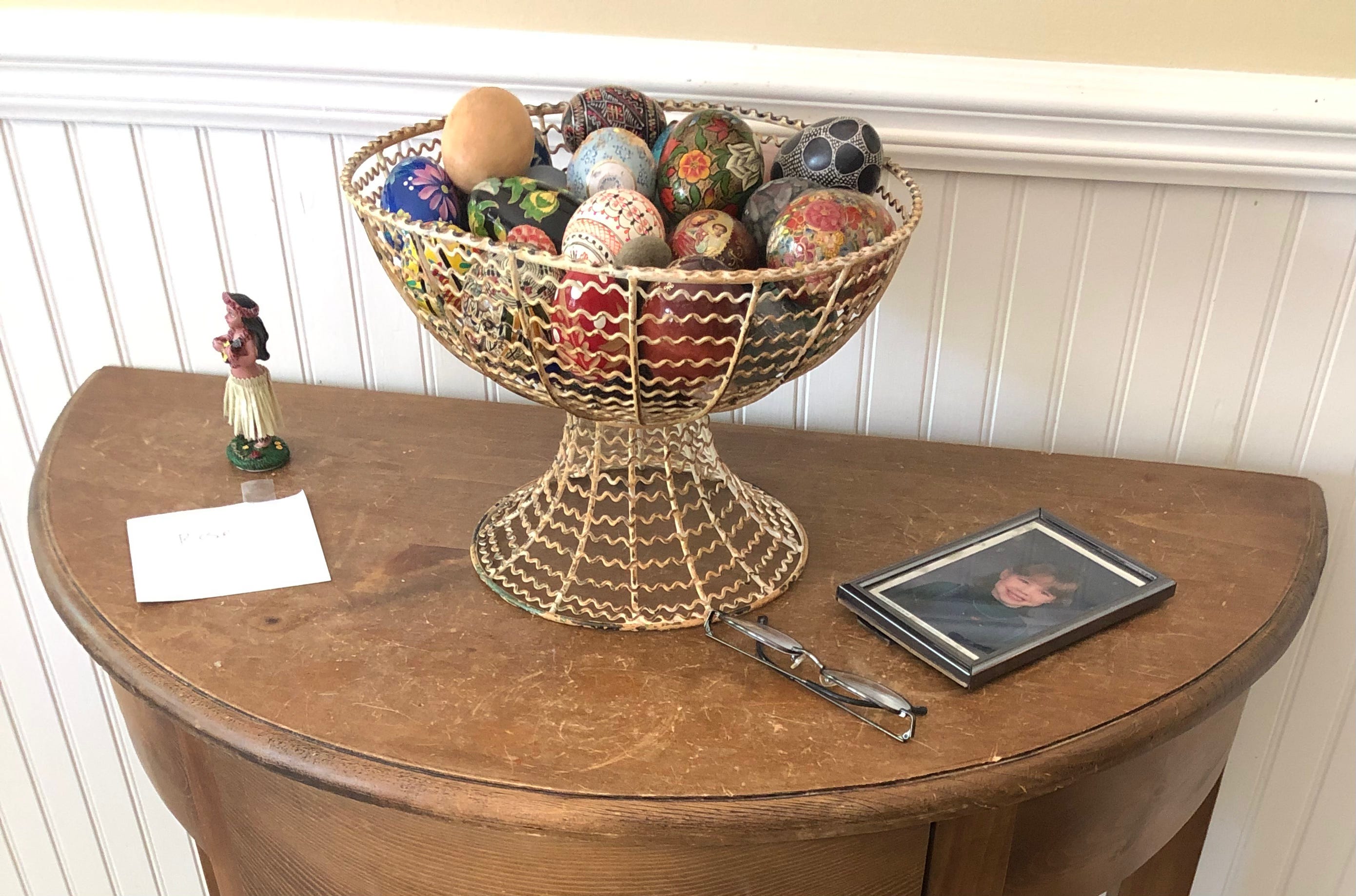
“I’m married to my home and inanimate objects,” my friend Helaine once told me. She was 97 at the time and dead serious.
I laughed, I couldn’t help it, the way she said it so solemnly. She laughed too, once she realized how droll she sounded; but her amusement was a brief respite from a deep sadness. She was a longtime widow stuck in a nursing home after a fall and desperate to move back to her home. (Reader, she made it. She is now 98 and living happily amongst her beloved inanimate objects.)
At the time Helaine told me she was married to her home, I was divorced from mine. Unlike Helaine, when my husband and I downsized into an apartment, we had zero regrets other than leaving behind dear friends from the neighborhood. Even shedding two-thirds of our furniture and decorative items was unexpectedly easy, especially because we were giving away things we loved to people we loved. Any pangs about unloading were met with a vigorous Toss it! and Good riddance! from my husband. Besides, the closer the moving date the more sentimentality gave way to indifference. As long as I could keep my piano and those books that meant the most to me, I would be fine.
A year after my conversation with Helaine, we moved again, out of the apartment and into an already fully-furnished home. Now the remaining 1/3 of my life’s possessions had to be whittled down by 3/4’s at least (you do the math, it’s beyond me). Once again I could bring my piano, but most of the books had to go.
I was able to keep a few things that held emotional power— various serving dishes, some of which were wedding gifts and others that belonged to my mother and grandmother; my decorative egg collection (no surprise I had one); two ceramic speckled hens my husband had given me; a bronze crab representing my beloved home state of Maryland; a wooden box for TV remotes with a labrador carved on top which reminded us of our dog Jane; a velvet necklace case filled with baby teeth from my four erstwhile toddlers, jumbled all together, undifferentiated; old journals, writing projects, and some handwritten letters from my parents; family pictures in boxes and albums; a framed poster that said, “I say let the world go to hell, I shall always have my tea.” Some of these things went into the attic, which is pretty much the same as saying goodbye forever.
If I felt sad (and I did feel sad), I told myself it was because I had loved living in an apartment in a small city near my friends. It was hard to move to a more isolated abode.
But mostly I was in a ruthless frenzy of giving away everything in the apartment down to the last spatula, texting my sisters, sisters-in-law, and daughters pictures to see who wanted what. I had a sense I was being liberated from material possessions that dragged me down, inanimate objects, as Helaine would say, that demanded to be dusted and displayed and eventually updated. Good riddance!
In the midst of this dispersing and disposing mania, one of my sisters-in-law texted me about which items she wanted and added, I’m sorry if I’m being insensitive to you breaking down your home and possessions you probably bought not thinking you would one day give away.
That came as a shock. It was like hearing, years after the fact, that you hurt someone you had no idea you had hurt. Except the person I hurt was myself.
Now, months later, when I visit friends whose homes are bursting with the shared life of the people who live in it, homes with photos on the fridge, tchotchkes on windowsills, display cabinets full of stacked china, and shelves double-layered with books, I don’t think—as I might have in the heady days my minimalist arrogance—Clutter!— or —Divest and set yourself free, people! I think instead of a conversation I once read in a novel, a conversation between two women in London discussing the possibility of moving their valuables out of harm’s way during the bombing raids of WWII. The words present themselves as a warning written just for me, as a testament to the life I gave away:
Mrs. Staples considered. ‘You mean specimen glass and china, and that sort of thing?’
‘Yes, the irreplaceables, the things you never use—those are what really matters. I’ve got a damask table-cloth, you know, and napkins to match for twenty-four people. I’ve heard it said that a woman’s possessions are a part of herself. If she loses her things, her personality undergoes a change.’
[from Human Voices by Penelope Fitzgerald]
It may well be.
It may well be loss, not liberation at all.
Or loss and liberation, both together to the end of my days.
*
Overheard
At the Metropolitan Museum of Art, a frail old woman stood in front of a brilliant red kimono patterned with fingered waves. “It would be very hard to be calm if you wore that,” she said to her daughter.
*
Soul lozenge
I keep notes on my phone the way some people keep lozenges in their pockets—I pull them out when my raspy soul needs soothing.
Here’s an old note from a Nov. 16, 2016 Fresh Air interview with writer Zadie Smith. In this segment Terry Gross is asking Smith about political divides:
Zadie Smith: I retain this idea that citizens, individual people, do not have one idea within them. I feel that they are pluralistic within them. The question of what ideas come to the fore or are suppressed at any one time in history depends a lot on who is gathering them, who is speaking to them, who is trying to provoke them, one way or the other…. I don’t believe that great swaths of the population are in some ways fundamentally stupid or evil or this that or other.
[Later, speaking specifically of her own family:]
We have large differences but anyone who has in-laws like this or extended family like this knows it is possible to speak across such divides. They are…not permanent walls. Our family relations let us know that all the time. It is possible to still love and respect people whose opinions differ from yours. It’s also possible to talk them round and to be talked round. So, not being a politician, not being somebody who has a general idea of people, I can only go from my intimate experiences, and my intimate experience is that there is some flexibility, if it’s allowed to flourish.
*
For soffpotatis* only
(*Swedish for couch potato)
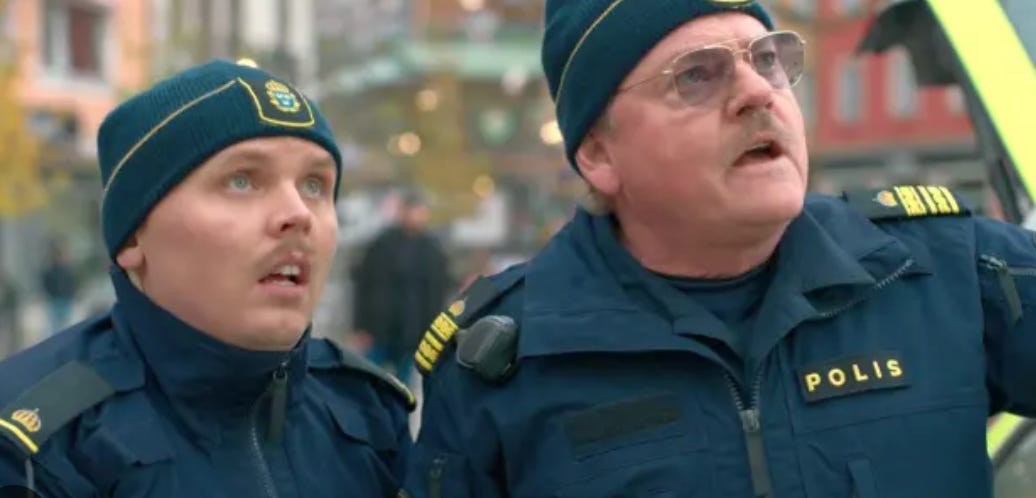
If you are looking for comfort TV and have had your fill of increasingly-ridiculous murder mysteries, try the Swedish series Anxious People on Netflix. It’s based on a book of the same name by Frederik Backman (who wrote A Man Called Ove).
After a grim opening scene, the show moves into a light dramedy about a robbery/hostage situation in which no money was taken and no hostage harmed. A bumbling father-son police team try to figure out what happened, and each episode focuses on a different suspect.
An ensemble cast of quirky characters and a beautiful ending with redemptions galore, forgiveness, romance, and a new baby —and you get to hear Swedish cadences and get a taste of Swedish humor—there is so much to love about this show. It is not premiere television by any means, but you will have some laughs, tears if you have a heart, and gladness in watching fundamentally decent people do their best.
The trailer makes it look more like a comedy than it is. That said, I was laughing out loud more than once.
*
Egg-stra, Egg-stra
· A conversation between Zadie Smith and Terry Gross is a match made in podcast heaven. Gross has interviewed her twice. (I’ve only listened to the 2016 interview so I can’t vouch for the 2023 one.)
· Human Voices (mentioned above) is one of my favorite Penelope Fitzgerald novels. Set in London during the early days of WWII, the novel follows BBC employees housed in a concert hall converted to a dormitory because of the threat of nightly bombings. It can be hard to follow at first, but once you get in the swing of the characters and their work titles and nicknames, it’s a funny, in-the-trenches picture of wartime life. How Fitzgerald pulls out poignant moments in the midst of the humor—or how she manages humor in the poignancy—is a feat. She herself worked at the BBC during this time, and she thrusts you right into that world, no prologue, no backstory. The dialogue is pitch-perfect, and her pacing, as always, is unapologetically brisk.
This was a great issue. I look forward to every issue.
My favorite is "Overheard..." laugh out loud funny! But I do love "Soul Lozenge" as well.