
Issue #3

. . . And your very flesh shall be a great poem. . .
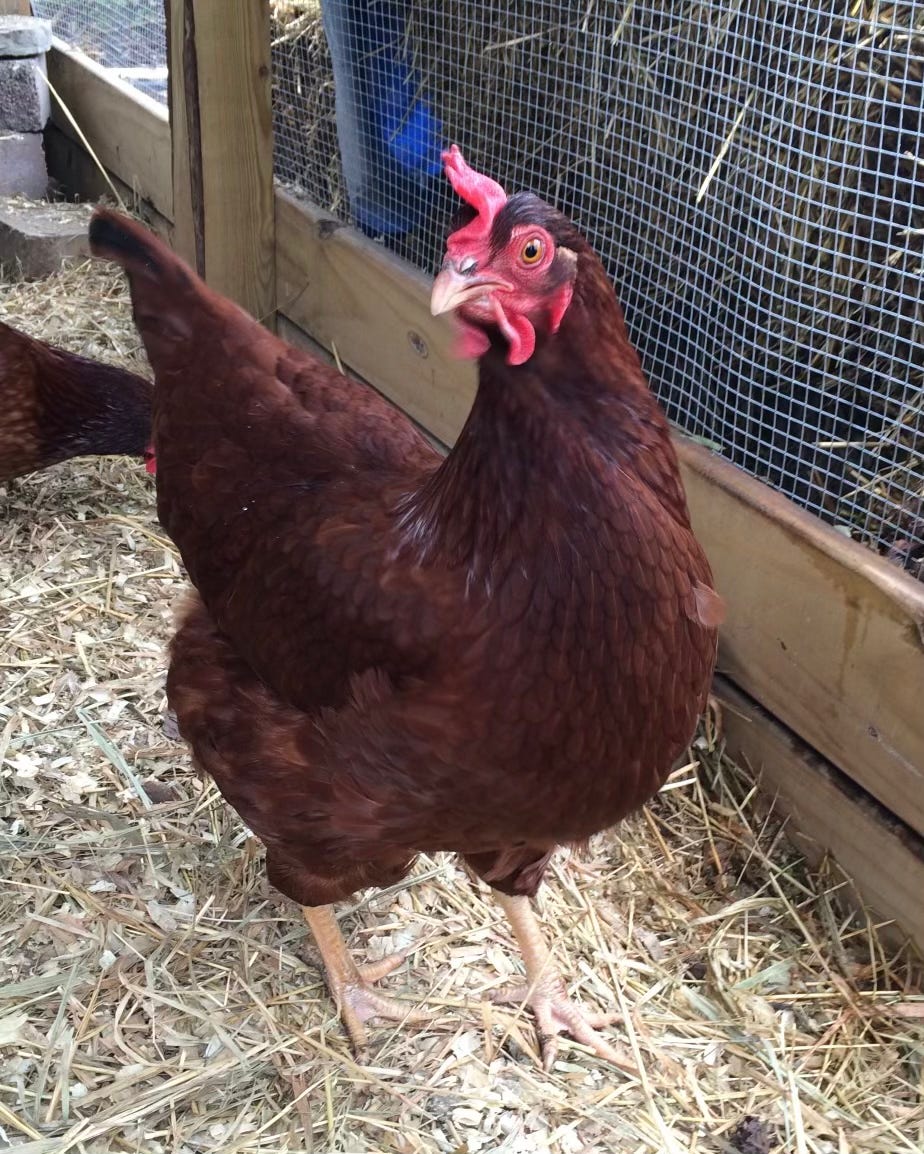
My neighbor once took me into her chicken coop and there we saw a scabby, bedraggled chicken cowering in the corner, its feathers half-gone. The other chickens had pecked it, and barring intervention, would peck it to a gory end. Some kind of weakness or disfigurement in the ailing chicken—maybe a spot of blood or exposed skin—had ignited the other hens’ instinct to attack and kill.
Chicken life is a grim business and let us be grateful we weren’t to the henhouse born.
Last summer I had Mohs surgery for a small basal-cell cancer on my face, just below my right nostril. After two passes and 33 stitches, the crumb-sized scab became a one-and-a-half inch scalene triangle outlined with black thread that extended from the top of my jowl to the outer corner of my upper lip. I cried when the surgeon handed me a mirror.
Feeling like a freak, a monster, I saw no one but family the first week. When I finally ventured out in public, I covered the area with white gauze and white tape. That was a mistake—it only made the target of my disguise three times as big. Then I tried a flesh-colored specialty scar bandage which was about as effective a camouflage as a cheap Halloween bald wig. Make-up was no better.
I decided to stop hiding and sally forth au naturel. At the grocery store I asked a young worker which apples were crispiest. He looked startled and then covered up his shock with a huge smile. He was clearly uneasy but wanted to be kind. He talked more than he needed to and then cut up an apple for me to sample.
I began to notice this phenomenon everywhere I went. People were just so nice. Their kindness jolted me the same way mirrors used to jolt the flattering version of my appearance I carried around in my head. I’d forget I had dark red bumpy ridges on my face until someone would smile extra wide, make a concerted effort at eye contact, and engage in friendly conversation. Children might stare, but most people wanted to carry on with grace and good manners, as if they hadn’t noticed.
“Oh, you can hardly see it!” my friends said. “Honestly!” I didn’t believe them, but I sure did believe in them. Good people, sweet lies.
As the scars fade, so does this phenomenon. But it’s left an imprint. A commonplace truth has become visceral to me. Unlike chickens, we humans are drawn together by our vulnerabilities. My vulnerability was plain for all to see, but any exposed vulnerability allows people to connect with us. The energy we put into hiding our imperfections can prevent others from showing their kindest sides.
Granted, if I had the same scars but I were sleeping on a heating grate, my hair matted and clothes filthy, I wouldn’t see one-tenth of this kindness. Mostly I would be invisible. That’s something for all of us to work on.
But for now, I celebrate the goodness of others. I have never depended on the kindness of strangers, but oh, do I ever delight in it.
*
. . . I sing the body electric. . .
One of my dad’s many projects late in life was a series of poems that celebrated the body. The human body was a wonder to him, complex and beautiful in its workings. “It’s fantastic,” he would say, “unbelievable!” He wanted to describe in great detail the organs and systems of the body, using scientific terms, to create modern psalms. (The only such psalm he completed was about the eye, which was both fitting and sad. He was a compulsive reader who eventually lost the ability to read because of macular degeneration.)
I recently listened to a podcast about lower back pain and was reminded of his admiration. Here’s the relevant excerpt from Dr. Attia’s The Drive interview with Stuart McGill:
Dr. Attia: The stability, the flexibility, the mobility, the amount of nerves, muscles and ligaments that are involved—you could almost argue it's a miracle we don't get more injured, even though the frequency with which we do is intense. Take us through the anatomy.
Stuart McGill: I would almost argue the opposite, Peter. There was a television show that they were producing and asking various experts around the world, if you got to re-engineer your particular area, me being the spine guy, and they had a cardiac person, endocrine system person, how would you re-engineer it and make it better? And every expert said they couldn't. It was perfect.
Set aside your own degeneration, macular or otherwise, and consider that even as you read this sentence, your perfectly-designed human body continues its silent, diligent work, unaided by your will or thoughts or actions.
*
. . . The powerful play goes on, and you may contribute a verse. . .
The other morning a Miller Williams’ poem popped in my head, and I want to share it. “A Note to the Alien on Earth” is not Williams’ finest poem—maybe it’s not even an especially good poem—but I’m fond of it just the same. It’s like a picture of your mother you look at when you have need of her old wisdom and humor.
A Note to the Alien on Earth
by Miller Williams

Here, in the interest of time, some words to work with,
assuming you’re pretending to be a man
or woman and understand English.  If this should find you,
know that I’m glad to help any way I can.

A letter beginning “Dear Friend” is not from a friend.
A “free gift” is redundant and not free.
A teenager is sex with skin around it.
The one word used as much as “I” is “me.”

People who are politically correct
which means never offending by what they say,
will lie about other things, too.  Be careful with them.
And people insulting groups of people may

look in the mirror too much or not enough.
What you say is not what anyone hears.
Be wary of one who is always or never sad.
And try to be patient with us.  It looks bad,
but we’ve only had a few hundred thousand years.
The lines that came to me, unbidden, and drove me to look up the poem, were a memory-impaired version of these:
And people insulting groups of people may
look in the mirror too much or not enough.
*
. . . As to me I know of nothing else but miracles. . .
Speaking of aliens on earth, I do believe I saw one at the local farmer’s market here in Kilauea.
Ahead of me at a produce booth, a little girl, maybe 4 or 5, barefoot, begged her dad for green beans. She picked out the biggest bunch from the table and then asked if she could have one. She ate it raw, munching on it the way other kids her age would eat a fruit roll-up. This alone was as far from my experience of child-raising as could be imagined.
Then her dad said, “Eat your fruit pop first, it’s going to melt.” He put the frozen fruit pop in her hand. She continued to eat the green bean, even as he gently nagged her to eat the sweet. The popsicle melted on down her little fist.
How could I not smile at such a scene? How could I not marvel at the home life that produced such a child? How could I not think, There are more things on heaven and earth, Horatio, than are dreamt of in your philosophy?
*
And lastly. . . A glimpse through an interstice caught. . .
· Poet Miller Williams’ daughter is the singer-songwriter Lucinda Williams, the best singer-songwriter, in my opinion, of our time. (“Are You Alright” was my pandemic go-to; “Sweet Old World” and “Am I Too Blue” are my feel-better-by-feeling-sad songs.) Father and daughter collaborated on a beautiful version of Millers’ poem “Compassion.” It hits me down where the spirit meets the bone, as the song says.
· If you want to explore more Miller Williams, I’ve featured him several times over the years on my blog Poem Elf. His voice is easygoing, unassuming, and quintessentially American in the very best way.
· For those who live with back pain or the fear of a back blowout, Dr. Attia’s 2 ½ hour discussion with Stuart McGill will be fascinating. (If you want to listen to the podcast it’s the January 28th episode of “The Drive” on Apple.)
All subtitles are lines from Walt Whitman poems.
Thanks, Trish...sorry to hear about the root canals--nothing worse in my book!
It's humbling to "go out anyway" but in a weird way good for everyone around you. Thanks for reading and commenting!