
Issue #34
Going, going, gone

This Bye’s For You
An article in the paper today made me roll my eyes so hard they almost jumped warp speed into another galaxy. Which is about how far I wanted to get away from the people described in the article. Certain mothers, it seems, are spending between five and ten thousand dollars to decorate their beloved offsprings’ college dorm rooms. The “cozy” and “homey” living quarters will allow said beloved offspring to “flourish” and to not feel homesick. The comment section was full of “back in my day” type anecdotes, descriptions of decorations from simpler times (beer can pyramids, stolen highway signs, milk crates and kitten posters), and various expressions of regurgitation, “barf” and “vomit” being most prominent. Once you see these gussied-up dorm rooms as baby nurseries for 18-year-olds, it’s hard not to feel nauseated—and to think of these mothers as would-be Mama Roses elbowing their way to Baby June’s sorority stardom.
But looking at these mothers more charitably, I can sense a motivating factor beyond their stated goals and the obvious underlying ones. Maybe there is something tender and raw at the base of this lunacy. Maybe it’s just really hard for them to let go.
It’s been years since I had college farewells, and the memory of that particular heartache, in light of worse heartaches that followed, seems quaint now, almost cute, like thinking of a long-ago toddler grieving a melted snowman. But at the time, it was neither cute nor quaint, and the days following college move-in day felt hollow. The pain was sharp-edged.
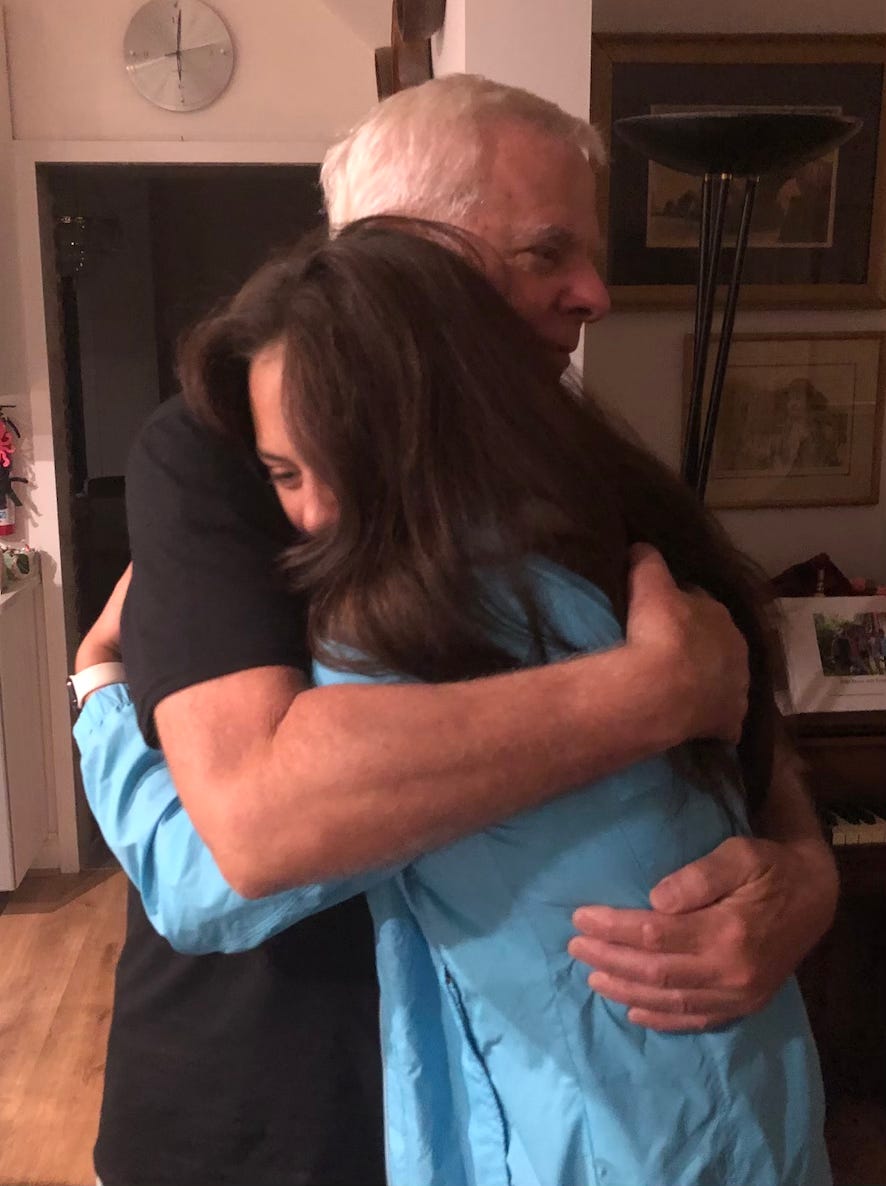
All those old feelings were brought back yesterday by a picture shared on a family text thread. It’s a picture of my niece on her way to her freshman year of college saying goodbye to my brother. I can’t stop tearing up when I look at it.
Over the many years I published my old blog Poem Elf, I would process my sad kid-going-off-to-college feelings by writing about them. I’ve recycled and upcycled some of those old posts, heavily edited and mish-mashed together, for today’s Restless Egg. (For context, every Poem Elf post featured my musings on a poem I had placed in a public space for strangers to encounter. To give you an idea of how old these posts are, I had to go back and remove the double-spaces after periods.)
And so, dear families saying goodbye, taking pictures, embracing, driving home in emptied-out cars—this issue is for you. I realize each of these mini-excerpts ends on a downbeat. Take heart in the fact that they are mere glimpses of a moment, and that none of it seems sad to me today. For you it will be the same.
I’ll include the accompanying poems at the end of this issue.
*
Goodbye, Little Boy
[When my third child went off to college, I featured Maria Mazziotta Gillian’s poem “After the Children Leave Home” on my blog, and I left a copy of the poem on the shelves of the now-defunct Bed, Bath & Beyond. In the poem, Gillian writes of how she and her husband “almost grow accustomed to the noise/of absence, that terrible stillness/that slides along carpeted surfaces.” At the end of the poem, she describes this new stage of life with her husband as a “grave dance.”]
This time of year scores of parents across the nation sit on neatly-made beds in empty bedrooms, wishing, for the first time, that the covers and sheets were heaped in the usual jumble. A few may plan new uses for the rooms, but most gaze at left-behind posters and framed photographs, thumb through yearbooks, and examine ticket stubs tacked on bulletin boards, just to feel for a moment the presence of the child who grew up too fast.
I have many friends sending children off to college this fall. For some it’s the first time, and I feel tender towards those weepy mothers, having gone through that a few years back. I wish I could say something other than, “It’s not as bad as you think”—a comment at least one woman I know would call a bald-faced lie. Other friends have just sent their last child off to college. I don’t have any comfort to offer them, and not even much curiosity. I don’t really want to know, just yet, what an empty nest is like.
Mazziotti Gillan’s “grave dance” is still three years away for me—my youngest is in high school—but the past few weeks I’ve been reluctantly learning the preliminary steps. The only boy in the family is gone, and dang we miss the noise, even the arguments, the bluster and bravado, the slammed doors, the blare of the car radio, the thumping bass from upstairs, the burst of boys in the house, ready to eat and slump on couches and tease each other.
In his late high school years my Joe would sometimes block me when I rushed around the kitchen. After a few seconds of trying to escape this way and that way around the island, I would give up whatever mission I was on so he could embrace me in a bear hug. I’d try to cut it short, but he would hold on tight and say, half-joking, “Settle down there, Mother. Someday this is all going to be gone and you’ll wish you had it back.”
Now I walk around the empty kitchen island and think how wise he was. What I was rushing for? To put the rice in the pot? To turn off the tea kettle? Answer the phone? Check my email?
When he was a little boy I used to sing to him at bedtime. His favorite of my nighttime repertoire was “Shenandoah.” The verse goes like this:
Oh, Shenandoah, I long to hear you,
Away, you rolling river
Oh, Shenandoah, just to be near you,
Away, I’m bound away, cross the wide Missouri.
Even though I’m a committed alto and my voice warbles in the upper ranges like an old lady’s, Joe would tell me that he really liked when I sang the high parts of the song. He was sweet that way, if a little tone deaf.
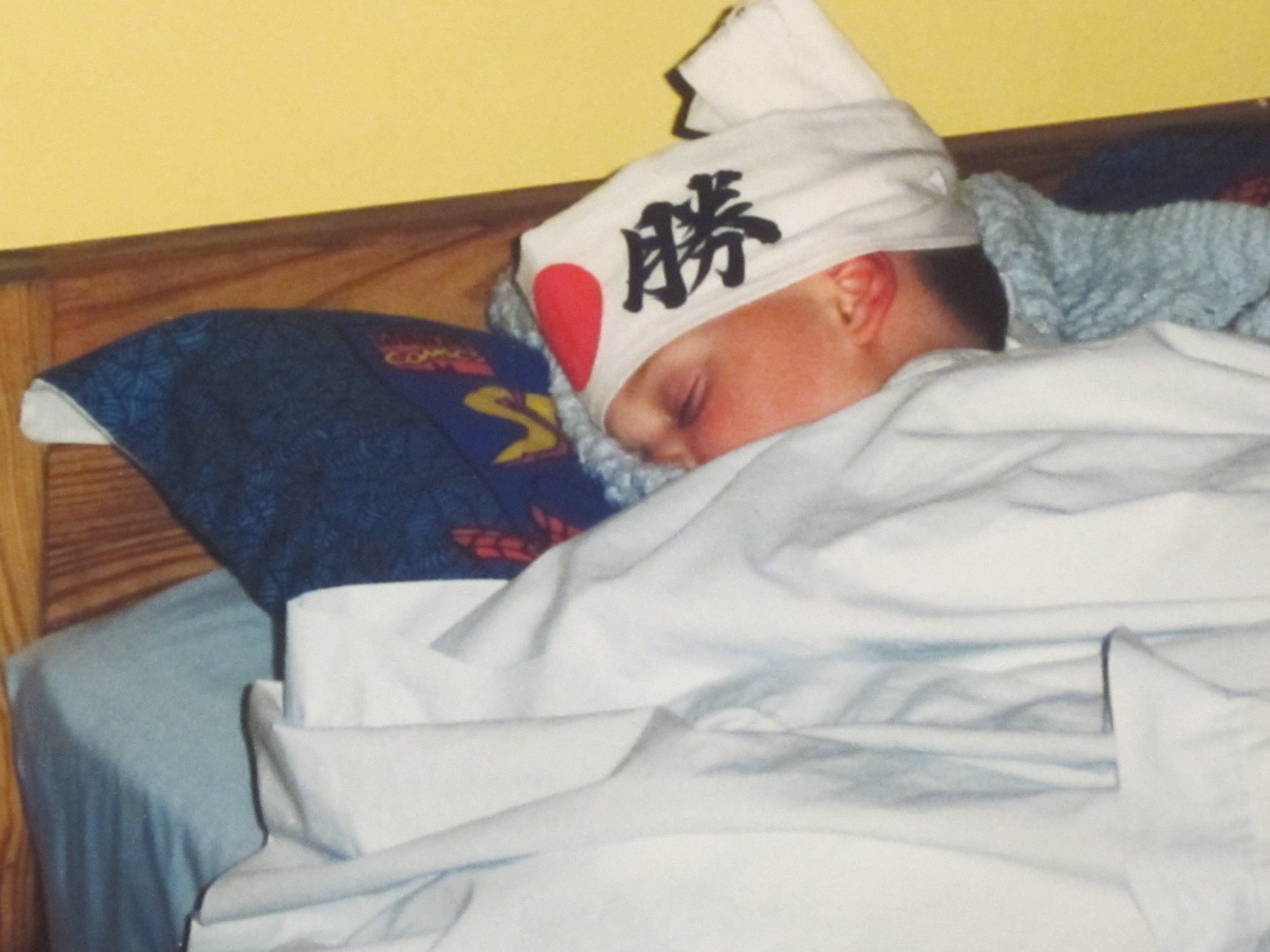
In his teen years, once in a great while he’d ask again for “that song.” I would stand just outside his bedroom door to sing because while I loved the fact that he wasn’t too old to want to hear a bedtime lullaby, his request embarrassed us both. Over time it became our little joke. But a joke is only funny with the two of us to share it. Alone now, I find it’s just a really sad song that I will probably never sing to him again.
*
Hatched
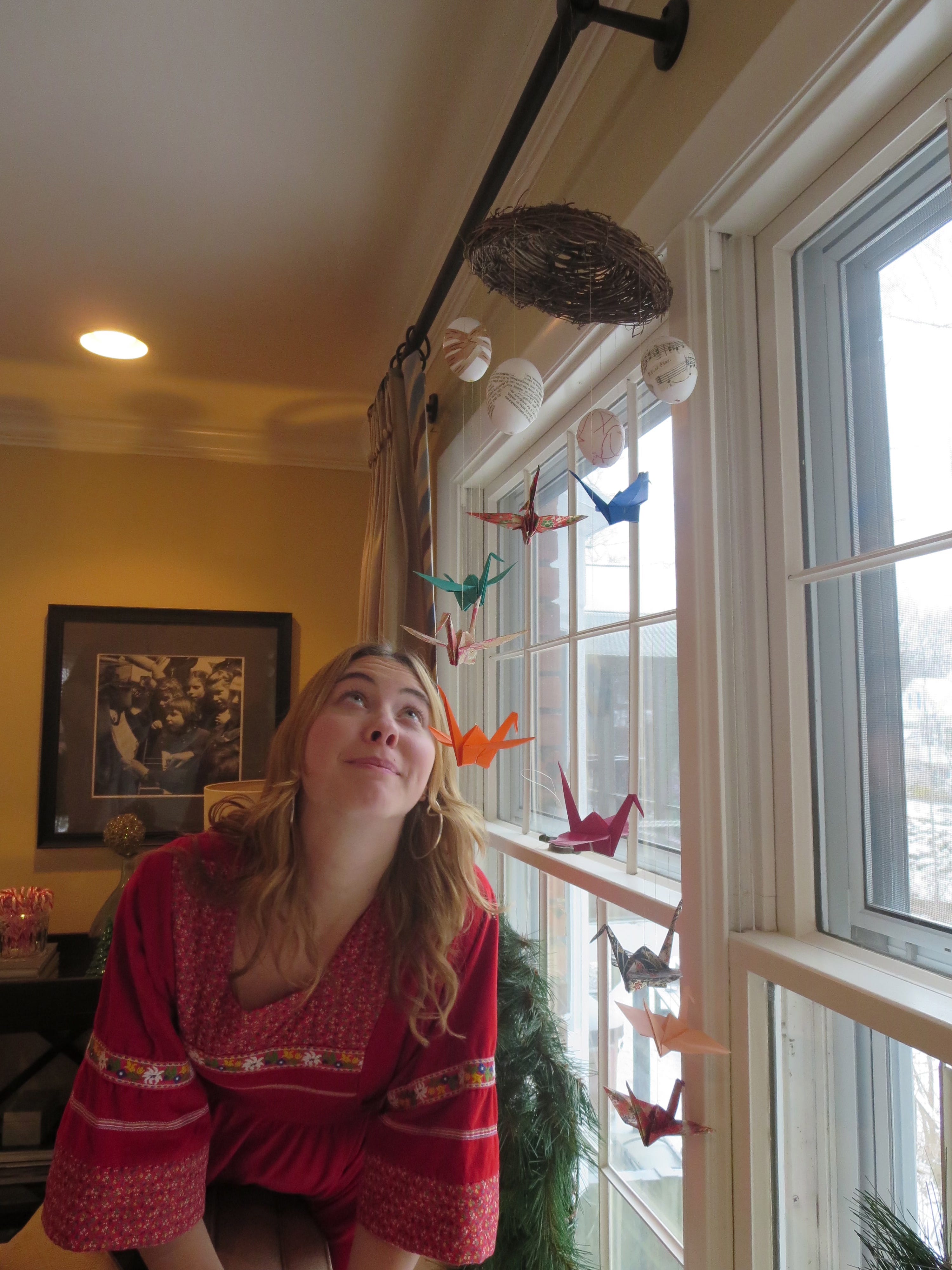
Last Christmas, one of my daughters made me a mobile with a nest, eggs and origami birds. Out of an overturned nest fell four eggs and out of the eggs fell a flurry of birds. I didn’t get the symbolism at first, but with a little help I understood that the mobile represented my empty nest come next fall when the last of my four would leave for college. There was a poetry to it. The birds were ready to fly off on their own paths; the eggs represented possibility, my new life waiting to begin. All part of the beautiful cycle of life.
Now the egg-hatching day is here, and it seems less a poetic cycle than a prosaic ending. The end of my mothering.
Certain people, those who like to fix more than listen, tell me I should be glad that my daughter is right where she should be at this time in her life. Yeah, yeah, yeah, I know. With her new bedding and roommate and independence, Anne Marie is as happy as I could have hoped. And, yes, I’ll sleep better on weekends, cook less on weekdays, keep a cleaner house, keep all my socks to myself, and finally have time to organize my digital and analog photo collection. After 25 years of organizing my days around kids, I’m free to organize my days around picture albums.
Bah. Right now I’d take four little kids pulling me in four different directions over freedom and organization. A drawer full of matched socks can be depressing. Uninterrupted sleep can be dull. An orderly house can be a sad house. An orderly house means a house without Anne Marie’s worn Birkenstocks and enormous backpack, a house without her dancing and deep sleeping, her jars of Nutella, her unmade bed, her unexpected wisdom, her little kindnesses, the nearness and dearness of her—
[At this point in the post I turned to the Jane Kenyon poem “Briefly It Enters, and Briefly Speaks” which I had left on a bench across the street from my daughter’s new dorm on move-in day. It’s a beautiful poem, one of my all-time favorites. Kenyon speaks of an unconditional love at work unseen in our lives. A few sample verses to give you an idea:
I am water rushing to the wellhead,
filling the pitcher until it spills. . . .

I am the patient gardener
of the dry and weedy garden. . . .

I am the stone step,
the latch, and the working hinge. . .   ]
I left the poem as a kind of protection, a talisman, a reminder of the love that will always be hers. But there’s another reason I chose this poem. Telling other people what to do is one of the aspects of mothering that’s hard for me to give up, and so after I reminded my daughter to take her thyroid medication and go to every class and eat vegetables and wear her glasses and go to Mass, I left the poem behind as my final instruction. To her and to all incoming freshman and returning upperclassmen, I say: Look out for each other, dear children. Be the patient gardener, the working hinge, the basket of fruit. Because college can be a lonely place sometimes. And for some kids, it’s lonely every day, every hour, every second. Suffering so often hides in plain sight.
*
Unfinished Business
What changes a year brings. Last year when I dropped my youngest off for her freshman year of college, I unpacked the car all the while packing in as much advice as I could. Eat healthy. Join clubs. Keep your room clean. Blah Blah blah. This year on drop-off day I almost forgot to tell her anything at all until I heard her roommate’s father tell his daughter to study hard. Oh yeah, that.
When I finally got around to it, my advice was much less inspiring:
Don’t spend all your money on coffees.
Get a job.
Don’t be the drunkest girl at the party.
What can I say, she’s got good sense, this one. Or maybe I’ve learned something.
Maybe I’ve learned that even if I could open up my children’s heads and pour in my life experience and wisdom like cake batter, they’d still have to figure things out themselves. They have to learn—or not learn—from their own mistakes.
I say maybe I’ve learned because the urge to throw advice at my kids and hope it sticks never goes away, and sometimes (often times, if I’m truthful) so overwhelming I give in.
This is why I love Grace Paley’s poem “For My Daughter.” The speaker wants to tell her daughter so many things. She wants to tell these things right now, before she dies or loses her mind. She wants to correct, praise, encourage. Control.
But she keeps her mouth shut.
The un-acted upon urge animates the poem. “But I didn’t” is the unspoken coda. The poem reminds me that however much I want to shelter my kids from hardship and steer them towards happiness, in the end I can’t. By the time college comes, the bulk of a parent’s work is done, and that is part of our grief.
In the old Mother’s Almanac by the wonderful and eminently wise Maguerite Kelly, there’s a paragraph on sending your kids off to kindergarten that I’ve never forgotten. You will cry, Kelly says, not because you’ll miss all the good times you had together; you will cry for all the things you didn’t do, all the experiences you didn’t get around to having, all the lessons you didn’t get to teach.
So it was then, so it is now. So it will always be.
*
If you enjoyed this issue of Restless Egg, share it with someone else who will too! I love to get new subscribers.
*
Poems
After the Children Leave Home
by Maria Mazziotti Gillan


Slowly, we settle into the quiet house.
We almost grow accustomed to the noise
of absence, that terrible stillness
that slides along carpeted surfaces.
“The house is so quiet without them,”
you say, your voice husky with loss.

For years, we have adjusted ourselves
to their schedules, the nights of fever
and coughing, the days of car pools
and tinker toys, PTA meetings
and homework, our time together
torn by their needs.

Now facing each other across this empty
landscape, we are vulnerable
as creatures suddenly bereft of skin.
somewhere along the way, caught in our busyness,
we lost the habit of speech,
the pathways leading to the secrets
of the heart.  So we begin
slowly our grave dance, moving
through the Braille of touch
into that textured country
where words are unnecessary.
Our bodies give warmth and comfort
as we struggle to reinvent the language
through which we name ourselves.
*
Briefly It Enters, and Briefly Speaks
by Jane Kenyon

I am the blossom pressed in a book,
found again after two hundred years. . . .

I am the maker, the lover, and the keeper....

When the young girl who starves
sits down to a table
she will sit beside me. . . .

I am food on the prisoner's plate. . . .

I am water rushing to the wellhead,
filling the pitcher until it spills. . . .

I am the patient gardener
of the dry and weedy garden. . . .

I am the stone step,
the latch, and the working hinge. . . .

I am the heart contracted by joy. . . .
the longest hair, white
before the rest. . . .

I am there in the basket of fruit
presented to the widow. . . .

I am the musk rose opening
unattended, the fern on the boggy summit. . . .

I am the one whose love
overcomes you, already with you
when you think to call my name. . . .
*
For My Daughter
by Grace Paley

I wanted to bring her a chalice
or maybe a cup of love
or cool water      I wanted to sit
beside her as she rested
after the long day     I wanted to adjure
commend   admonish      saying don’t
do that   of course     wonderful   try
I wanted to help her grow old      I wanted
to say last words the words     famous
for final enlightenment      I wanted
to say them now     in case I am in
calm sleep when the last sleep strikes
or aged into disorder      I wanted to
bring her a cup of cool water

I wanted to explain     tiredness is
expected     it is even appropriate
at the end of the day
This one is so relatable, and the picture of little Joe is just precious!
Love this, Maggie! So happy to be a new subscriber to your articles!!