
Issue #29

Time to Shake the Grass
To scroll or not to scroll? I think about not scrolling. Of course I scroll. I feel exhausted from scrolling. Still, I scroll. I scroll on reels about the dangers of scrolling. I scroll on reels about how to stop scrolling. I scroll on and on.
Scroll scroll scroll.
There was a time I considered giving up scrolling altogether. But I kept right on scrolling. Then I thought I’d reduce my weekly screen time. I did, but—it was still too high, especially considering that just a few years ago my scroll time was zero. Now I am resigned. The more I scroll the more deadened to not scrolling I become. Scrolling is the fly-sized crack in the windshield that no one repairs. It grows slowly from dime-sized to penny to quarter-sized, eventually sprouting a crooked line that that creeps its way across the glass unchecked because the hassle of replacing the windshield seems more onerous than just living with its brokenness.
Life before scrolling gets harder to remember. How did I spend my time when I didn’t scroll? What did I do at traffic lights, in grocery lines, before sleep, in the middle of the night, on the toilet, when I wanted a break from writing, what did I do?
“By jingo,” says a booming, energetic voice, “snap out of it!”
It’s Frank Gilbreth, the principal character of Cheaper by the Dozen. (I am speaking of the book, a favorite of my youth, not the abomination that is the 2003 Steve Martin movie.) Gilbreth was a real-life person, a pioneer of industrial efficiency in the early twentieth century. Both in his professional career and in his home life as father of 12 children, Gilbreth bounded about trying to improve everyone’s lives. His projects and enthusiasms for saving time are the very antithesis of scroll culture. And now he’s giving me a swift kick in the patootie.
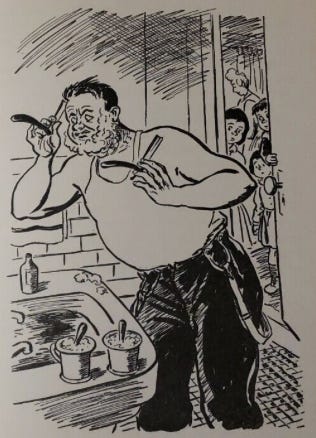
He tosses me the book his children wrote about him, and it falls open to the last page. My eyes land on the final paragraph, one I’ve read so many times that the passage has its very own pulpit in my brain, ready to preach when called upon.
“Someone once asked Dad: “But what do you want to save time for? What are you going to do with it?”
“For work, if you love that best,” said Dad. “For education, for beauty, for art, for pleasure.” He looked over the top of his pince-nez. “For mumblety-peg, if that's where your heart lies.”
His litany reads like a poem, so I’m making it one. I’ve taken out his words to be filled in with other life-before-scrolling words.
          But what do you want to save time for,

      what are you going to do with it?

For _______, if you love that best

for __________, for ________, for _______, for ________

for ____________ , if that’s where your heart lies.
(I think this “found poem” has the flavor of Ray Carver’s oft-quoted “Late Fragment”: And did you get what you wanted from this life, etc.)
Fellow slugs, let’s imagine de-slugging together. Send me your version of the fill-in-the-blank poem, if you’re pleased with it, in the comment section below.
I’ll close out this section with another poem. Ezra Pound wrote a cutting little lament about wasting time that I really ought to tape to the back of my iPhone:
And the days are not full enough
by Ezra Pound

And the days are not full enough
And the nights are not full enough
And life slips by like a field mouse
       Not shaking the grass
It’s a vision to make you shudder. Like George Bailey shouting on the bridge—Please, I want to live again! I want to live again. I want to live again. Please God, let me live again—I’m swearing to myself, I don’t want to be a field mouse! Please God, don’t let me be a mouse!
Tomorrow, then? A new schedule? Less zombie scrolling, more grass-shaking?
*
For Work, if you love that best:
My original idea for this issue was to find a poem to illustrate each of Gilbreth’s time-worthy pursuits—work, education, beauty, art, pleasure, mumblety-peg. But the collection was getting unwieldy, and I knew it would try the patience of all but the most fervent poetry-lovers, so I am only offering one, “To Be of Use” by Marge Piercy.
My friend Michele loves this poem, and there’s someone else I hope will too. This other friend is crazy about work and being useful but not so crazy about poems.
To Be of Use
by Marge Piercy

The people I love the best
jump into work head first
without dallying in the shallows
and swim off with sure strokes almost out of sight.
They seem to become natives of that element,
the black sleek heads of seals
bouncing like half-submerged balls.

I love people who harness themselves, an ox to a heavy cart,
who pull like water buffalo, with massive patience,
who strain in the mud and the muck to move things forward,
who do what has to be done, again and again.

I want to be with people who submerge
in the task, who go into the fields to harvest
and work in a row and pass the bags along,
who are not parlor generals and field deserters
but move in a common rhythm
when the food must come in or the fire be put out.

The work of the world is common as mud.
Botched, it smears the hands, crumbles to dust.
But the thing worth doing well done
has a shape that satisfies, clean and evident.
Greek amphoras for wine or oil,
Hopi vases that held corn, are put in museums
but you know they were made to be used.
The pitcher cries for water to carry
and a person for work that is real.
Those last lines!
*
Mother of the Dozen
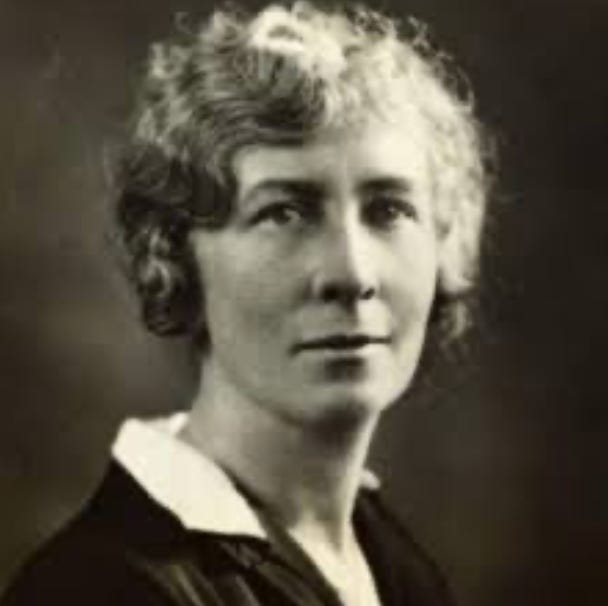
I can’t find my old orange copy of Cheaper by the Dozen but what I remember most from it is the father, an outsized figure who had some characteristics in common with my own dad.
The father dominates the book, but he died fairly young in the life of the family. It was Lillian who carried on, put everyone through college, and made a huge impact on industrial and home life in ways that we take for granted today.
Frank was the efficiency expert, focused on time and wasted motions. Lillian, with her psychology background, turned her attention to worker satisfaction and fatigue. According to a PBS very short documentary (worth watching!), Frank was interested in how to make workers work faster and she was interested in how to make workers happier. After WWI, when veterans returned to the workforce with missing limbs, she looked for ways to make work safe and comfortable for them. Her work with disabled workers paved the way for ergonomics.
What she accomplished even as she single-handedly raised 11 children (little Mary, who was the second of 12, died at age 5 of diphtheria), even as she was, after Frank’s death, the sole breadwinner, even as she faced discrimination, makes my jaw drop. She and Frank were co-partners in Gilbreth, Incorporated, their consulting firm, and she co-wrote their papers, but she was either not acknowledged or was listed with initials to conceal her gender. After Frank died, she turned her attention to domestic studies for a time because that was a more acceptable realm for women than business and manufacturing.
She invented the trashcan with a pedal foot, shelves on refrigerator doors, and wall light fixtures. She created the work-triangle still used today in kitchen design and designated the optimal height for counters and appliances.
(Not to sell Frank short: among other things, he invented adjustable scaffolding for bricklayers, patented a concrete mixer, and came up with the idea of a “caddy” to hand surgeons tools during surgery.)
I won’t list all her “firsts” and her honors, but here’s a few: she became the first female professor at Purdue School of Engineering, was put on a postage stamp in 1984 as part of the Great Americans series, and a painting of her hangs in the National Portrait Gallery.
She’s so freaking amazing I started to wonder why there hasn’t been a movie or television series made about her. Then I read about her ugly interest in “positive eugenics.” Perhaps that’s why. She doesn’t seem to have discussed eugenics in any place that I could find, and maybe it was an early interest she later lost interest in. It’s hard to know how deep her beliefs were. And how much they were just a product of her time.
Other than that, she seems to have been kind and positive and super-humanly capable and brilliant. At the end of her life she said her work with the disabled was the work she was most proud of.
The detail that brings her back to the human level is the fact that when she died she only had one picture in her wallet—that of her little daughter Mary whose loss she had never spoken of publicly.
*
Once More, With Feeling!
Ray Carver’s “Late Fragment” has been used so many times I’ve grown immune to its charms. But this recitation of his very short poem by Gabriel Byrne breathes fresh air into it.
*
If you enjoyed this issue of Restless Egg, please share with someone else who might enjoy it too! I love to get new subscribers.
I Loved the book Cheaper by the Dozen as a child and actually think of it often. Fun to know more about Lillian.
Great article, we all have ways to idle away our precious time. Showing my age here, but I don't scroll reels b/c I don't even know how to....and I resent any outside force telling me what to watch. And yes fond memories of Cheaper by the Dozen. I still remember the explanation of the most efficient way to bathe!