
Issue #27
Wedding Season

In Good Times and Bad
On the long drive to the train station we bicker on and off (mostly because I was rushing us so that I would have time to get a kombucha and Peppermint Patty for the train, although I didn’t say that at the time); and on the train we bicker a little more, but quietly, with looks more than words. (He is irritated by my rushed energy and his discovery of the reason for my rushing. I am irritated that I do not have a kombucha or a Peppermint Patty.) Halfway through the train trip a reminder pops up on my laptop screen: May 30, anniversary. Whoops.
I feel bad for bickering on a day we should be all goo-goo eyes, but I don’t feel that bad about forgetting because we always forget—only my mother consistently remembered our anniversary. She’s been gone nine years now and no one has taken her place to reliably say, Happy Anniversary!
We are traveling to Chicago to attend the wedding of the son of dear friends. There will be no time to celebrate the anniversary we forgot except for a brief discussion of exactly how many years we’ve been married (38). To put our nonchalance about our anniversary in the very best light, let me say that every year we forget about it because our years together feel seamless. Making a big deal out of every May 30th would be like a yearly celebration of our bicuspids growing in. We just are. We’ve been together since we were 17. We’ve had our share of sorrows and difficulties, but those are overshadowed by an easy, ordinary, day-to-day happiness of talking and laughing and bickering and not bickering.
*
Friday night at the wedding welcome party, I spy a tall slender woman with red hair and a beautiful Irish face talking to someone near me. I know her. Impulsive as usual, I interrupt her conversation. “Excuse me,” I say. Her name comes to me even as I’m speaking to her. “You’re Susan, Beth’s sister?”
*
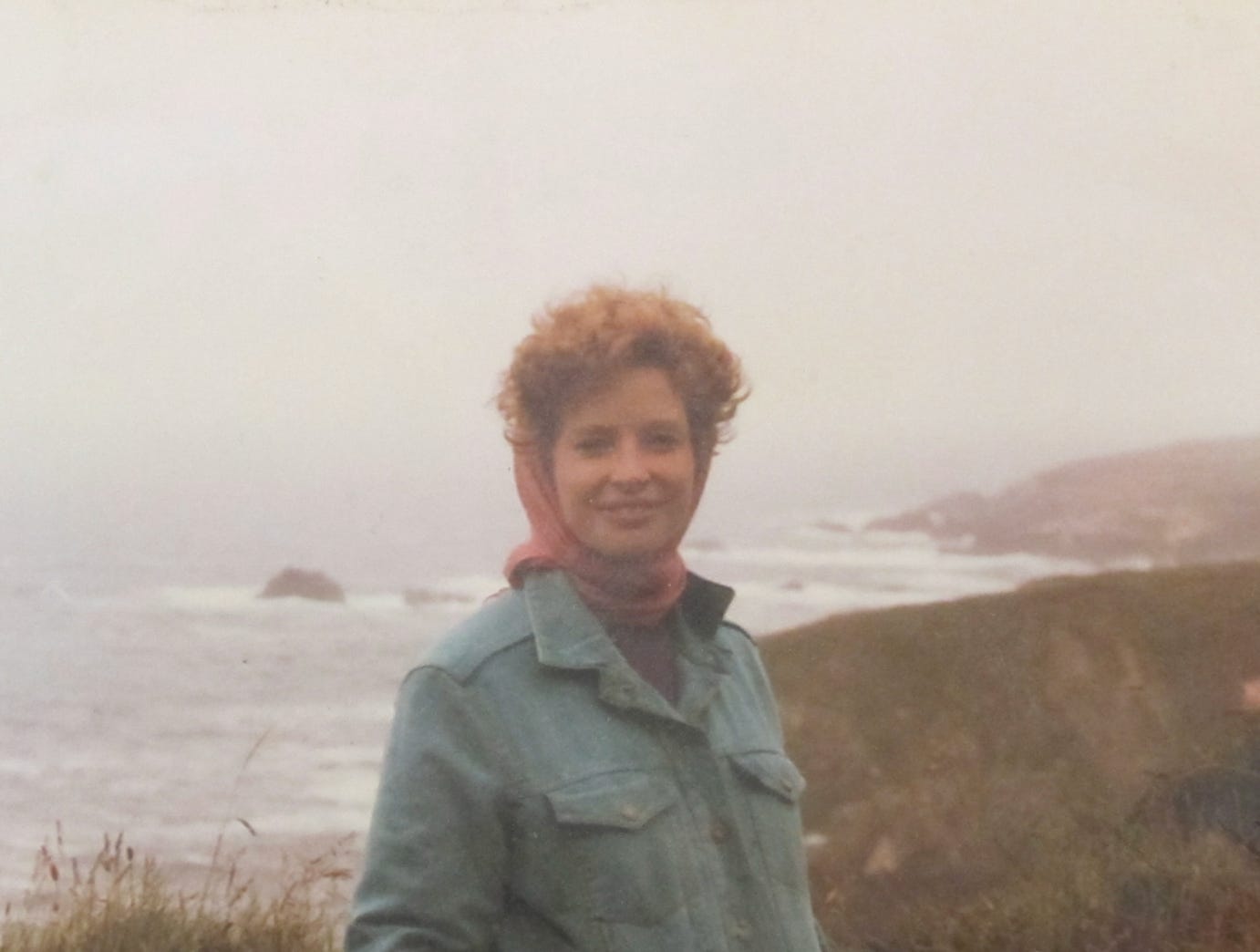
I met Beth when I first moved to Michigan from Maryland and she had just moved from Chicago. We introduced ourselves across a buffet line at a gardening lecture where we both were thinking, What the hell am I doing here? She was a little kooky, a little bohemian—as much as a person of Irish descent can be bohemian, as much as a mother living in the suburbs can be bohemian. With a self-taught expertise in yoga and tinctures and natural hygiene products, she was ahead of her time. She always had something interesting to share—poems by John O’Donohue, a CD of Sinead O’Connor, a funny story about an absurd interaction. She was a close talker. She’d lean towards you, tuck in her chin and sotto voce deliver a joke with vaudevillian zest. Then laugh with her customary exuberance. I’d never met anyone like her and I never would again.
She died when she was 43 years old, one week before 9/11. Her youngest was six or seven.
During Beth’s illness I got to know some of her family when they would come in from Chicago to help with her care. Susan I saw more than the others. After Beth died, a group of us made a kind of pilgrimage to the Chicago neighborhood where she grew up. We met her childhood friends, and then we had lunch at Susan’s apartment, just a few blocks from our hotel and the restaurant where Susan and I would re-connect, some 23 years later.
*
Susan, it turns out, is good friends with the bride’s mother. She remembers me or pretends to. We embrace. I am holding her tighter than she hugs me. A strong surge of something is working through me, a mix of joy at seeing someone I like who I wasn’t expecting to see and grief for Beth that hasn’t surfaced in many years. If we weren’t in a bar surrounded by happy people celebrating a happy event, I would have held Susan for a lot longer than is appropriate, holding her till tears came, because I have felt so little of late.
I ask Susan about Beth’s kids, Ciara, Aisling, Siobahn and Brian. All are doing well, partnered and reproducing. Clearly they make their aunt happy and proud. I’d love to re-hash stories of Beth, but I sense Susan would rather not.
Lying in bed after the party, I think about our encounter, what it signified. As we hugged I felt we were in the presence of a crowd, and I’m not talking about the bride and groom and their relatives and friends. Beth was there in that hug, and my younger self too, and the whole cast of characters I knew through her, Pat and Kathy and Gary and Linda, Marge, Maureen, Mary Pat, Diane, all the Irish folks who visited their house, all the people who loved Beth as I did, all people I have not seen in twenty years.
There was another presence I felt when I hugged Susan. I was hugging a woman who had lost her sister. That is to say, I was hugging myself.
*
We are staying at a small boutique hotel across from Lincoln Park. In the lobby the morning of the wedding I see the bride-to-be. She’s on her way to get hair and make-up done, but she takes a minute to chat. I tell her about the long-ago connection with her mom’s good friend Susan. That’s crazy, she says. As per usual, I get caught up in telling a story better relayed at a different moment. Here she is, on the happiest day of her life, at least thus far, surrounded by bags that need to be carried to the street, her head full of all the details of the upcoming day, and I decide to further explain that when I hugged Susan I got emotional because I was also thinking of my sister Josie, who died in December. I’m not trying to say, Woe is me—it’s just that I’m still surprised at my reaction and I think, foolishly perhaps, that it is worth sharing.
Melissa looks straight into my eyes and says, I didn’t know about your sister. She opens her arms and pulls me in for a hug.
It was the type of thing a mother or older aunt would do. There, there. There, there. I’m not used to being comforted by young women—I have long settled into the role of the comforter.
I am so moved by her warmth that I well up with tears. I beat them back with a smile. It’s going to be a wonderful day! Good luck!
*
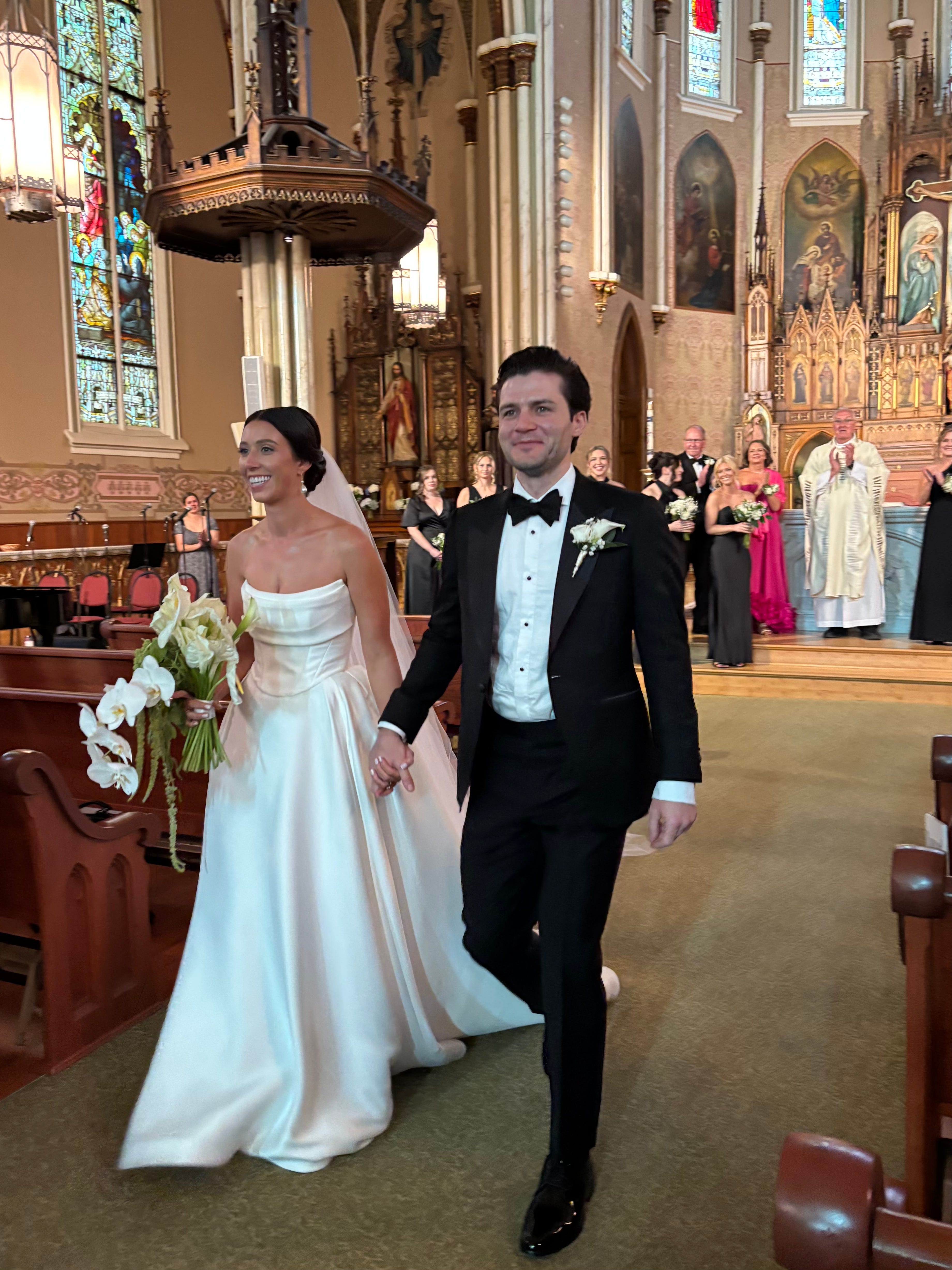
After the exchange of vows (traditional ones, the “in good times and bad, in sickness and in health” ones, which I love), the priest asks the couple to turn to face the congregation. “Remember this moment,” he says. He reminds them how fast their wedding day will go by. He gestures to all of us in the pews. “These are the people who will love and support you all your days.”
Colin and Melissa are beaming. Looking at them on the altar, young people so beautiful and kind-hearted and so in love, how could we not beam back?
*
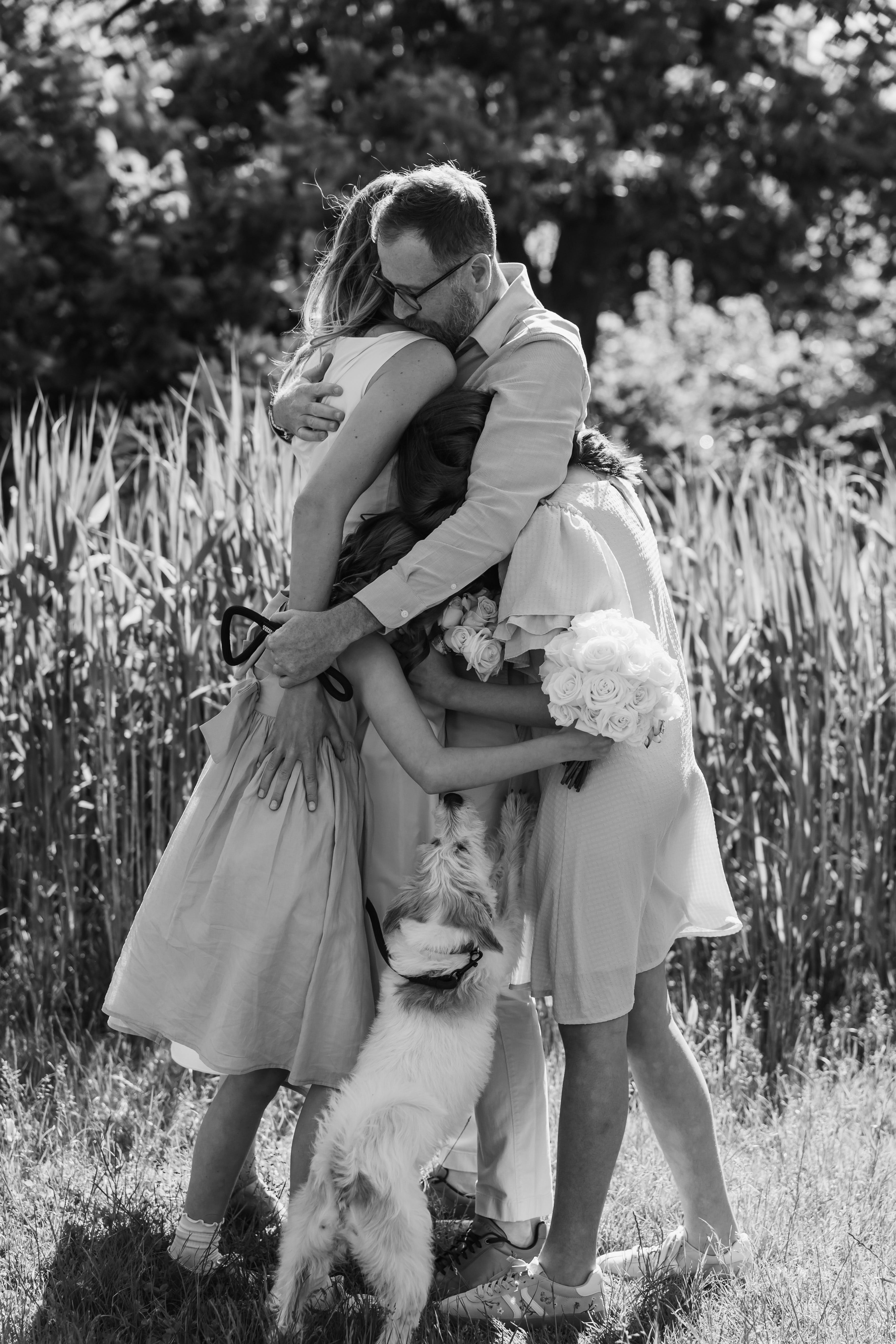
We wait in the lobby back at the hotel for our Uber to take us to the reception. A family of four suddenly whooshes through the revolving door like a cluster of spring blossoms carried in by the Chicago wind. The woman wears a jean jacket over a knee-length white linen dress, simple and elegant. She carries a small bouquet of yellow roses. The two little girls are also in dresses and jean jackets. They also carry small bouquets, but theirs are white roses edged with pink. Their hair has been curled, their nails painted the same color. The younger one wears silver sequined Mary Janes. The man is neatly dressed but casual. Everyone looks radiant.
“Kathryn!” I say. I know this woman, she’s a friend of my daughter’s. She introduces everyone and tells us that moments before, in the park across from the hotel, she and her fiancé got married. Her stepdaughters tell me the plan for the rest of the day: a drink on the rooftop, dinner at a special restaurant, a stay at a Navy Pier hotel.
Our Uber arrives. Out the revolving door we go. The coincidence of seeing them just after they got married and their obvious happiness are wedding favors we take with us to the next celebration.
*
Later that night I survey the crowd, just as Colin and Melissa did earlier in church. The dance floor is bouncing, full of young and old. The young people move really well in ways we older people can’t. I see Susan dancing, jumping really; my friends dance together, Brigette singing all the words, Amy with her air guitar, Mary with her little shimmies, my husband with his silly hand movements, John the groom’s father spinning his nieces, Renee the groom’s mother holding hands with her parents, getting them to shake it. Others I see sitting together, having cake and conversation.
It's a merry scene, full of merry faces. For a mere minute, a minute not so dark as it sounds, I dwell on what those faces have seen: every one of them some suffering of one kind or another, of some lesser degree or more, some perhaps bordering on agony. Many of the sorrows in the room I know, many more I do not. But here we all are, arms wide, laughing, celebrating. Sorrows will come as they will, but our hearts are made for joy.
*
Fruit and Shade
There’s a Rumi poem I love to share with newlyweds. I first shared it 14 years ago with my nephew and his wife for their wedding in Minnesota. As it happens, Beau and Gena have an anniversary coming up next week, and I’m certain they’ll do a better job celebrating than their aunt and uncle did.
I send this poem to them once again, with my congratulations and blessings, and to Colin and Melissa, and all the couples getting married this wedding season.
This Marriage – Ode 2667

by Rumi

May these vows and this marriage be blessed.
May it be sweet milk,
this marriage, like wine and halvah.
May this marriage offer fruit and shade
like the date palm.
May this marriage be full of laughter,
our every day a day in paradise.
May this marriage be a sign of compassion,
a seal of happiness here and hereafter.
May this marriage have a fair face and a good name,
an omen as welcome
as the moon in a clear blue sky.
I am out of words to describe
how spirit mingles in this marriage.
Fruit and shade is my favorite metaphor for a marriage. Growth and repose, joys and refuge.
I originally posted the poem on my blog Poem Elf. Here’s an excerpt of what I wrote after Beau and Gena’s outdoor wedding:
Right after the ceremony I had a lovely moment with my nephew. He was sitting alone on a bench while his new wife was occupied with bridesmaids and the photographer. “Come over,” he called to me. I was pleasantly surprised and flattered that he wanted my company but also touched in my auntily fashion at his demeanor. He looked stunned. Clearly he was still processing what just happened.
Of all the unforgettable moments of the day, the vision of him sitting on the whitewashed bench stands out. A man overwhelmed by love.
In our brief time before the photographer (who we later found out was an excellent dancer) called him away, we discussed how he had publicly declared the deepest, most intimate feelings a man could have, and the joy he felt in doing so. “I almost have a headache from feeling so much happiness,” he told me.
That’s exactly what happens at the end of this poem. After twelve lines rhapsodizing about the marriage, the poet is overwhelmed by love and is rendered speechless:
I am out of words to describe
how spirit mingles in this marriage
*
Mother Knows Best Addendum
Restless Egg Issue #23 featured advice from mothers of a certain generation. Here’s one that arrived too late to publish then. It’s from my friend Julie, and I love it.
My mother never allowed us to assume a bad intention from anyone regardless of how glaringly “obvious” it was. For example: “Someone didn’t say hi to me so she obviously doesn’t like me” . . . that sort of thing. She would always make excuses for everyone and if I didn’t accept any other reason for the other person’s behavior she would resort to the old standby excuse: “The person must have to go to the bathroom badly.” That one always worked for me no matter the “offense.” 😂
*
If you enjoyed this issue of Restless Egg, please share it with someone you think might enjoy it too!
I love so much about this, Maggie, not least of which is “that person must have to go to the bathroom”. That’s a keeper! 😘
Just beautiful