
Issue #26

Time to Face the Music
Composer Charles Strouse died recently. Unless you obsessively read obituaries or dig into the nuts-and-bolts of Broadway musicals, his death probably escaped your notice. It did mine until I tuned into a Fresh Air tribute to him.
Fresh Air’s Terry Gross is an especially great interviewer of musicians, and even when she interviews someone from a genre I’m not interested in, say jazz or country, I end up interested. Her interview with Strouse paints a portrait of a modest, unassuming fellow who crossed paths with luminaries of the classical and popular music world (he met Dean Martin and the rest of the Rat Pack while nude in a sauna) and made his own mark on American musical history.
Strouse, a classical pianist and composer by training, wrote the music to Bye Bye Birdie, Annie, Golden Boy and dozens of other shows, revues, and film scores. He wrote the theme song for TV’s All in the Family (I could sing it in my sleep) and—inspired by childhood memories—came up with the idea of Archie and Edith singing the song at the piano for the show’s opening.
Strouse tells a wonderful story about his piano mentor Nadia Boulanger, under whom he studied when his focus was classical music. Boulanger was a towering figure in American music: the New York Times called her “the most renowned composition teacher of the 20th century—if not all music history,” and the BBC News proclaimed her the greatest music teacher that ever lived, period. Among her students were Phillip Glass, Quincy Jones, Leonard Bernstein, and Aaron Copland—her reach was wide—and she was the first woman to conduct the New York Philharmonic.
When Strouse worked with Boulanger, she asked him to play everything he’d ever written. She listened to his sonata and his concerto, and then asked, “What else?” After some hesitation, he sheepishly played a few silly songs he had written to entertain his family (one of which, “Welcome Home, Able-Bodied Seaman Strouse,” he wrote for his brother returning from bootcamp) and one he had written to woo a girl named Janet (“Moon Over 83rd Street”). After he was finished, Boulanger said, very simply but without condescension, “You have a great talent for light music.”
“That was her genius,” Strouse says in the interview, “Her genius was taking a young kid like me—I was a young kid, like 18 or so, and I know from my own experience with my own children, what it is to be searching for an identity—and she in her soft, brilliant way, was able to contribute to my identifying who I was.”
According to his obituary in the New York Times, at that moment he wasn’t quite so sanguine about her judgment:
After he had worked with her for a time, Ms. Boulanger informed Mr. Strouse that he had a talent for light music. He was crushed, he recalled, until she told him that “to make someone forget illness and suffering is also a calling.”
It was as if, Mr. Strouse later wrote, she had been able to peer directly into his childhood home.
Not for nothing did he title his memoir, Put On a Happy Face. His mother suffered from depression, sometimes threatening suicide, and his father had other health issues, so singing around the piano was literally how the family was able to “forget illness and suffering.” Knowing that history adds poignancy to the relentlessly cheerful song from Bye Bye Birdie, a depth that doesn’t register when Dick Van Dyke clowns around with cartoon smiley faces and a ghost version of Janet Leigh.
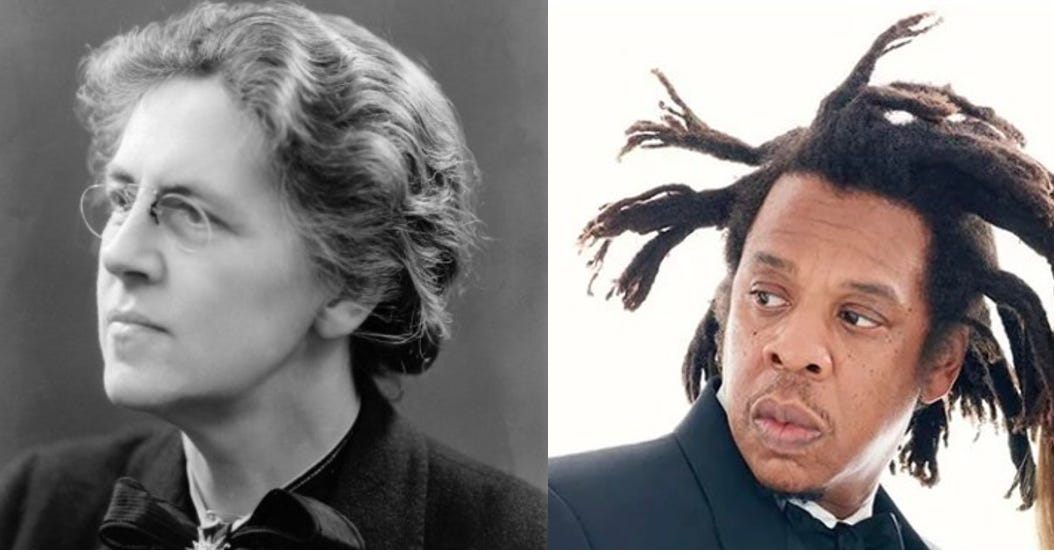
One more story from the interview. As much as the show Annie sets my teeth on edge (having endured too many local and school productions), Strouse’s stories about writing “The Sun’ll Come Out Tomorrow” and “Hard Knock Life” make the show’s music fresh and interesting again. Rapper Jay-Z, whose sister is named Annie, fell in love with “Hard Knock Life” when he first heard it on the television version of the show. Years later he wrote to Strouse for permission to sample it in a rap song. Jay-Z says (to Terry Gross, in a connected interview) he was “immediately drawn to that story, and those words, ‘instead of treated, we get tricked, instead of kisses, we get kicked.’” He connected to the song’s grittiness, and grittiness was the very thing Strouse was trying to achieve when he wrote it. Strouse sold the rights, and “Hard Knock Life (Ghetto Anthem)” was the result. (Jay-Z’s song was later parodied in the Austin Powers sequel Goldenmember.)
It's a funny thing that the venerable and classically-trained Boulanger had a small hand, in a very roundabout way, in the creation of a rap hit; and funny too that little red-haired Orphan Annie with her bucket and mop would find herself in a song subtitled “Ghetto Anthem.” (A fact which gives some credence to the mostly tongue-in-cheek Tik-Tok meme, “Gingers are Black People.”)
Finally, I must mention an intriguing connection I discovered that gave me a small thrill: Strouse was childhood friends with Burt Bacharach, another great composer of “light” music. I adore Bacharach, and I wonder what they talked about as boys and if they met up later as grown men with successful careers.
*
Time to Face the Music Part II (But Please Don’t Dance)
Nadia Boulanger’s influence on Strouse has me thinking about seed-planters. I’m calling them seed-planters rather than mentors because mentors stick around for a while to guide, direct, correct and connect. Seed-planters enter a life but for a moment. A seed-planter shows you something about yourself that was hidden or unacknowledged: “You’re good at this,” they tell us. “Maybe go in that direction.” Or conversely, “This path is not for you.”
I’m mixing metaphors, I know, paths and seeds, (and I’ve even taken out the holding-up-a-mirror reference), but however I describe them, seed-planters encourage growth, even when their truths are biting. Although I’ve not had an illustrious career in anything, I’ve been lucky to have had several seed-planters in my life, beginning with Sister Mary Denise in 8thgrade who called me in from recess to tell me sternly, “You are a writer.” There was an unspoken directive that I’d better do something about it.
I have another seed-planting story to tell, but this one more in the vein of Boulanger’s re-directing Strouse from his chosen path. In my early twenties I auditioned for a dance troupe operating out of the studio where I was taking classes. I had long since given up my childhood dream of being a dancer and choreographer, but I thought I was good enough to pursue dance in a local non-professional company. My sister came to watch my audition, which consisted of performing in small groups a routine we learned on the spot. I danced my heart out, but I did not make the cut. I thought it was unjust, I was furious, I was crushed, I was sobbing. Wasn’t I better than the other girls who made it, I asked my sister, and why oh why wasn’t I selected? She hemmed and hawed. I pressed her and pressed her until finally she said, kindly, gently, “Sometimes it seemed like you didn’t know which direction you were going in.” It stung. But it was truthful. I pictured my dancing and I knew exactly what she was saying.
It wasn’t that she saved me from pursuing a dance career or from spending money on dance classes—the seed-planting was more subtle, and she surely didn’t even mean to do it. Her telling me my dancing wasn’t as good as I thought was the beginning of a much-needed humility, a dawning understanding that I could be completely, utterly wrong about myself and my abilities. It wasn’t the end of the world to discover I was an extremely average dancer at best. Knowing my limitations, in dancing or in later years, in writing, allowed me to move towards my strengths.
I wish everyone a Nadia Boulanger or a Sister Mary Denise, and I hope, perhaps more than I ever hoped to be a better dancer or writer, to be one myself.
*
Bridget is Whelmed Again
I’m not a young person, but I love young people, I love their passion and fresh eyes, I admire how they navigate a world more challenging than the world I faced at their age, I like to tune in to their antennas, to know what’s on their radar, what they’re listening to, caring about, creating. Which is why I’m so excited writer Bridget Gamble is resurrecting her newsletter Whelmed.
Whelmed was formerly on Tiny Notes, and now Bridget is re-launching it on Substack. The newsletter will feature Bridget’s signature insights and stories, playlists, visual art, and for local Chicago folks, in-person meet-ups. You can subscribe here.
Bridget has a special place in my writer’s heart—she was not only one of the people who inspired me to create Restless Egg, she also advised me how to get started. Congratulations, Bridget!

*
If you enjoyed this issue of Restless Egg, share it with someone else who might enjoy it too!
And if you haven’t subscribed, please do! I love to get new subscribers.
Love this so much: “I’ve been lucky to have had several seed-planters in my life, beginning with Sister Mary Denise in 8thgrade who called me in from recess to tell me sternly, ‘You are a writer.’ There was an unspoken directive that I’d better do something about it.
Always a treat to start my day with a fresh Restless Egg — and this one even came with a mention?! Thank you for the shoutout Maggie!