
Issue 2

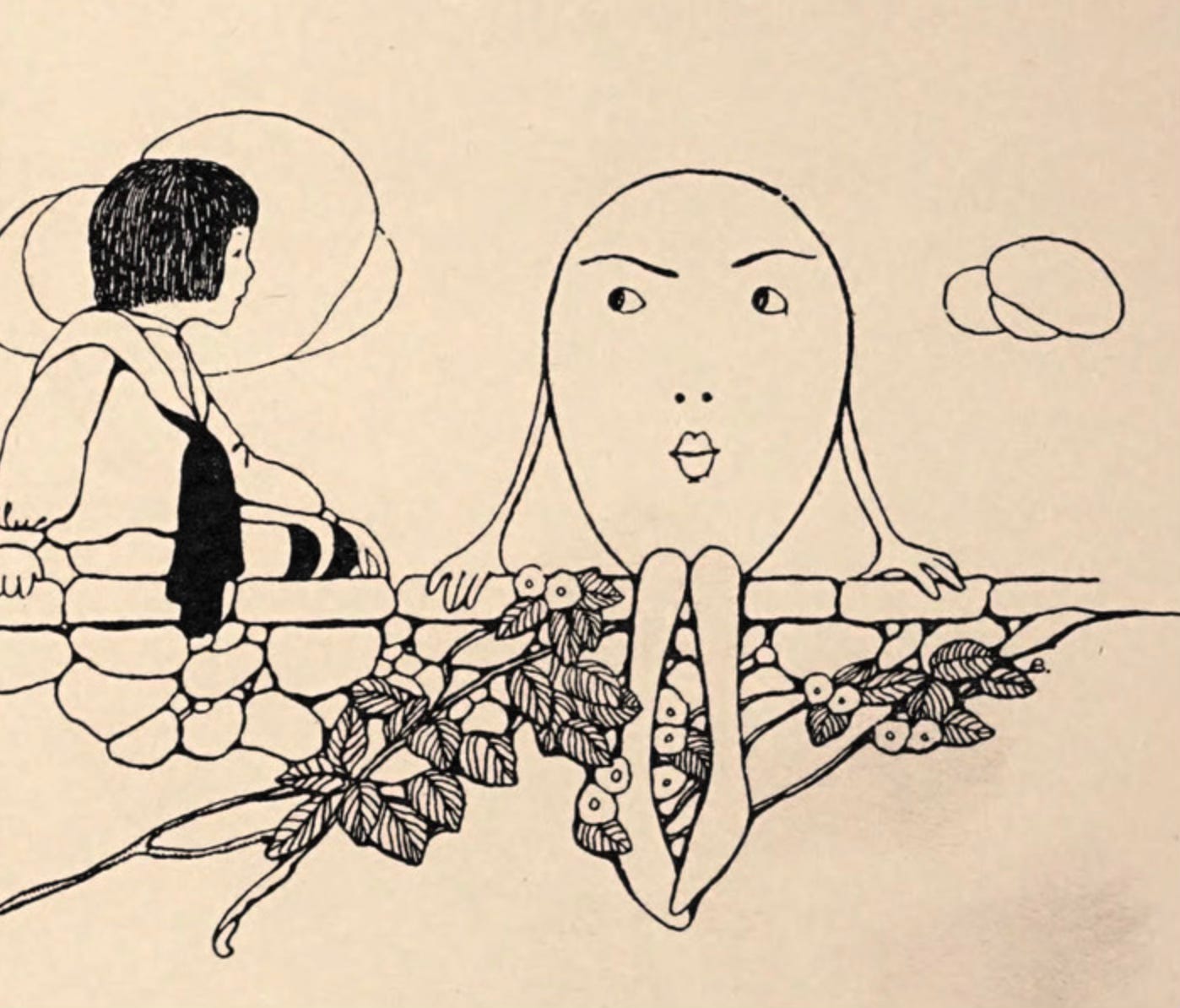
‘The time has come,’ the Walrus said,
‘To talk of many things:
Of shoes — and ships — and sealing-wax —
Of cabbages — and kings —
And why the sea is boiling hot —
And whether pigs have wings.’
—(from “The Walrus and the Carpenter” by Lewis Carroll)
Indeed the time has come, my friends, to talk of many things. . . to talk, at least in this space, of things unserious. Let us for one moment put aside —division — exhaustion—and turn our flinty eyes towards folly.
*
—Of Cabbages— and Kings—
If you came of age in the 70s, you know Captain and Tenille’s “Muskrat Love,” and you probably hate it. If you are like my husband, you even hate people talking about how much they hate this song. But bear with me. This discussion is for Gen Z’ers most of whom will be astounded to know that a song about two muskrats copulating was ever #4 on the charts. This discussion is also for those who don’t know about the song’s impressive trajectory from soft-rock ear worm to the ear canals of some of the most powerful people on the planet.
So here we go.
As a duo, Captain and Tenille had a No-Business-Like-Show-Business vibe that was out of style even back in their day. Daryl Dragon tried to escape his intrinsic forgettable-ness by wearing a costume-store yacht captain’s hat. Toni Tenille, fresh-faced and pretty, had a mouth so large she could probably fit a whole muskrat in it; and a smile so wide and genuine you’d swear she enjoyed it.
They weren’t the first or even the second group to sing “Muskrat Love” (that would be America) but their version was the most popular. It’s hard to fathom. The premise of “Muskrat Love” is terrible, the lyrics even worse. The intimate relations between Muskrat Sam and Muskrat Susie are laid out in phrases that will make you cringe until you seize:
Now he’s tickling her fancy
Rubbing her toes
Muzzle to muzzle now
Anything goes
As they wiggle
Sue starts to giggle
(Still—you may find, if you listen to it again, there are things to like. Toni Tenille’s voice is lovely and honey-toned; and in spite of the cheesy instrumentation, the melody itself is catchy and pretty.)
Now let us move on to the ridiculous part.
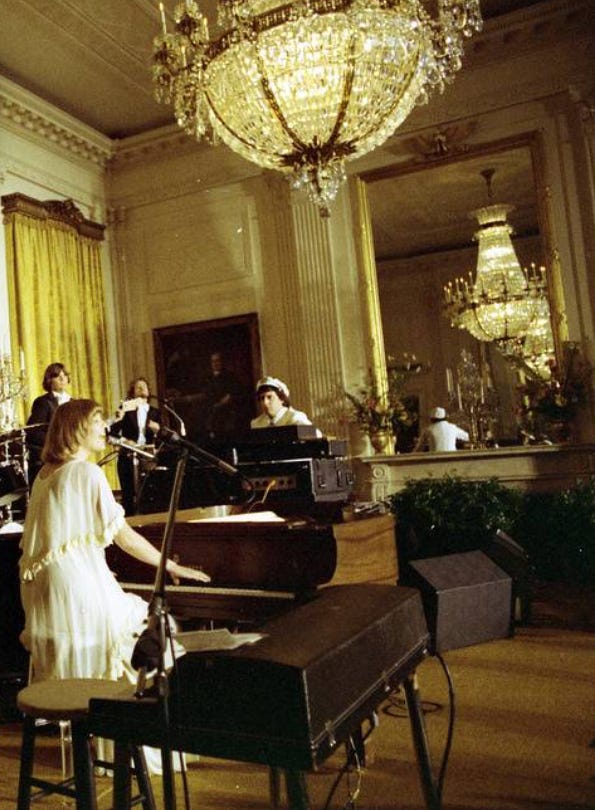
In 1976, President and Mrs. Gerald Ford hosted Queen Elizabeth II and Prince Philip at a White House state dinner to celebrate the bicentennial. Captain and Tenille were invited to perform because the Queen was a fan.
Betty Ford was also a fan and asked them to sing her and Gerry’s favorite song, “The Way That I Want to Touch You.” (The title completes the phrase, “I never wanted to touch a man—” oh my goodness, Gerry and Betty! Get it on!) Tenille decided that a song about touching a man might not be appropriate for the illustrious crowd—but that a song about muskrats touching each other would be.
So there they were in the glittering East Room of the White House, singing “Muskrat Love” to 224 guests, all the Who’s Who of the political and entertainment worlds.
Prince Philip smiled and tapped his foot.
The Queen fell asleep.
And Henry Kissinger glowered.
I’m trying to imagine Toni Tenille at this moment. The duo has come to the part of the song where the Captain uses a synthesizer to create the squeaks and purrs of muskrat ecstasy. Tenille does not sing during the simulated orgasms—her role is to look delighted and amused. Henry Kissinger, Secretary of State, advisor to twelve presidents (he has no equivalent today, in terms of power and prestige), a global figure, the very definition of sophisticated—sits a few feet away. He is disgusted and not hiding it.
Did she cringe at her keyboard? Did she look out at her audience and suddenly realize what a terrible decision she made?
She never expressed regrets, but she must have felt something because she found her revenge. After that performance, every time she sang “Muskrat Love” at a live show, she took a moment to dedicate the song to Henry Kissinger.
Here’s looking at you, Henry! Muskrat love forever!
*
To Be or Not To Be Ridiculous
Every fall my sisters (there are six), sisters-in-law (three) and I have a leaf-catching tradition. My sister Susie (who is not now nor never has been a muskrat although she is small) started it years back.
In our tradition, we send the group a selfie when we catch our leaf. Bragging rights are given for the first caught leaf of the season and for the prettiest. Having a large leaf fall on your head counts but is not admired.
But let me warn you: catching a leaf is much harder than you’d think, and impossible to do with any kind of dignity. The leaf flits and drifts and sinks. You dart, dash, change direction. In this pure moment of pointless pursuit, time reverses, and there you are, a child again, grabbing at air, laughing at yourself, not caring if anyone is watching.
*
Numpties, Eejits, and a Ridiculous Scottish Show
I have tried and tried to get people to watch Hamish McBeth, one of my favorite shows ever and not coincidentally one of the most absurd. Which is perhaps why I’ve been unsuccessful in garnering an audience for this Scottish “detective” series from the mid 90’s.
Set in the fictional coastal Scottish town of Lochdubh, the show features few actual murders and more often the bizarre scrapes of eccentric Lochdubhians. Hamish joins a local production of West Side Story to pay back his debts, a doomsday cult targets the mellow policeman as the devil incarnate, a village competes with another village in a treble-singing contest—this is not your standard police-procedural fare.
Have I sold you on the show yet? Maybe a few clips from one of my favorite episodes will seal the deal. For background, in episode 4 of season 1, an underground radio station has taken off in Lochdubh. One of the radio programs, “Book Lady,” features Hamish’s sometimes-girlfriend Alex reading classic novels aloud, which causes the villagers to become so enamored of literature that the local pub has turned into a virtual library, and no one is buying drinks.
The first clip is Alex reading from Thomas Hardy’s Far from the Madding Crowd. Please enjoy the delicacy of her articulation. The second clip features the frustrated pub owner and his non-drinking non-customers.
(Apologies for the reflections on the screen—my tools and skills are limited.)
If you start the series out of curiosity, please stick with it—sometimes the plot dithers here and there before going absolutely bonkers.
On Prime.
*
What a Ridiculous Thing to Say
I don’t know how it started, but in her older years my mother enjoyed a good Bunbury.
“Bunbury” is a term from Oscar Wilde’s play The Importance of Being Ernest. Algernon, one of the main characters in the play, describes Bunbury thusly:
I have invented an invaluable permanent invalid called Bunbury, in order that I may be able to go down into the country whenever I choose. Bunbury is perfectly invaluable. If it wasn’t for Bunbury’s extraordinary bad health, for instance, I wouldn’t be able to dine with you at Willis’s to-night, for I have been really engaged to Aunt Augusta for more than a week.
My mother didn’t Bunbury in that sense—she just liked to work the word into conversations. In her best British accent with lots of faux outrage and bluster, she’d say, “Bunbury?” And then we’d all get in on it.
If you want to try to Bunbury yourself (my mother’s Bunburying, not Wilde’s), here’s a bit of dialogue [Bunbury emphasis mine]:
JACK.: This ghastly state of things is what you call Bunburying, I suppose?
ALGERNON: Yes, and a perfectly wonderful Bunbury it is. The most wonderful Bunbury I have ever had in my life.
JACK: Well, you’ve no right whatsoever to Bunbury here.
ALGERNON: That is absurd. One has a right to Bunbury anywhere one chooses. Every serious Bunburyist knows that.
JACK: Serious Bunburyist! Good heavens!
*
And if you need more cowbell. . .
The most ridiculous part of “Muskrat Love” comes about 3:27 into this video, when the Captain jams on the keyboard to make muskrat noise.
The trailer for Hamish MacBeth gives some sense of the off-kilter nature of the show. Kudos to anyone who can translate the last thing Hamish says. The best I can figure is: “How can anyone blank blank blank wee dogs?”
*
So there you go. Should any of you listen to “Muskrat Love,” watch Hamish MacBeth, catch a leaf, or pull off a Bunbury—let me know in the comments.
And if you enjoyed this issue of Restless Egg, please share with friends who might enjoy it too!
Oh my gracious! You had me rolling with your description of Toni Tenille.
I am not a gen z'er but I have never heard Muskrat Love before. I sincerely hope to never hear it again. At least now I know that saying something about how "music just isn't what it used to be these days" is actually a positive, not a negative as I thought before hearing that song.
Ha, I hadn't looked at it that way!