
Issue #17
It's spring and a young man's fancy turns to. . . bleach

Hope for Messy Children
Packing up for a recent move, I unearthed an embroidery project from my preteen years—
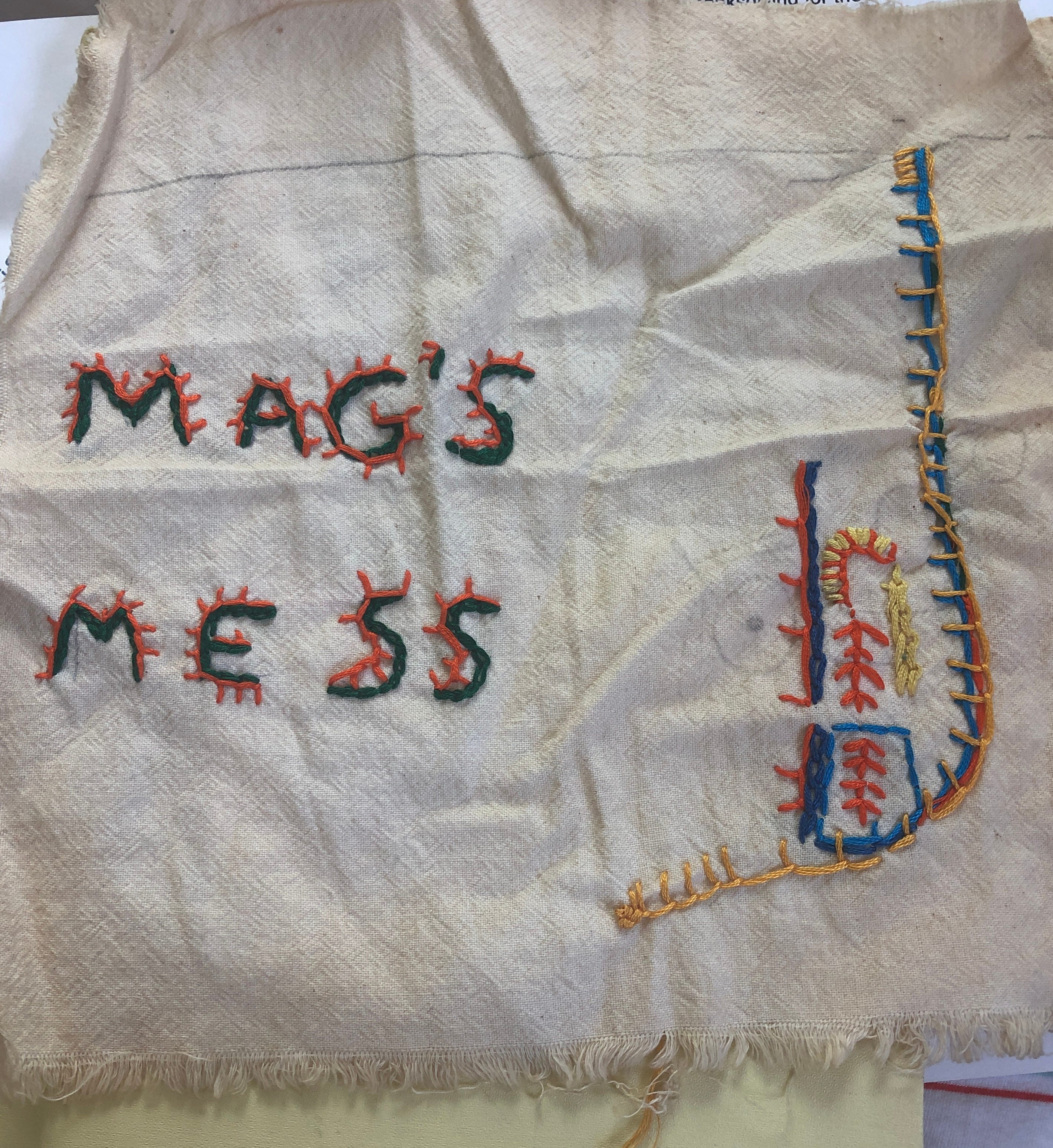
I have no idea what this half-finished scrap of muslin was meant to be—a sign to hang over a cluttered desktop, a small pillow for my messy bed, a cry for help? The more important question is, why did I spend hours stitching “Mag’s Mess” rather than just taking a few minutes to clean the damn mess up?
I know, I know, it’s a classic ADHD move to put energy, lots of it, into what holds interest while ignoring what urgently needs to be done. But there’s something less clinical and more interesting at work here: a nascent yearning in young Mag to not be messy. Because what is “Mag’s Mess” but an embellished label? To label something is to contain what has been sorted; and sorting and containing are two pillars of organizing.
More evidence for this subconscious yearning was the fact that I married a clean and tidy man, something I didn’t fully realize until we shared a home. And Exhibit C is my one-time obsessive interest in the science of cleaning. As a young mother I once pulled every how-to-clean book off the library shelf (and there were lots of them in those pre-internet days), and read them, one after the other, marveling over how many different techniques there were to remedy the same issue. My husband returned from work to find the usual mess—baby toys and gummed Cheerios on the carpet, paper piles on tabletops, an octave of the piano keys smudged with something brown—and me on the couch leisurely reading a book about housecleaning. The irony escaped me until he kindly pointed it out.
I’ll rest my case with fact that these days I’m in recovery from Mag’s Mess, which is to say, I’m clean-ish and tidy-ish. My rehabilitation happened slowly and by degrees, and I give most of the credit to four people who never knew the influence they had in my evolution. In no particular order I salute my mentors:
Mrs. Heller. She was a harried mother of six who lived in a tiny, dirty house. I was twelve and willing to do anything for spending money. Mrs. Heller paid me two dollars for two hours of cleaning and babysitting. It would take me almost an hour just to scrub off the sticky layers of grease and dried-up food on the linoleum floor in her galley kitchen. The toilets were worse. I hated her house, how it smelled like bacon fat and dirty diapers, and I hated how every week it all looked like it hadn’t been cleaned in a year. Mrs. Heller was a nervous, exhausted woman with an air of sadness that repulsed me. She was my Jacob Marley. I never ever wanted to be a woman so understandably desperate to escape my own house.
Jessica. Jessica was the wife of my brother’s friend Charlie. I only knew her from my brother’s imitation of her attempts to domesticate her husband. My brother would hold a spatula or pencil in the air and say in a girlish pitch, “Everything has a home, Charles, and your job is to find its home.” Jessica and Charlie eventually divorced (unsurprising if my brother’s imitation was even halfway accurate), and while Jessica may have been condescending and controlling, she wasn’t wrong. “Everything has a home” is the first rule of keeping a tidy space. Jessica’s voice lived in my head for years, and eventually I really heard her.
My mother-in-law. One time she said to me, and I cannot give you the why or wherefore of the conversation, only that she spoke with a small note of surprise but with no judgment at all: “Oh, you have to make your bed every day!” This news startled me into action, and I’ve made my bed every day since. If you need more explanation as to why this is one of the best pieces of advice I’ve ever received, I refer you to Admiral McRaven’s famous commencement address at University of Texas (“If you want to change the world, start off by making your bed”). But credit where it’s due: my mother-in-law said it first, and said it better because she said it with love.
Sally Somebody-or other. Sally and I ran the talent show at our kids’ grade school. She had been a drama major and was an actress in community theater, so she had way more artistic chops than I did. She was also a few years older than me, polished, elegant, organized, efficient, and decisive. Obviously, I looked up to her. One time she said to me, “I have to have everything cleaned up first. Then my mind is clear to do the creative work.” That was a lightning bolt. Up to that point I had subscribed to the notion that truly creative people were messy because they had more interesting things to think about and do. It would be years before her conviction became mine, but the seed of “clutter hampers creativity” had been planted.
The point is, parents, do not despair. Your messy child may not always be messy. Messy people change when they realize they are happier and calmer in cleaner environments. With any luck, the right people will come into your messy child’s life and say or do something that has a more lasting effect than nagging, bargaining or browbeating.
*
If you need help being tidy:
Words of wisdom reached me from sources other than those hallowed names above. One of the most important was Organizing from the Inside Out by Julie Morgernstern. I still remember (and use) her acronym for organizing, SPACE:
S = Sort
P = Purge
A = Assign a home (she must have talked to Jessica)
C = Containerize
E = Equalize (meaning, periodically see how your system is working)
But the real value of the book was her parsing of psychological obstacles to getting organized. You’ll have to read the book for her detailed descriptions—this list won’t do justice to what so accurately identified my own issues. Here they are in brief:
◦ The Need for Abundance
◦ Sentimental Attachment
◦ Fear of Success or Failure
◦ The Conquistador of Chaos
◦ Indecisiveness
◦ Lack of Focus and Concentration
◦ Overwhelm
*
If you need help cleaning:
Let me introduce you to my friend Tanya. I don’t know anyone who loves to clean as much as she does—to give you an idea, her dream volunteer job is cleaning house for old people who can’t do it themselves.
I asked her for her best cleaning advice, and here’s what she sent me:
The Joy of Joy (& Dawn & Simple Green)
Cleaning is wonderfully satisfying: you get a little exercise, you get quick and concrete results, and no one is mad at you when you're done.
Also, with good earbuds you can read while you clean & match the book to your task & mood: Jeeves stories for chuckling through the basics, Flannery O'Connor for furious revenge-cleaning, and Tolstoy for a thoughtful and meticulous reorganizing of your closets.
Windows & glass:
Skip the Windex and towels: get a concentrated window cleaner at any hardware store: 2 TBLS in a gallon of water. Use that in spray bottles for all glass.
For real window-cleaning, use a wide, long-handled scrubber and squeegee plus microfiber towels for wiping edges.
Use a wide, rectangular bucket with 2 sides, one for clean solution & one for soapy for screen cleaning. (Of course sponge & hose screens before windows.)
Wood floors:
Nothing works like Bona and microfiber mops. Yes, you need to rinse them out every 10 sq ft or so but it's the only thing that doesn't leave streaks.
Swiffers are an abomination.
Fabric, upholstery:
Better than any spot remover, use plenty of water and a viscous, unscented soap (unscented Tide or Meyers dish soap) with a toothbrush.
I put duct tape around my cleaning toothbrushes so I don't surprise myself in the morning ablutions.
Chrome & porcelain sinks/appliances:
Better than scouring powder, spray with diluted Simple Green, let stand for 2 min, & then scrub lightly.
I have piles of those multi-colored scrubber cloths and sometimes use them instead of toothbrushes (the ones with duct tape on them).
*
One for the road
My humble addition to Tanya’s wonderful list is something I retained from one of those how-to-clean books I read back in my twenties:
When cleaning surfaces, use feel not just sight; be sensitive to any slight bit of resistance that tells you some dirt remains to be cleared. It’s especially useful when cleaning speckled surfaces like granite counter tops—you can’t always see a stain, but you can probably feel it.
*
Cleaning inspo
If you need a little inspiration to get going on your spring cleaning, how about Van Morrison’s “Cleaning Windows.” Now send me your own housecleaning tunes!
*
If you enjoyed this issue of Restless Egg, please share it with someone else who might enjoy it too!
Another issue popping up in my mailbox- love it! Spring cleaning my house ? I’m motivated.
I too, at times, have found myself preferring to read books about cleaning and organizing more than doing it :)