
Issue #15

How I Unsevered Myself from Severity
People always used to tell me to smile. My sisters got the same command. “But this is my natural expression!” one of my sisters would say.
RBF (Resting Bitch Face) is our maternal inheritance. Some people get jewelry and china, we got a facial expression that says, “Yeah, not impressed.” I’ve passed it on, too—one of my daughters once had someone say to her, “You think smiling at a man is like showing your breasts.” It’s not untrue, not for her, not for me either.
When the term first came into popular usage, my mother and sisters and I claimed it for ourselves. We were proud of having RBF and didn’t care that our outies didn’t match our innies. My mother’s face was often set in a frown: the corners of her mouth pulled downwards as if in disapproval, her eyes narrowed slightly. But she loved to laugh, she enjoyed silliness and jokes more than most. We might look sour to the rest of the world, but to us, the rest of the world smiled too much, too inauthentically. Having RBF meant we weren’t phony. And to my mother, being phony was just about the worst trait a person could have.
This all changed for me last year. I was filling in for my friend Joan at our food pantry sign-in station here in Kauai. This job involves the tricky balance of asking intrusive questions in a tone that is friendly and not judgmental: How many in your household, how many children, are you employed, do you receive any government assistance? The answers don’t matter—it’s all for records—so the signer-in has no agenda other than making people feel welcome. I noticed right away that my interactions with the locals were less friendly than Joan’s. Some of them seemed defensive. More than one person asked, disappointed, “Where’s the other lady?” One woman, a native Hawaiian, thought I was giving her a hard time.
Then I realized what was happening. My words were friendly, but my face was not. RBF made me come across as judgy and wary. Joan was a smiler. Her warm facial expression relaxed people, put them at ease. So I started smiling too. At first it seemed forced, but the people I smiled at didn’t seem to mind or think I was being fake.
I smiled at grocery clerks and at people I passed on my walks. I smiled at restaurant workers, the pharmacist, the UPS man, and folks in line at the post office. People smiled back. Potentially irritating interactions became more pleasant. I noticed that when I smiled I felt more open, more patient, calmer.
The funny thing was that smiling not only changed how other people interacted with me, it changed how I felt about other people. If I smiled at someone, I was more disposed to like them. For most of you this wouldn’t be a eureka! discovery. But it was for me.
A recent MoS surgery made smiling easier and more instinctive. The surgery left me with a crooked mouth, one side shorter and higher than the other, and visible scars from my nostrils past the right edge of my mouth. But if I smile—! The asymmetry and scarring all but disappear. It’s one case where vanity has taken me in a good direction.
I’m not advocating going about your business grinning ear-to-ear like a child actor in a local production of Annie; I’m talking about smiling at people. Because who doesn’t like being greeted with a smile? Who doesn’t like to receive the message that someone is glad to see them?
With that last thought in mind, I’ve been running an experiment at home. Every time I see my husband, I smile. When we get up in the morning, when he comes out of his office for a break, when he comes back from his walk, when we sit down for dinner, I smile at him. It’s been good for me. Smiling makes me less likely to be critical or engage in bickering. Smiling makes me enjoy his company even more.
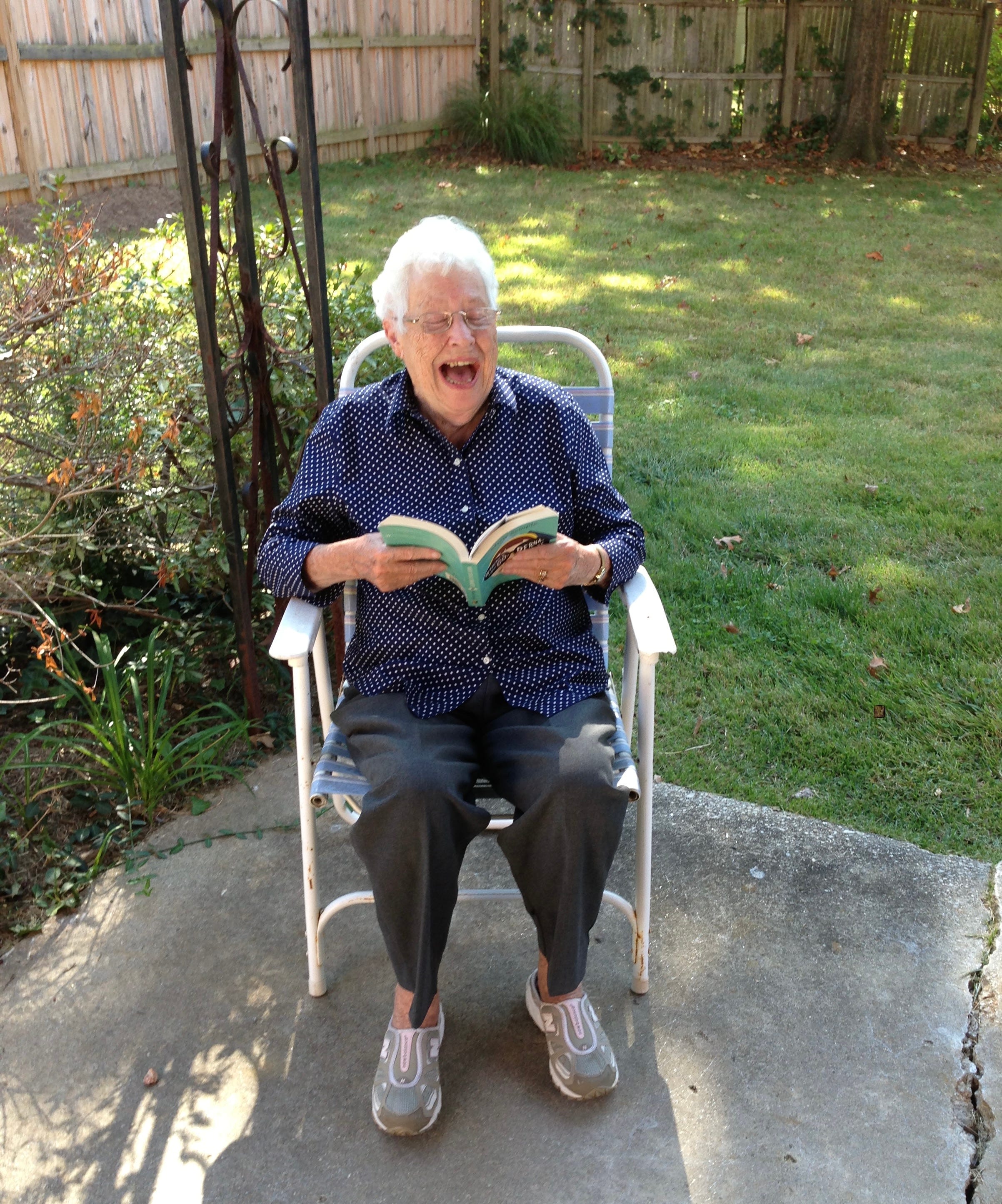
He, on the other hand, doesn’t like it. He’s not sure what’s going on, for one thing. The first time he noticed my smiling he said, “I can’t talk to you. You look weird.” A few days later he said, “Stop doing that! It scares me.” Why? I asked him. “It’s like you’ve detached from your body and someone else is in there. It’s creepy.” I get it. He’s known me since I was 17, and he’s become accustomed to my RBF. But in time he’ll get used to my smiling. And as he reads this, and he finally understands why I look so weird and creepy, he’ll be smiling in spite of himself.

*
Repent and Reintegrate
Speaking of making a major change, I listened to a podcast about doing just that. Sean Illing of The Gray Area interviewed writer Olga Khazan about her new book, Me, but Better. The name of the episode is “How to Change Your Personality.” Basically Khazan set out to stop being neurotic and depressed (and sell a book). The two things that helped her change the most were meditation and doing improv. It’s not the most riveting interview, but it’s hopeful, and that means a lot to me these days.
Yesterday was Ash Wednesday, which marks the beginning of Lent. Lent is the original How to Change Your Personality, except we call it transformation and we do it for very different reasons than Khazan. Traditional Lenten practices of almsgiving, prayer and fasting are the means to the end.
The point is, whether you’re in the secular or spiritual world, you can only change who you are if you change what you do.
*
What the Doctor Ordered
If you are in need of something cozy today, I offer you a few scenes from Rebecca West’s The Fountain Overflows. I’m only 150 pages in, but I love it, and I don’t usually like episodic novels.
The story is loosely based on West’s childhood in pre-WWI London. Rose, the narrator, is a sharp and not always kind observer of her family. Her father is charming but unreliable, her Scottish mother, a former concert pianist, is nervous and trying to keep the family from dire poverty, and her siblings are a mixed bag, the much-hated Cordelia, her twin Mary and the adorable baby Richard Quin. Rose is endlessly quotable, and the characters are wonderful. I cannot recommend this book enough, and I thank my friend Tanya for introducing me to it.
Anyway, on towards the cozy:
Rose wakes up in the night with a toothache. For background, in addition to the physical pain, she suffers with anxiety about how a trip to the dentist will be paid for. Rose is always protective of her mother, monitoring her moods and worrying about her as if her mother were the child and she the parent; and here, for once, Rose experiences the rightful order of childhood.
When we told Mamma in the morning she called me all the broad Scots pet names which always came from the back of her mind when we were ill or had hurt ourselves, and then she hurried out of the room and came back very quickly, for she moved faster than anybody I have ever known, stirring a bowlful of honey and hot milk. It was her panacea for every ailment, and it did in fact anaesthetize by distraction. She sent Cordelia and Mary down to breakfast, and sat down on my bed, and I enjoyed being alone with her, feeling the warm, invisible fluid of her love flowing out towards me, comforting me as the warm sweetness of the milk and honey comforted my mouth.
Later, on the train to see the dentist—
I had slept so little in the night that I slept in the train, nuzzling against my mother’s shoulder. Though it was a mild autumn day she had wrapped me in a tartan shawl that was always brought out when we were ill. Milk and honey and that tartan shawl, they were our ju-jus, I had felt relief at the sight of it on her arm as she got into the trap. When we reached Edinburgh I awoke, feeling warm and babyish and contented, and the pain was so much less that I could hop with joy as we went along Princes Street . . .
I love these scenes because they take me back to my own childhood, to Dr. Roundbelly, my father’s alter-ego when we were sick. It was a fitting moniker because at the time my father was a very large man. Dr. Roundbelly brought us gifts to make us feel better—paper dolls or a comic book, magazines when we were older. My dad was a gruff man and scary sometimes, but his heart was soft for misfortune of any kind, and he knew, like Rose’s mother, that distraction and kindness are medicines of the first order.
*
If you enjoyed this issue of Restless Egg, please share with someone else who might enjoy it too!
“There’s something in my pocket, it belongs across my face…” I’ll put my brownie shoes on and wear that smile
There is actual scientific reasons while a smile works...smiling releases the good happy hormones in one's brain....it's not mystical other than I always find wondrous things happening in the body....and I'm in awe... check it out